Every Keystroke You Make
Meta is installing tracking software on its US employees’ computers to capture mouse movements, clicks, and keystrokes — not for security, not for productivity management, but to train AI agents that will eventually replicate their work. This isn’t dystopian fiction. It’s a memo Reuters saw, an internal mandate that transforms every employee into an unwitting data-labeler for their own replacement. And it marks a genuine inflection point: the moment a major tech company stopped merely surveilling its users and started explicitly surveilling its workers as a raw material extraction exercise.
The mechanics matter. Meta’s system doesn’t just log that you worked eight hours. It captures granular behavioral data — where your cursor lingers, how fast you type, what sequence of clicks you use to navigate a workflow. It compares individual employee activity to peers and generates “red flag” alerts for perceived productivity gaps. This is keystroke-level behavioral telemetry being fed into training pipelines for AI agents designed to “complete work tasks autonomously,” per the company’s own internal framing. The employees aren’t being monitored in the traditional sense. They’re being mined. Every drag-and-drop, every tab switch, every moment of hesitation before clicking “submit” becomes a training signal for a system that, if successful, makes those employees redundant.
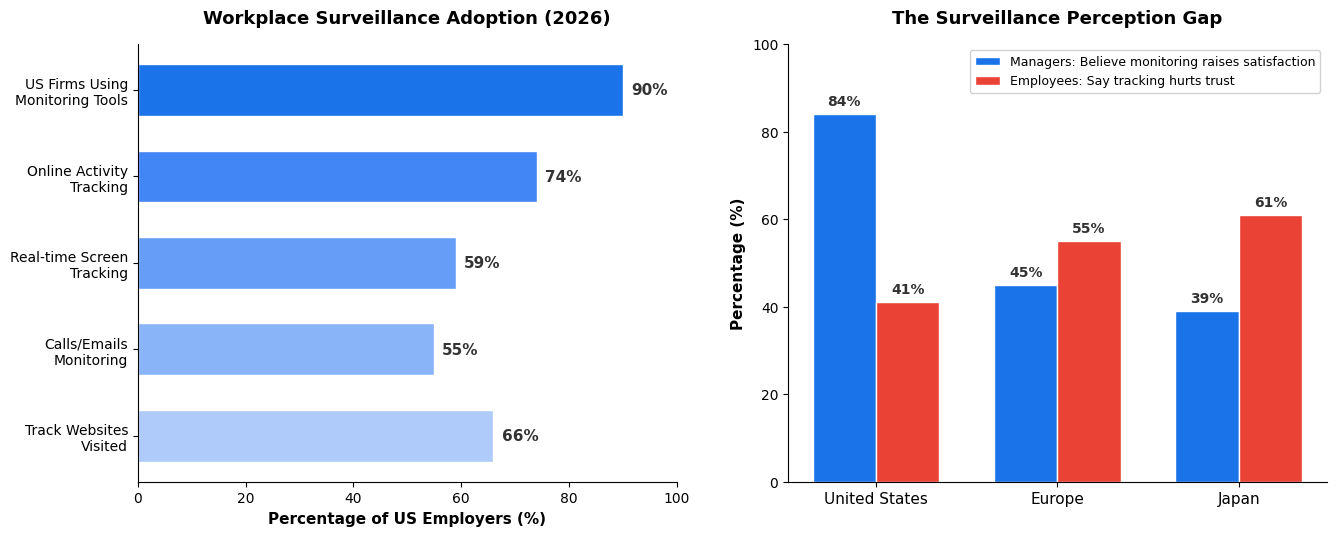
The broader numbers are staggering and alarming in equal measure. Meta guided to $115-135 billion in capital expenditures for 2026, with a significant chunk going to Meta Superintelligence Labs. Simultaneously, the company is preparing layoffs affecting roughly 10% of its workforce — about 8,000 people — beginning May 20. The juxtaposition is hard to miss: you’re being watched so carefully because you’re about to be replaced. Industry-wide, 90% of US firms now use employee monitoring tools, 74% track work activities online, and 59% perform real-time screen tracking. But Meta has crossed a line that most companies still pretend exists — the line between “monitoring for productivity” and “extracting your behavioral patterns as proprietary training data.” This isn’t the same as Hubstaff logging your active minutes. This is your employer owning the digital shadow of how you think through a task, and planning to sell a product based on it.
The employee backlash has been predictably fierce but structurally powerless. Internal forums lit up with comparisons to “the ramblings of a supervillain” (a phrase already circulating about another tech CEO this week). But Meta’s calculus is brutally rational: the company ended 2025 with $81.6 billion in cash, generated $115.8 billion in operating cash flow, and employs 78,865 people it considers increasingly optional. The AI Workforce Mandate — an internal initiative that ties performance reviews partly to AI usage — creates a perverse incentive structure where employees are judged on how enthusiastically they train the system that will absorb their workflows. Refuse to cooperate with the tracking? That’s a red flag. Cooperate fully? You’re accelerating your own obsolescence. It’s a closed loop with no good exit for the individual worker.
What strikes me most is the regulatory vacuum this exploits. The EU is busy debating association agreements and ceasefire proposals. The US has no federal workplace surveillance law with teeth. 84% of American managers believe algorithmic monitoring tools actually raise job satisfaction — a delusion that 45% of European and 39% of Japanese managers share, suggesting that cultural context, not evidence, drives this belief. Between 56% and 67% of European and Japanese firms cite employee opposition as a reason for avoiding algorithmic management. In the US, where at-will employment makes objection professionally suicidal, opposition barely registers as a data point. Meta’s move will be watched closely by every large employer sitting on terabytes of employee interaction data they haven’t yet monetized through AI training. If Meta gets away with this — and given the current US regulatory environment, they almost certainly will — the precedent is set. Your keystrokes aren’t yours. They belong to whoever pays your salary, and they’ll use them to build whatever they want.