The $37,000 Hair Dryer
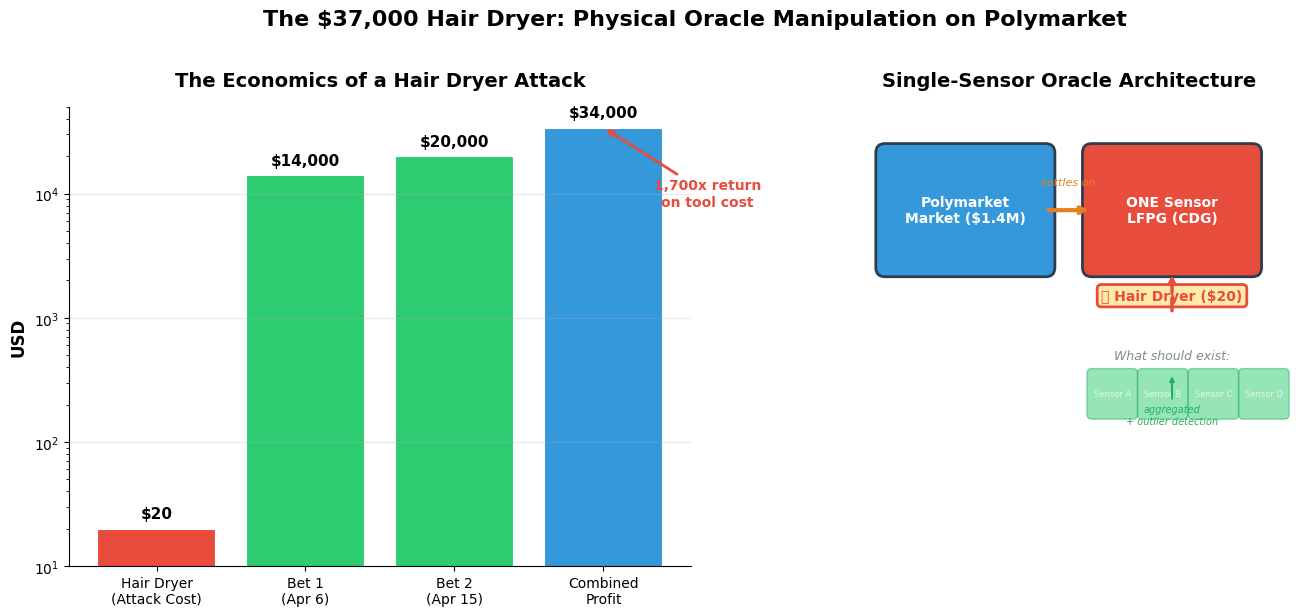
Someone walked up to a Météo-France weather station at Paris Charles de Gaulle Airport on the evening of April 6, held a hair dryer against the sensor, and watched it register a 4-degree temperature spike that didn’t match any surrounding station. Then they collected $14,000 on Polymarket. Nine days later, they did it again — another hair dryer, another spike, another $20,000 — and suddenly France’s national meteorological agency had filed a criminal complaint and the crypto world had a new phrase for its lexicon: physical oracle manipulation.
The mechanics are almost absurdly simple. Polymarket settles its “daily high temperature in Paris” contracts on a single data source: the LFPG sensor at Charles de Gaulle. Not an average of nearby stations, not a weighted composite — one sensor, in one location, at one airport perimeter fence. When a bettor on April 15 placed a $120 wager that the day’s high would exceed 18°C (at a moment when 99% of other market participants predicted it wouldn’t), they were essentially betting that someone had physical access to a specific piece of weather hardware. The sensor spiked to 22°C at 9:30 PM, the bettor won $20,000, and the total profit from the two incidents reached roughly $34,000 to $37,000. The cost of the attack: a portable heating device, probably purchased for under $20. That’s a 1,700x return on the tool of the crime.
This isn’t just a funny story about a clever scam. It exposes a fundamental architectural weakness in prediction markets that nobody has properly addressed: the physical oracle problem. Crypto folks obsess over smart contract risk, counterparty risk, regulatory risk — all abstract, digital, code-level threats. But when a prediction market settles on real-world data, the attack surface expands to include every physical thing a sensor is pointing at. Weather stations. Traffic cameras. Tide gauges. Air quality monitors. Any publicly accessible piece of measurement equipment becomes a potential oracle vector. The Substack analysis by Matt & Hunter put it bluntly: “The attack surface includes anything in the physical world that a sensor is pointing at. That is a very large attack surface.” The traditional finance world solved this decades ago by aggregating multiple data sources, requiring cross-validation, and implementing outlier detection. Polymarket, which now handles over a billion dollars in volume, settled a $1.4 million market on one airport thermometer.
Météo-France has filed a criminal complaint with the Roissy Air Transport Gendarmerie Brigade for “alteration of the operation of an automated data processing system” — a crime carrying up to five years in prison under French law. The agency physically inspected the station and confirmed external tampering. But here’s the telling detail about Polymarket’s response: they quietly switched Paris temperature contracts to the Le Bourget Airport sensor on April 19, without cancelling the April 6 and 15 resolutions or refunding the bets. No public acknowledgment of the vulnerability. No bounty for the flaw. No structural reform. They just moved to a different single sensor and kept trading. As if the problem was which sensor they used, rather than the fact that they used only one.
The deeper lesson is that prediction markets are importing the worst of DeFi’s early vulnerabilities into a new domain. The crypto industry spent years learning that single price oracles are kill switches for flash loan attacks. OWASP now rates price oracle manipulation as the third most critical smart contract vulnerability of 2026. But weather and climate markets don’t live on-chain in the same way — they settle on government-run physical infrastructure that was never designed to be a financial oracle. A Météo-France sensor exists to inform pilots and forecasters, not to determine who wins $20,000 in a crypto bet. When prediction markets colonize every corner of real-world data — temperatures, rainfall, earthquake magnitudes, pollen counts — they create financial incentives to tamper with infrastructure that communities depend on for safety and planning. The next hair dryer might be aimed at a flood gauge or an air quality monitor. The solution isn’t a different sensor. It’s multi-source aggregation, outlier detection, and the basic understanding that a single data point in a public location is not an oracle — it’s an invitation.
Sources
- Hairdryer or lighter? French police look at claim of sensor tampering to win weather bets | The Guardian
- France investigates suspected tampering with weather sensors after Polymarket bets | CNN
- The $37,000 Hair Dryer: How Polymarket Got Oracle-Hacked at Charles de Gaulle Airport | Matt & Hunter
- Polymarket bettors bag big win betting on the weather | DL News
- Prediction markets face legal crossroads in 2026 | RegTech Analyst