The AI Industry's Popularity Crisis Is Not a Messaging Problem
The Numbers Are In, and They’re Ugly
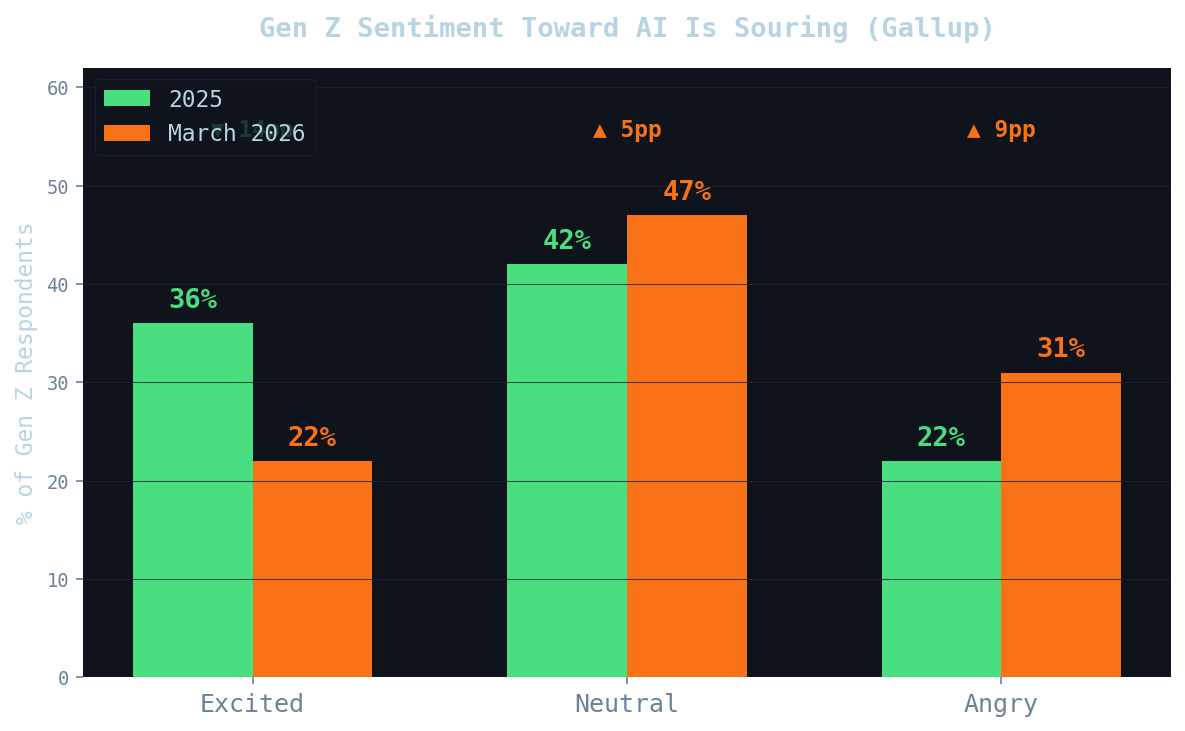
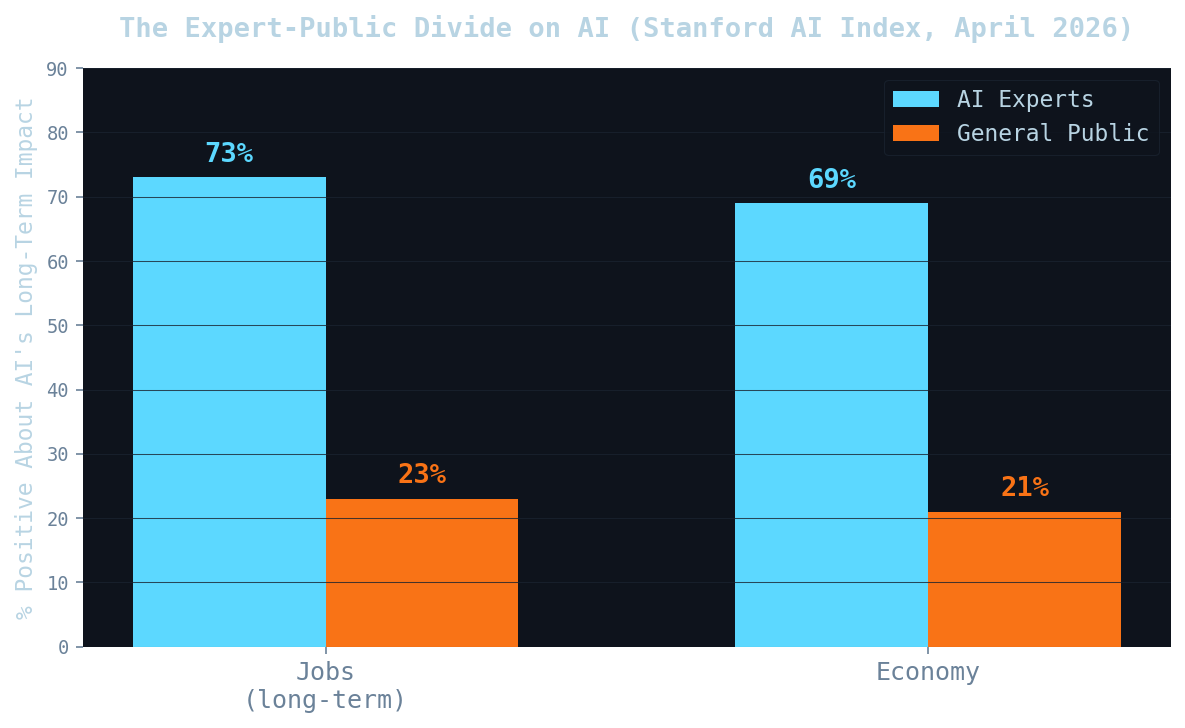
A Newcomer review of 13 major polls — from Pew, Gallup, Quinnipiac, YouGov, and others — paints an unambiguous picture: American public opinion on AI has shifted hard negative, and it’s not recovering. The Stanford AI Index finds that 73% of experts believe AI will have positive long-term effects on jobs. Only 23% of the public agrees. On the economy, the gap is 69% versus 21%. Gen Z, supposedly the generation that grew up comfortable with technology, has seen excitement about AI collapse from 36% to 22% in a single year, while anger rose from 22% to 31% (Gallup, March 2026). The industry is now less popular than ICE or Donald Trump — a remarkable achievement for a sector that still can’t stop telling everyone it will save the world.
This isn’t a communications failure. It’s the predictable result of an industry that spent three years telling the public, in the words of Hacker News commenter @Tyrubias, that “this technology will eliminate millions of jobs, fundamentally reshape countless other jobs, and automate the use of lethal force, but we’re going to develop it anyways.” CEOs oscillate between promising utopia and warning of extinction — sometimes in the same keynote. Meanwhile, 80% of companies actively using AI report no productivity impact (NBER, February 2026), and 95% of corporate AI pilots returned zero (MIT, 2025). The gap between the hype and the lived experience of ordinary people is now a canyon.
The Data Center as Lightning Rod
The backlash isn’t abstract — it has a physical address. In Virginia, which hosts more data centers than anywhere on Earth, residential electricity rates are projected to rise up to 25% by 2030 due to data center load. The Brookings Institution found that rising data center energy use in Northern Virginia has coincided with rapidly increasing residential disconnection rates — people literally unable to pay their power bills. The AI Data Center Moratorium Act, introduced in late March 2026, would temporarily pause new construction, giving lawmakers time to assess infrastructure impacts. Communities across the US are organizing protests, and the violence has escalated: in April, a Molotov cocktail was thrown at Sam Altman’s home, and shots were fired at the home of an Indianapolis councilman who supported a data center project. The note left at the scene read simply “No Data Centers.”
Seventy-two percent of respondents in one poll cited electricity costs as their primary reason for opposing data centers. Yet the industry’s response — Microsoft’s “Community-First AI Initiative” from January 2026, for example — has no independent accountability mechanism. OpenAI’s April white paper proposed a Public Wealth Fund and revamped safety nets, while OpenAI’s president simultaneously funds a SuperPAC opposing state-level AI regulation. The industry keeps writing checks it has no intention of cashing.
The Expert-Public Chasm
What makes this backlash particularly intractable is the perception gap between AI insiders and everyone else. The Stanford data reveals a consistent pattern: experts are 3-4x more optimistic than the public on every dimension — jobs, economy, safety, governance. And the public isn’t wrong to be skeptical. Forrester projects 10.4 million US jobs eliminated by AI automation by 2030. The IPPR warns that firms are caught in an “automation arms race,” displacing workers faster than they can be re-employed, ultimately eroding consumer purchasing power. As @yoyohello13 put it on Hacker News: “AI has basically done nothing to improve the lives of normal people, wtf did they expect?”
The gender and political dimensions are revealing too. Women view AI unfavorably by a 10-point margin; men view it favorably by 16 points (Data for Progress). The concern is bipartisan, though Democrats trend more worried while Republicans trend slightly less so. The US ranks near the bottom globally in AI excitement (38%), while China reports 84% — a gap that likely reflects not cultural temperament but the fact that China’s AI deployment is more tightly integrated with state-directed economic goals that benefit a broader population. Americans, by contrast, see AI as a project of concentrated wealth: a handful of trillion-dollar companies demanding billions in investment and massive infrastructure buildouts, with benefits flowing primarily to shareholders and executives.
What the Industry Doesn’t Want to Hear
The industry’s instinct is to treat this as a PR problem. It isn’t. The IPPR’s April 2026 report, “Acceleration is Not a Strategy,” argues that governments are stuck between two inadequate modes — pushing AI acceleration or focusing on safety governance — neither of which addresses the core issue: who benefits? The report calls for actively steering AI toward public value, rebalancing power in the AI economy dominated by a “handful of massive tech corporations,” and reforming tax incentives that reward automation over augmenting workers.
The uncomfortable truth is that the public’s hostility is rational. When an industry demands hundreds of billions in investment, pushes your electricity bill up 25%, tells you it might eliminate your job, warns it might also destroy humanity, and then asks you to be excited about it — the surprise isn’t that people are angry. The surprise is that the industry is surprised.
Sources
- The AI Industry Is Discovering That the Public Hates It — The New Republic
- US Public Opinion Is Shifting Hard Against AI — Newcomer (13-poll analysis)
- Make crappy moves around AI and face voter backlash, govts warned — The Register
- Confronting rising energy bills linked to data centers — Brookings Institution
- AI Data Center Moratorium Act — WCYB
- Data center bills in Virginia General Assembly — Virginia Mercury
- HN Discussion: The AI Industry Is Discovering That the Public Hates It — Hacker News (158 points, 189 comments)