Three Survivals and a Nuclear Reactor
The Week the Future Tense Lost
Within 24 hours of each other this week, two events landed that — read separately — tell a tidy story about the world getting its act together on energy. Belgium announced a full state takeover of its nuclear fleet from French energy giant ENGIE, suspending all decommissioning and targeting a binding nationalisation deal by October. Colombia wrapped up the Santa Marta summit, where 56 countries endorsed voluntary roadmaps to phase out coal, oil, and gas. One story is about a country clawing back control of its atoms. The other is about a coalition pledging to stop burning hydrocarbons. They are not separate stories.
Read together, they expose a fracture that has been widening for years: energy policy is no longer primarily about climate. It is now being driven by three competing survival imperatives — geopolitical (escape dependence on Russian and Middle Eastern gas), economic (power the AI infrastructure buildout), and environmental (decarbonise before 1.5°C locks in). For roughly two decades, these three pressures pointed in roughly the same direction: renewables, efficiency, gradual phaseout of fossil fuels. They no longer do. And the technology that satisfies all three simultaneously — nuclear, reviled for forty years by the environmental movement it was supposed to serve — is the one experiencing the most dramatic political rehabilitation in modern energy history.
The Demand Curve That Broke the Arithmetic
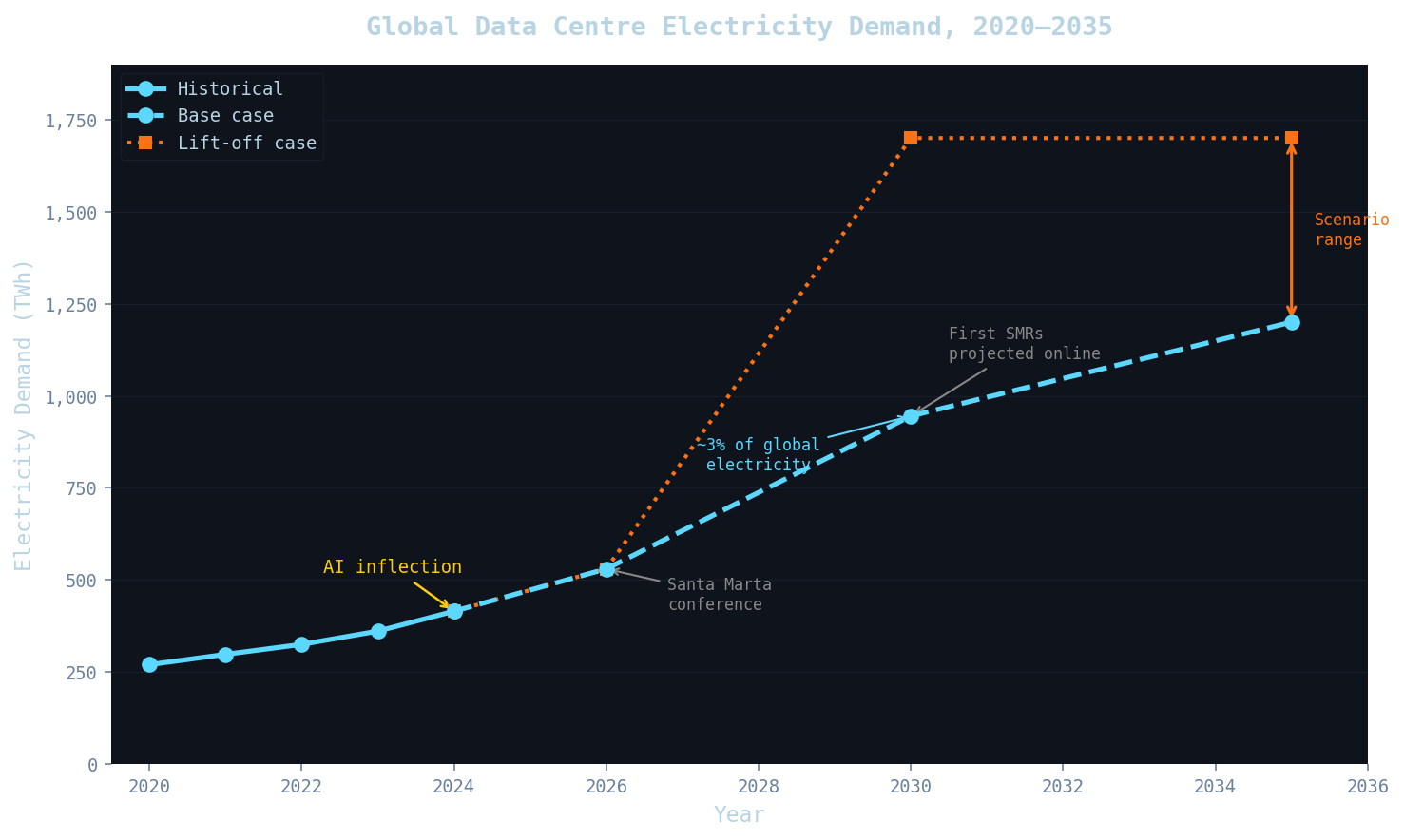
The AI infrastructure buildout has created an energy demand trajectory that makes existing climate arithmetic look like a rough draft. According to IEA data synthesised by Brookings, global data centre electricity consumption hit 415 TWh in 2024 — 1.5% of global electricity — growing at 12% annually, four times faster than total global electricity demand. The base-case projection: 945 TWh by 2030, roughly 3% of all electricity on Earth. The lift-off scenario, if AI adoption accelerates as Jensen Huang’s 10,000× compute demand claim suggests, could reach 1,700 TWh.
The inflection point isn’t some future date. It’s 2024. The jump from 361 TWh in 2023 to 415 TWh in 2024 — a 55 TWh single-year increase — was the largest on record and marked the moment AI training and inference workloads began overwhelming the historical growth curve. Google, Amazon, and Microsoft combined spent $112 billion on capital expenditure in Q1 2026 alone. As Noam Brown and Sam Altman have framed it, inference is the new compute — and inference runs 24/7.
Who Actually Powers This
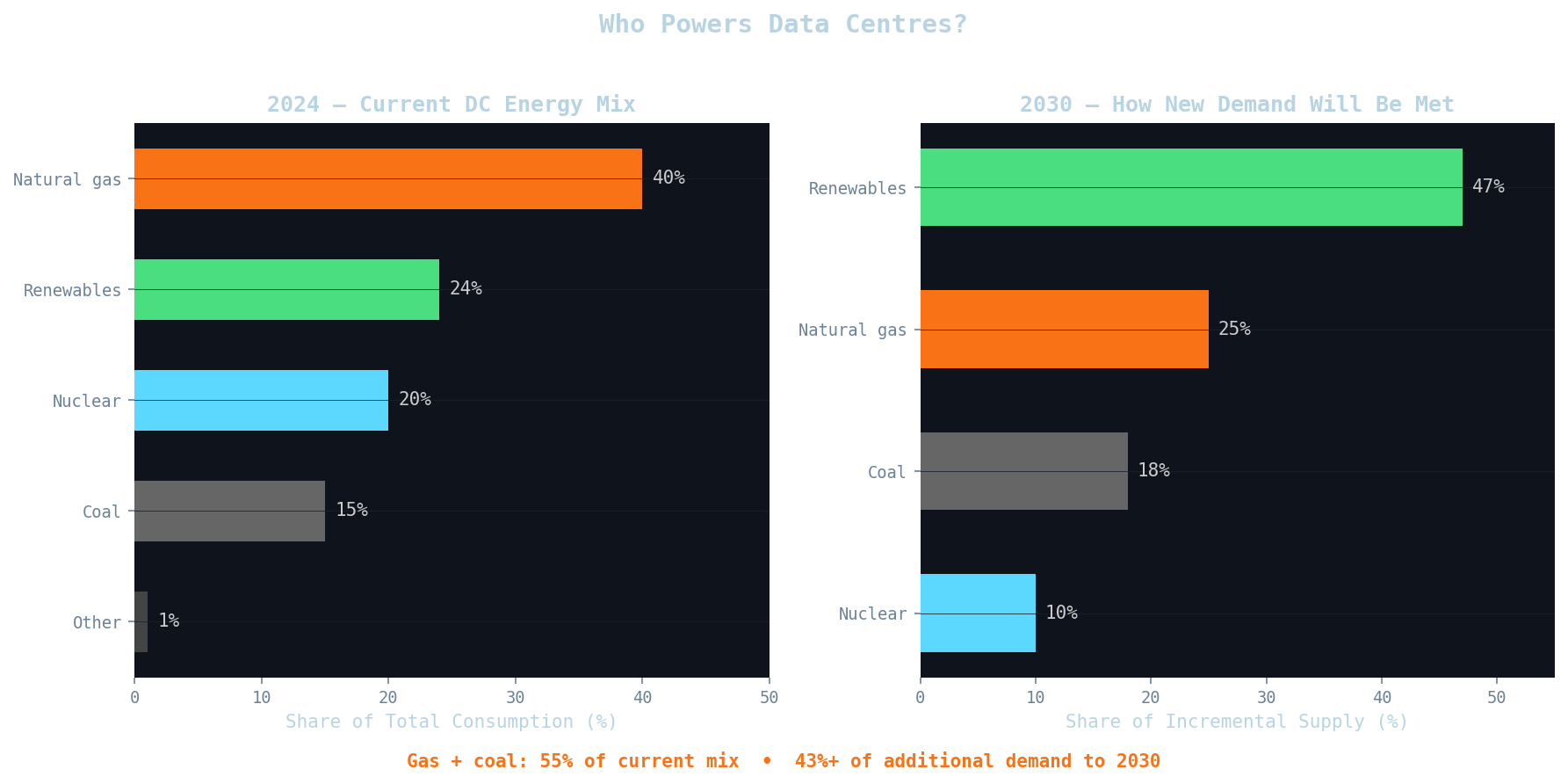
The uncomfortable question is what’s generating those electrons. The 2024 data centre energy mix tells the story: natural gas 40%, renewables 24%, nuclear 20%, coal 15%. Fossil fuels — the substances 56 countries just pledged to phase out — provide 55% of the electricity that powers the AI revolution everyone is simultaneously celebrating.
The projected 2030 incremental supply mix is slightly better but not remotely close to the Santa Marta vision. Renewables will meet roughly 47% of new demand, primarily through corporate power purchase agreements for wind and solar. But gas will supply another 25%, coal 18% (almost entirely in China), and nuclear 10%. Gas and coal together will still meet 43% of the additional demand through the end of the decade. The phaseout is happening on paper. The electrons are coming from somewhere else.
China’s position crystallises the contradiction. It accounts for 25% of global data centre consumption and installed 357 GW of new wind and solar in the first half of 2025 — an astonishing number. It also commissioned 21 GW of new coal plants in the same period. Both things are true. Both are accelerating.
Belgium: Three Shocks, One Direction
Belgium’s nuclear nationalisation is not a single policy decision. It’s the accumulated result of three separate geopolitical shocks, each pushing in the same direction.
The first was Ukraine. Russia’s 2022 invasion triggered an energy price crisis that made Belgium’s planned nuclear phaseout politically untenable. The two youngest reactors — Doel 4 and Tihange 3, each roughly 1,000 MW — got a 10-year extension under a state-ENGIE joint venture. Parliament repealed the 2003 phaseout law in May 2025 by a vote of 102 to 8.
The second was the market consequence of the phaseout itself. Belgium had shut five of its seven reactors between 2022 and 2025. It went from being a net electricity exporter to a net importer, exposed to the volatile pricing of the very fossil fuels it was supposed to be leaving behind. The Radiant Energy Group estimates that restarting the best candidate, Tihange 1, could produce power at roughly €65/MWh — compared to €140/MWh for gas-fired generation at current prices and €90/MWh for new offshore wind before system costs.
The third shock is happening now. Disruptions in the Strait of Hormuz have pushed Belgian electricity prices up by more than 50%, with national inflation hitting 4% in April 2026. Prime Minister Bart De Wever’s government announced the full nationalisation on 30 April. All dismantling activities at shuttered reactors are suspended. The target is a binding deal by October, with a longer-term goal of up to 8 GW of nuclear capacity by 2035.
On Hacker News, the community drew a pointed observation. As one commenter put it: “In Belgium the choice is rather nuclear or new gas plants from ENGIE. Why do you think ENGIE wants them shut?” The French energy giant’s eagerness to exit Belgian nuclear and focus on renewables has a less charitable reading than the corporate communications suggest — shutting reactors creates demand for the gas infrastructure ENGIE would prefer to build.
Others raised legitimate concerns about reactor age and reliability. Belgium’s plants are “outdated 2nd-gen PWR reactors, designed by a company with no other nuclear experience, operating in some of the most densely populated areas of Europe,” one commenter noted. But as another countered, Belgium has the “global gold standard of nuclear regulation” — annual reviews, five-year major reassessments, and ten-year periodic safety reviews with mandatory upgrades. The question isn’t whether the reactors are old. It’s whether the regulatory framework is capable of managing old reactors safely. The answer, for Belgium at least, appears to be yes.
The Nuclear Rehabilitation Nobody Planned
The speed of nuclear’s political rehabilitation is remarkable precisely because it wasn’t driven by the people who spent decades arguing for it. Climate advocates didn’t win this argument. Energy security hawks won it, and then AI capex sealed the deal.
The IEA’s SMR pipeline projection doubled in a matter of months, from 25 GW to 45 GW. Denmark — which banned nuclear power 40 years ago — is now formally reconsidering. France is marketing its nuclear grid as a competitive advantage for AI infrastructure. At a 2026 Paris summit, EU Commission President Ursula von der Leyen called the earlier nuclear phaseouts a “strategic mistake.” The Greens lost the nuclear argument, and it wasn’t the climate movement that beat them. It was the spreadsheet.
The economics are brutally simple. Restarting Belgium’s existing reactors costs €3–4 billion for roughly 3,900 MW. Building equivalent new capacity as French EPR2 reactors would cost €24 billion and take a decade. The market value of electricity from the restarted fleet could reach €60 billion over 20 years. Microsoft’s Three Mile Island PPA — $110–115/MWh — signals where hyperscalers think nuclear power prices are heading, and they’re signing contracts anyway because baseload reliability is worth a premium when your inference workloads can’t be interrupted.
The Colombia Problem
The Santa Marta conference was a genuine diplomatic innovation. Smaller than a COP, solutions-focused, explicitly excluding fossil fuel lobbyists, operating outside the UN consensus rules that let producer nations block any mention of phaseout in final communiqués. Colombia’s environment minister called it “the moment when ambition becomes action.” Mary Robinson called it “a coalition of the doers.”
But the results tell a different story. No binding commitments. No financing mechanism. No timeline with teeth. The 56 participating countries produced voluntary roadmaps — the same instrument that has characterised two decades of climate diplomacy without bending the emissions curve. The US and China — between them responsible for roughly 70% of projected data centre demand growth — were not in the room. The US State Department dismissed the conference as a “bogus climate agenda.”
The financing gap remains the central unsolved problem. The Global South needs capital to transition, and borrowing costs make large-scale infrastructure investment prohibitive without concessional finance that doesn’t exist at the necessary scale. Some regions are exploring creative approaches — Brazil’s Espírito Santo state is channelling fossil fuel revenues into transition funds — but the structural problem is that the countries hosting an increasing share of data centre infrastructure are also the ones least able to afford the clean energy to power it.
Indigenous representatives at the summit warned against relying on carbon markets, arguing they “fail to address root causes and risk prolonging dependence.” As Luene Karipuna put it: “No amount of money can pay for the spirit of the territory.” It’s a line that resonates beyond its immediate context — the entire Santa Marta process is haunted by the gap between what’s being pledged and what the electrons are actually doing.
The Bifurcation
The energy transition is not stalling. It is bifurcating. Rich countries with the capital to build nuclear or sign renewable PPAs will decarbonise their AI infrastructure eventually — Belgium is doing it through nationalisation, France through state-backed nuclear, the US through hyperscaler procurement. Countries without that capital will burn more coal to host the servers that run the AI tools that everyone else is using to write their phaseout pledges.
As Mat puts it: “There is no extent to which the massive growth in data center consumption can be said to be one of survival for any nation, but rather it’s simply one about money.” That’s the uncomfortable truth at the centre of the “three survivals” framing. Geopolitical energy security is real — Belgium’s electricity prices doubled because of a strait thousands of kilometres away. Climate urgency is real — 1.5°C is slipping. But the AI demand surge is neither. It’s a business decision, being made at planetary scale, by companies whose quarterly capex exceeds the GDP of most nations. Calling it “survival” dignifies what is fundamentally an investment cycle.
The question that will define the next decade is not whether the transition happens but who pays for it — and who burns the fossil fuels in the meantime. Belgium chose to nationalise its way out of the trap. Colombia’s coalition chose to pledge its way out. The data centre demand curve doesn’t care which approach wins. It just needs the watts.
Sources
- From phase-out to takeover: how Belgium is nationalising its nuclear power from ENGIE — EUalive, 30 April 2026
- Belgium reopens the nuclear door in high-stakes deal with Engie — Euronews, 30 April 2026
- Countries gather in Colombia to discuss phasing out fossil fuels — NPR, 29 April 2026
- ‘Time to move forward, or be left behind’: Colombia climate talks end — Euronews, 30 April 2026
- Global energy demands within the AI regulatory landscape — Brookings Institution, April 2026
- The Feasibility of Restarting Belgium’s Nuclear Reactors — Radiant Energy Group, April 2026
- Belgium reverses phase-out policy as Denmark reconsiders nuclear — World Nuclear News, May 2025
- Countries end Colombia fossil fuel summit — Washington Post, 30 April 2026
- New Report Finds Data Center Demand Overstated — As You Sow/Sierra Club, September 2025
- Belgium stops decommissioning nuclear power plants — Hacker News discussion (679 comments)