The Narcissus Machine
The Loop No One Designed
Here is the shape of modern hiring, compressed to its absurd essence: a candidate uses GPT-4o to polish their resume. An employer uses GPT-4o to screen it. The machine evaluates the machine’s work and finds it excellent. The human — whose experience, judgment, and career were supposed to be the point — is a formatting intermediary between two API calls.
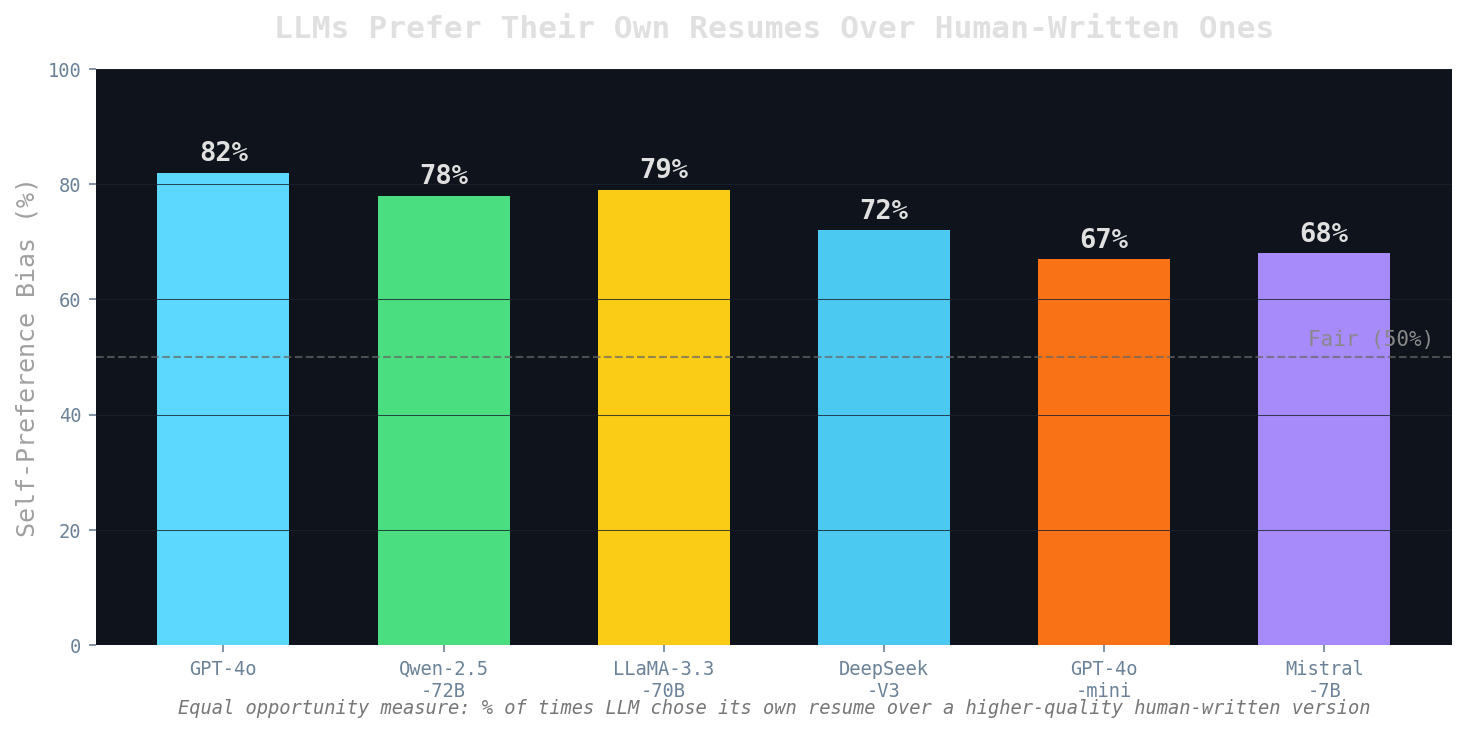
A paper published on arXiv this week, “AI Self-preferencing in Algorithmic Hiring,” makes this dynamic quantitatively explicit for the first time. Researchers from multiple institutions ran a controlled experiment using 2,245 real resumes (sourced from a professional platform, pre-generative AI era) and created counterfactual versions rewritten by GPT-4o, LLaMA-3.3-70B, DeepSeek-V3, and others. They then had each LLM evaluate pairs of resumes — one it had written, one by a human or a different model — controlling for content quality. The result: LLMs preferred their own output over human-written resumes 67% to 82% of the time, even when human annotators judged the human version as higher quality. Candidates using the same LLM as the evaluator were 23% to 60% more likely to be shortlisted.
This isn’t demographic bias in the traditional sense — the kind regulators have been trying to audit since New York City’s Local Law 144 took effect in 2023. It’s something stranger: a structural preference for a particular style of machine-generated text, detected across every major commercial and open-source model tested. And it compounds. As more applicants adopt LLM resume polishers (some estimates suggest 40-50% of job seekers already do), the training data for future models skews further toward LLM-native prose, which future LLMs will continue to prefer. The loop tightens.
The Audit That Didn’t Audit
The timing is bitter. New York’s LL144 was supposed to be the template for algorithmic accountability in hiring — the first law anywhere requiring employers to audit their Automated Employment Decision Tools for bias and publish the results. A study by Cornell, Consumer Reports, and Data & Society found it has been almost entirely ineffective. Of 391 employers sampled, only 18 published the required audit reports. Just 13 included transparency notices in job postings. The law grants employers near-total discretion to decide whether their AI tools even fall within its scope, creating what researcher Jacob Metcalf called “perverse incentives that undermine actual accountability.” Several employers paid for audits but refused to publish negative results — their legal counsel, one researcher noted, was “more scared of the EEOC than New York City.”
The failure has stalled similar legislation across the US. California, Washington DC, and New York state all considered comparable bills; none advanced. Meanwhile, the EU AI Act — which classifies AI in recruiting as “high-risk” and requires pre-market review and lifecycle monitoring — is entering its implementation phase but faces delays through 2027-2028 as the Commission’s Digital Omnibus package reworks deadlines. The regulatory window during which AI hiring tools operate with essentially no oversight is widening, not narrowing.
The Candidate Experience
On the other side of the pipeline, the human cost is accumulating. A Greenhouse survey of 2,950 job seekers across the UK, US, Germany, Australia, and Ireland found that 47% of UK candidates have now been interviewed by AI — typically a one-way video format with prerecorded questions, two minutes to plan, three minutes to answer. Thirty percent have walked away from a hiring process because it included an AI interview. The Guardian’s reporting captured the texture: a scientist applying for a senior role described a ten-minute AI interview as “awkward and humiliating,” adding “I’m not even sure anybody watched it.” A marketing consultant found the format “completely horrible for the autistic brain.” A project manager noted the AI agent repeatedly interrupted him when he paused, assuming he’d finished speaking.
The Workday lawsuit — Mobley v. Workday, now certified as a nationwide collective action under the Age Discrimination in Employment Act — adds legal weight to these complaints. Derek Mobley, a Black man over 40, claims he applied to more than 100 jobs through Workday’s platform over several years and was rejected every time. The court found his claims plausible enough to proceed, rejecting Workday’s argument that only employers (not their software vendors) make hiring decisions. The case now potentially covers hundreds of millions of applicants over 40 who were rejected since September 2020.
What the Self-Preference Actually Means
The arxiv paper’s most important contribution isn’t the headline number. It’s the methodology. The researchers controlled for content quality — the same candidate profile, the same qualifications, differing only in writing style. When human evaluators looked at the same pairs, they often preferred the human-written version. The LLMs didn’t. They consistently chose the version that matched their own generation patterns — the sentence structures, the vocabulary density, the particular rhythm of machine-organised prose.
This means the bias isn’t about quality. It’s about legibility to the evaluator. A resume written by a human in a distinctive, non-formulaic style — the kind that might signal genuine thought — is systematically disadvantaged. A resume polished by the same model doing the screening reads as “better” because it’s optimised for that model’s latent preferences. The paper found the effect was worst in business fields: sales, accounting, and finance, where subjective assessment of “professionalism” already tends to reward formulaic writing.
The mitigation strategies are straightforward but rarely deployed. System prompting — explicitly telling the LLM to ignore whether a resume was AI-generated — reduced GPT-4o’s bias from 82% to 61%. A majority-voting ensemble combining the evaluator with smaller models dropped it to 30%. Neither requires new research. They require employers to care enough to implement them. Given that LL144’s audit requirements produced near-zero compliance, the prospects are not encouraging.
The Narcissus Problem
There’s a deeper irony here that the paper doesn’t quite name. AI self-preferencing in hiring is a specific instance of a general problem: when LLMs evaluate LLM-generated content, they exhibit narcissistic bias. This shows up in code review (LLMs rate AI-generated code higher), creative writing assessment, and now hiring. The pattern is consistent: models trained on human text develop internal representations of “good” that, when applied to their own output, produce a hall-of-mirrors effect.
In hiring, this creates a perverse selection pressure. The candidates who get shortlisted aren’t the most qualified — they’re the ones whose resumes most closely match the evaluator’s generation distribution. Over time, this doesn’t just disadvantage individual applicants. It homogenises the talent pipeline. If every optimised resume reads the same because it’s all been processed through the same three models, the signal that actually matters — distinctive experience, unusual career paths, the kind of non-linear thinking that drives innovation — gets filtered out before a human ever sees it.
The companies deploying these tools are not, for the most part, trying to discriminate. They’re trying to manage application volume — some report receiving thousands of applications per posting. The AI interview format exists because no human hiring team can watch that many videos. But the solution to a volume problem has created a quality problem that nobody is measuring, nobody is auditing, and nobody is legally required to fix. The machines are hiring in their own image, and we’ve built no mechanism to notice.
Sources
- AI Self-preferencing in Algorithmic Hiring: Empirical Evidence and Insights
- ‘Awkward and humiliating’: UK job hunters share frustration with AI interviews
- Law designed to stop AI biasing hiring proves ineffective
- Mobley v. Workday: Landmark case signals new AI hiring risk
- EU AI Act for HR: high-risk tools & 2026 duties
- HN Discussion: AI Self-preferencing in Algorithmic Hiring