The Button Paradox: How Transformational Tech Displaces the Expertise That Made It Work
When “Modern” Meets the Real World
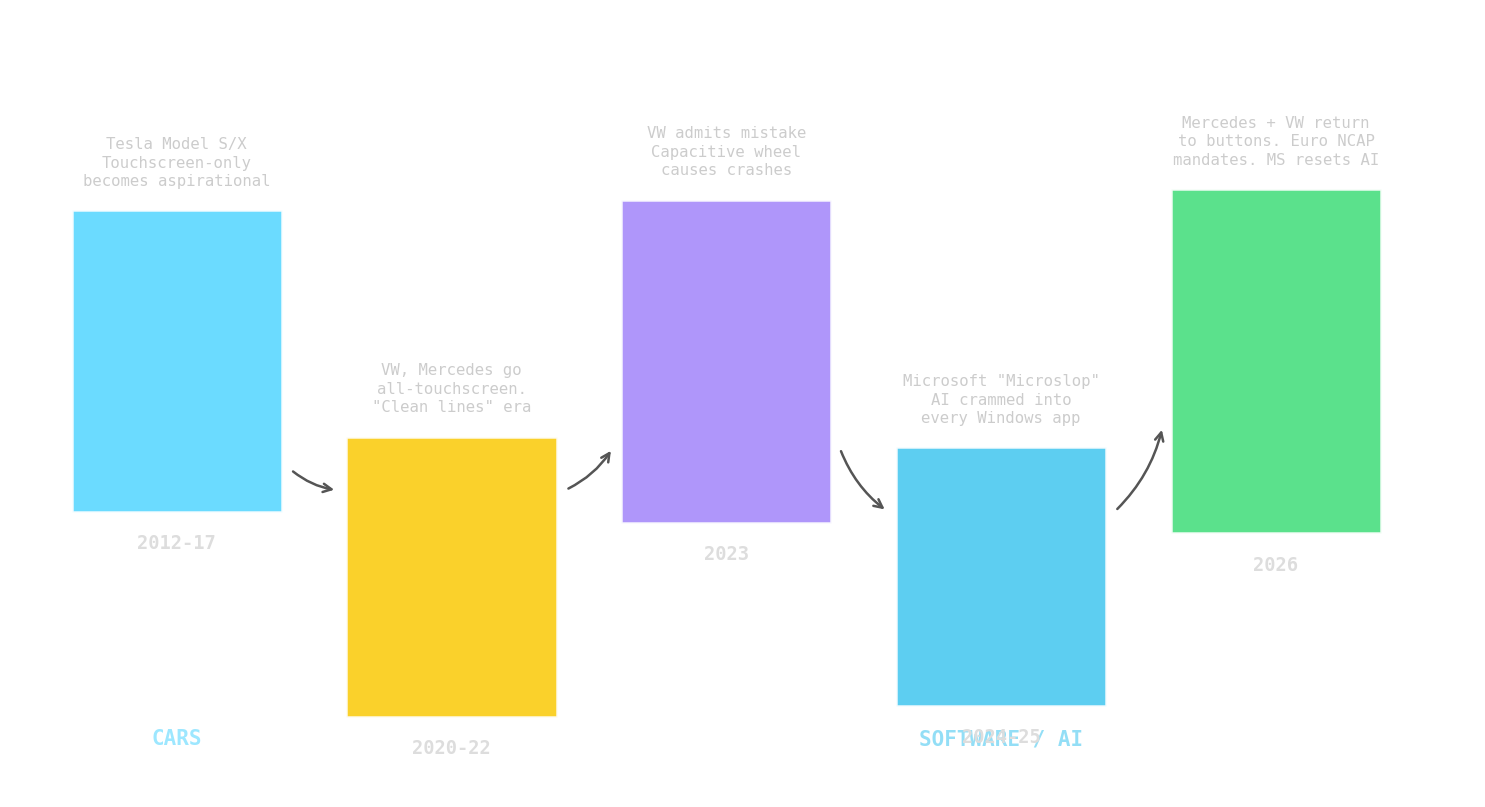
Mercedes-Benz has officially committed to bringing physical buttons back to its cars. Sales boss Mathias Geisen told Autocar that customers had been blunt: “Guys, nice idea, but it just doesn’t work for us.” The upcoming GLC SUV and C-Class will retain the massive 39.1-inch MBUX Hyperscreen — but will reintroduce physical buttons, switches, and dials for the controls drivers actually need while, you know, driving. Mercedes joins Volkswagen, whose design boss Andreas Mindt declared of the capacitive-touch steering wheel debacle: “We will never, ever make this mistake any more. It’s a car. It’s not a phone: it’s a car.” Hyundai has made similar noises. Euro NCAP, Europe’s safety rating body, has formalised the correction: from January 2026, cars need physical buttons for horn, indicators, hazard lights, wipers, and emergency calls to earn five stars.
This is not a minor trend reversal. It’s a wholesale admission that an entire industry chased an aesthetic at the expense of usability, and it took half a decade of consumer pain — and in VW’s case, potentially safety-implicated crashes from accidentally triggered cruise control — to correct course.
The Seduction of the Clean Line
What makes this story interesting isn’t that touchscreens in cars are bad — most people knew that immediately — but why so many manufacturers made the same mistake simultaneously. Mat’s framing nails it: once EVs became the transformational paradigm, the people who called the shots changed. Tesla, as the disruptor, could reasonably lack deep automotive UX heritage. But when established players like Mercedes and VW — companies with decades of ergonomic expertise in-house — followed the same path, something more structural was at work.
The mechanism is power rebalancing. When a new technology paradigm arrives, it doesn’t just change what’s built — it changes who gets listened to. The aesthetic designers who wanted “clean lines” and “space-age airy cabins” gained influence because their vision looked like the future. The button-placement obsessive, the person who spent years refining the tactile click of a steering wheel stalk, the ergonomics engineer who knew that a driver adjusting fan speed shouldn’t need to look at a screen — these people didn’t stop being right. They stopped being heard. Their expertise was reframed as legacy thinking, irrelevant to the electric revolution.
As one Hacker News commenter noted about a pre-touchscreen Mercedes W212: “The UI/UX is terrible anyway. My dad still has no idea how to bring up the tire pressure monitoring screen.” The point isn’t that physical buttons automatically make good UX — they don’t. It’s that the skills of people who think about tactile interaction, muscle memory, and eyes-on-the-road design are always relevant, regardless of whether the underlying platform is petrol or electric. The paradigm shift made decision-makers forget that.
The Evidence Was Always There
The safety data is damning. A 2025 study found that when drivers interacted with touchscreens, they drifted side-to-side in their lane 42% more often. Euro NCAP’s spokesperson put it with admirable directness: “Digging through menus just to activate your wipers isn’t progress — it’s dangerous.” The irony that using a phone touchscreen while driving is illegal in most jurisdictions, while embedding a much larger touchscreen as the primary vehicle interface was considered premium design, apparently escaped an entire industry for years.
The correction is now institutional. Euro NCAP’s 2026 scoring massively increased the weight of driver monitoring systems (from 2 to 25 points) and mandated physical controls for critical functions. This isn’t a suggestion — it’s a market force. Manufacturers who don’t comply lose their five-star safety rating, which is commercial poison in European markets.
VW’s specific case is particularly telling. In 2022, they switched to capacitive “buttons” on the steering wheel — touch-sensitive surfaces with no tactile feedback. The result: four crashes were likely caused by accidental activation of cruise control. The company admitted the error in 2023, but the physical-button redesign won’t reach production until the ID.2 in 2026. That’s a four-year gap between acknowledging the problem and shipping the fix, because car development cycles are long and the mistake was baked into multiple platforms.
The AI Parallel
Here’s where this becomes more than a car story. The same dynamic is playing out right now in software, and the pattern is eerily identical.
Microsoft spent 2024 and 2025 threading Copilot AI into every corner of Windows — Notepad, Paint, the Snipping Tool, the taskbar. The backlash was severe enough to coin a term: “Microslop,” a play on “AI slop” that spread so widely Microsoft banned it from official communities. By March 2026, the company published a candid blog post acknowledging the criticism and began pulling visible AI hooks out of apps. The Copilot button in Notepad became a neutral “Writing Tools” icon. The “AI Features” heading in Settings became “Advanced Features.” The capabilities stayed; the branding was stripped.
The parallel to touchscreens is structural, not superficial. In both cases:
- A transformational technology arrives (EVs / generative AI)
- Early adopters demonstrate market success (Tesla / OpenAI)
- Established players rush to follow, importing the aesthetic of the transformation rather than its substance
- UX expertise from the prior era is marginalised as “legacy thinking”
- Users push back — not against the technology itself, but against its indiscriminate application
- The correction takes years because development cycles are long and organisational momentum is real
The TUI (Terminal User Interface) resurgence happening in developer tools right now is another manifestation. As one analysis that hit Hacker News this week argues, the proliferation of inconsistent Electron apps and constantly-shifting GUI frameworks has driven developers back to terminal interfaces — not because terminals are better in absolute terms, but because they’re consistent and predictable. The “modern” GUI stack broke the basic contract of interface design: that you shouldn’t have to think about the interface itself.
The Consumer Always Wins (Eventually)
There’s a reassuring lesson buried in all this, and also an uncomfortable one. The reassuring part: consumers ultimately hold the power. You can’t force people to love a UX they hate. Mercedes heard “guys, nice idea, but it doesn’t work” and adapted. Microsoft heard “Microslop” and recalibrated. The market corrects.
The uncomfortable part is the lag. VW’s capacitive steering wheel was on the road for four years before the fix ships. Microsoft’s AI-in-everything phase burned goodwill across two major Windows cycles. The automotive industry collectively spent half a decade shipping interiors that were demonstrably worse at the thing interiors exist to do — let you operate the vehicle safely — because the wrong people had the loudest voices at the design review table.
And for AI, we’re still in the “cramming it in everywhere” phase. Every product update announcement reads like a checklist: AI here, AI there, AI in places where a settings menu would work fine. The correction is coming — the Microsoft “quality reset” is the canary — but like the car industry, it’ll take years to unwind the decisions that are already baked into roadmaps and platforms.
The meta-lesson is simple and has nothing to do with touchscreens or language models: when a paradigm shift happens, don’t fire the people who understood the last paradigm. The boring, unsexy expertise — where to put a button, how a settings dialog should work, what a user actually needs at 110 km/h on a motorway — turns out to be the thing that makes or breaks the new paradigm. Every time.
Sources
- Mercedes-Benz commits to bringing back physical buttons (Drive.com.au)
- VW Brings Back Physical Buttons After Admitting Touchscreens Are A Disaster (Carscoops)
- Euro NCAP brings back car buttons by 2026 (Euro Weekly News)
- From Microsoft to “Microslop”: The AI Backlash That Forced a Reset (Digital Trends)
- Why TUIs Are Back (Alcides Fonseca)
- Mercedes-Benz commits to bringing back physical buttons — HN discussion (333 comments)
- Why TUIs Are Back — HN discussion (259 comments)