Prediction Markets Have Become a Side Channel for Classified Intelligence
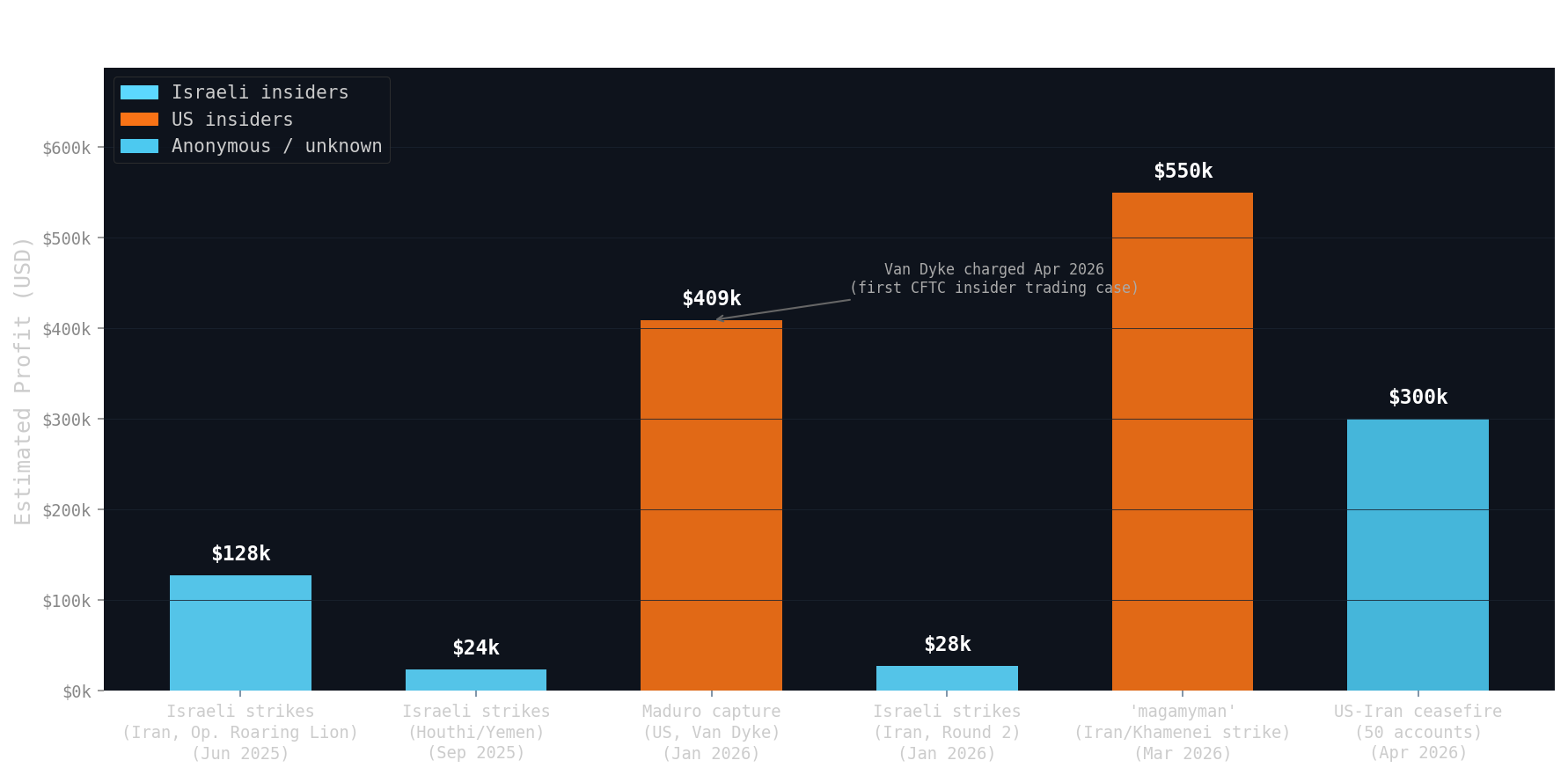
When Israeli authorities arrested Omer Ziv and an unnamed air force reserve major last week for allegedly using classified military intelligence to bet on Polymarket, the details read like a thriller written by someone who hates irony. WhatsApp messages instructing Ziv to “keep quiet, so we don’t go to jail” sit alongside blockchain transactions and crypto wallets containing NFT video clips that allegedly identified the pair. The major allegedly received operational briefings on “Operation Roaring Lion” — the June 2025 strike involving 200 Israeli jets hitting over 100 targets in Tehran — and relayed timing details to Ziv, who placed bets through multiple Polymarket accounts with deliberately vague usernames. They netted roughly $152,000 across a series of bets on Israeli military operations in Iran, Yemen, and again Iran. Both now face bribery, security offences, and obstruction charges. Ziv additionally faces aggravated espionage — a charge carrying potential life imprisonment.
But this Israeli case is just the most recent arrest in a pattern that has been accelerating since January. The American parallel is arguably worse: US Army Special Forces Master Sergeant Gannon Ken Van Dyke allegedly staked approximately $33,000 on Polymarket’s offshore protocol at around 7 cents a share that Nicolás Maduro would be out of office by January 31. The bet was placed between December 27 and January 2. On January 3, US forces captured Maduro. Van Dyke walked away with over $409,000. Then there’s the anonymous account “magamyman,” which made roughly $550,000 from trades on the day of the US strike that killed Iran’s Supreme Leader Khamenei, and the cluster of 50 newly created accounts that placed large bets on a US-Iran ceasefire hours before the official April 7 announcement. On the day of the Iran strike, Polymarket processed $478 million in bets — a single-day record.
The structural problem is this: Polymarket’s entire value proposition is that financial incentives surface private information. CEO Shayne Coplan has said as much, describing the platform as “the global truth machine” where “what’s cool about Polymarket is that it creates this financial incentive for people to go and divulge the information to the market.” That’s a feature when the hidden information is something like “I work at a company and know the quarterly earnings look bad.” It becomes something considerably darker when the hidden information is “I know when a country is about to launch a military strike.” The platform’s blockchain-based anonymity and crypto settlement make investigations difficult, while its offshore protocol — the same one the CFTC fined in 2022 for serving US persons — provides a jurisdictional grey zone. Foreign intelligence agencies can analyse on-chain trading data to identify patterns, potentially tipping off targets or manipulating markets to mislead adversaries.
The regulatory response has been contradictory at best. The CFTC under Trump appointee Mike Selig has vowed to pursue insider trading in event contracts aggressively, and the DOJ moved quickly against Van Dyke in April 2026 — the agency’s first-ever insider trading complaint involving event contracts. But the same administration closed federal investigations into Polymarket without charges after taking office, sued three states (Illinois, Connecticut, Arizona) that attempted to regulate prediction markets, and counts Donald Trump Jr. as both a Polymarket adviser and a Kalshi investor through his venture firm 1789 Capital. When asked about the Van Dyke case, President Trump compared it to Pete Rose betting on his own team — a remark that manages to both trivialise the problem and miss the point entirely. Meanwhile, the CFTC’s self-certification framework means Polymarket can list new markets without pre-approval, claiming contracts about “regime change” aren’t really about assassination, and the agency’s enforcement posture has been described by the Council on Foreign Relations as “laissez faire.”
Congressional Democrats have responded with the DEATH BETS Act, introduced in March by Rep. Mike Levin and Sen. Adam Schiff, which would explicitly ban CFTC-registered businesses from allowing bets on terrorism, assassinations, war, or death. Senator Blumenthal sent a pointed letter to Polymarket’s CEO in April demanding answers about the platform’s “continuing failure to prevent insider trading.” But the legislation faces long odds in a Congress where prediction markets enjoy bipartisan libertarian support and the administration has staked out a pro-deregulation position. The deeper problem that nobody wants to articulate clearly: catching insiders after the fact doesn’t fix the intelligence leak. If Iran had been monitoring Polymarket before Operation Roaring Lion, or before the Khamenei strike, the strategic consequences could have been catastrophic — the targets could have moved, operations could have been compromised, and the element of surprise that military planners spend months cultivating would have been sold for someone’s crypto wallet balance.
The CFR’s analysis frames this correctly: the goal should be preventing high-risk contracts from being listed in the first place, not prosecuting winners after they’ve already leaked the information. That means rigorous KYC, preemptive government vetting of new listings, and international cooperation to close offshore loopholes — the kind of coordinated effort usually reserved for terrorist financing. Instead, what we have is a platform that bets on war, a government that both prosecutes its users and protects its right to operate, and a growing body of evidence that anonymous prediction markets function as a side channel for classified intelligence. Polymarket’s CTO described the blockchain transparency as a virtue — “just how easy it is to find and charge criminal insider trading when markets are onchain.” The problem is that by the time anyone finds those transactions, the damage has already been paid for.
Sources
- Keep quiet ‘so we don’t go to jail’: the Israelis charged with bribery after suspicious bets placed on Iran strikes
- Insider Trading Is Going to Get People Killed — The Atlantic
- The Ultimate Price of Prediction Markets — Council on Foreign Relations
- Unregulated prediction market may endanger US national security — Military Times
- Lawmakers call for CFTC crackdown on prediction markets — CBS News
- Trump admin sues three states over prediction market rules — NPR
- Senator Blumenthal letter to Polymarket CEO (PDF)
- Bad bets: Recent enforcement actions — Herbert Smith Freehills / JDSupra