Disclosure Theatre
Everything You Wanted to Know About UFOs (Except What They Are)
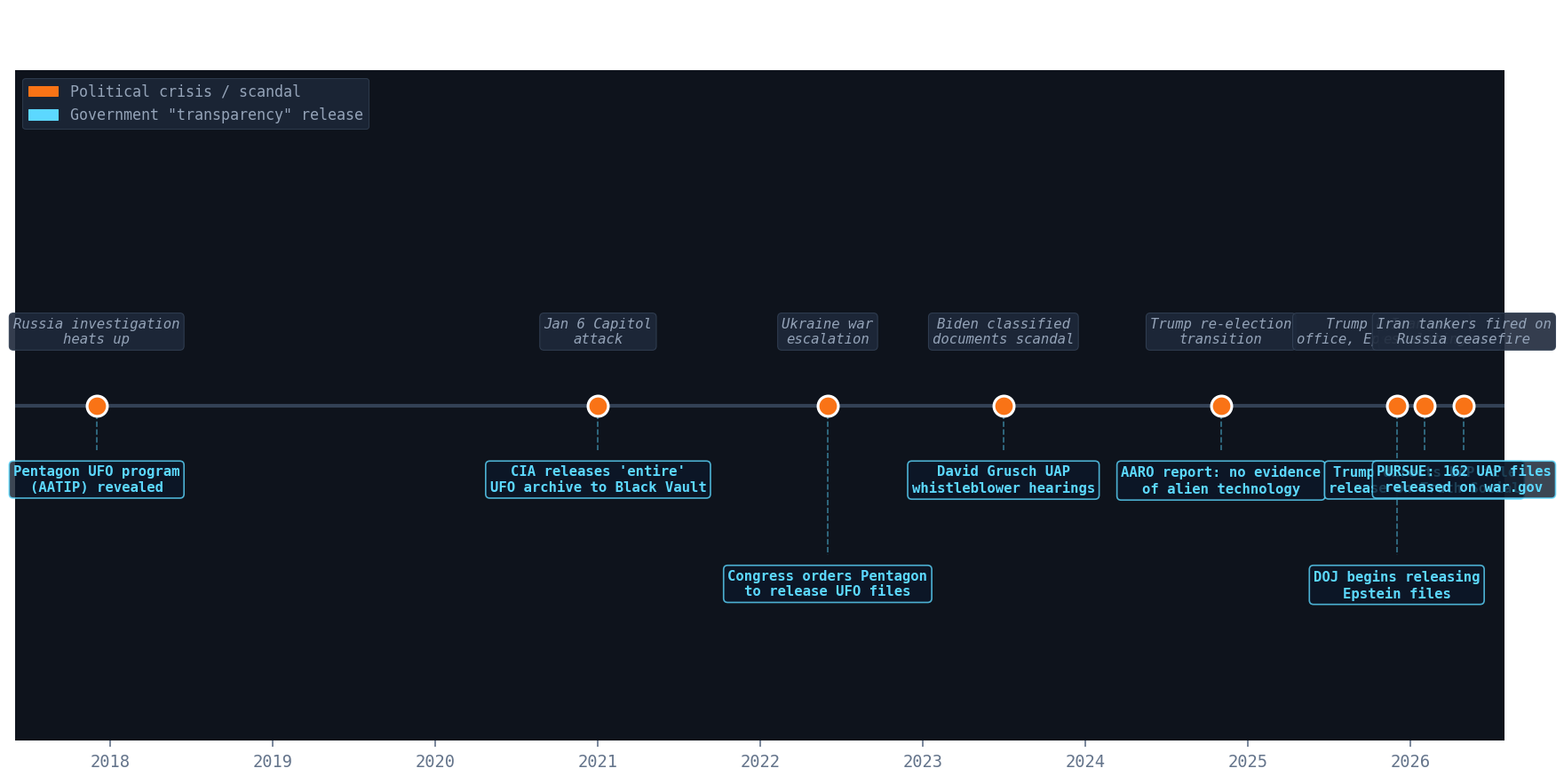
On Friday, the Pentagon released 162 declassified files documenting UFO encounters spanning eight decades — from Buzz Aldrin’s Apollo 11 debriefing to infrared footage of unexplained objects over the Middle East in 2024. The release is the first tranche of PURSUE (Presidential Unsealing and Reporting System for UAP Encounters), an initiative born from a February Truth Social post in which President Trump directed the “Secretary of War” to begin releasing government files on “alien and extraterrestrial life.” The site — war.gov/UFO — features a retro aesthetic of typewriter fonts and black-and-white military imagery. Pete Hegseth called it “unprecedented transparency.” Tulsi Gabbard described it as “the first in what will be an ongoing joint declassification and release effort.”
It is also, by the government’s own careful framing, a collection of things it cannot explain but also cannot confirm. The files document “unresolved cases” — a classification that means the government has insufficient data to determine what the phenomena were. The Pentagon’s press release is explicit: while files have been “reviewed for security purposes, many of the materials have not yet been analyzed for resolution of any anomalies.” You are invited to draw your own conclusions from data that the government itself hasn’t drawn conclusions from.
The Epstein Files Model
The structural parallel to the Department of Justice’s Epstein files release — which began in December 2025 and is still underway — is not incidental. NBC News reported that the Pentagon is using the Epstein release as its operational model. The same playbook: a dedicated website, a drip-feed of documents over weeks, no government interpretation, and the explicit instruction to “make up your own minds.”
That Epstein release was widely criticised for publishing material that was already in the public domain, for heavy redactions that obscured the most sensitive details, and for technical failures that plagued the website in its first days. The UFO release has hit similar speed bumps: users on Hacker News discovered broken links on the site, and one user found documents that still carried original classification markings — “SECRET//REL TO USA, FVEY” — that were never properly removed during declassification. “They really are supposed to remove those or at least cross them out,” the user noted, adding: “To see a document on the public internet with those labels still attached.” This is not a minor procedural error. Classification markings on a public website represent a failure in the declassification pipeline itself, and they suggest the release was rushed to meet a political timeline rather than a security one.
What’s Actually in the Files
The 162 documents break down into several categories: FBI files from the late 1940s (the original “flying disc” reports routed to J. Edgar Hoover), Apollo mission crew debriefings, Cold War-era military sighting reports, and recent infrared footage from military operations. Some highlights:
A November 1948 US Air Force Top Secret report on recurring sightings over Europe includes the remarkable admission: “They have been reported by so many sources and from such a variety of places that we are convinced that they cannot be disregarded, and must be explained on some basis which is perhaps slightly beyond the scope of our present intelligence thinking.” Swedish intelligence told US officers the phenomena displayed “obviously the result of a high technical skill which cannot be credited to any presently known culture on earth.”
Senator Richard Russell — then chair of the Senate Armed Services Committee — reported seeing “flying disc aircraft” from a train window in the Soviet Union in 1955, with his companion Lt. Col. Hathaway corroborating. The Air Attaché who prepared the report rated the witnesses as “excellent sources.”
And yet the most telling detail may be the mundane one. A 2023 FBI interview describes a drone operator — a woman with “deep experience with US military aircraft and drones” — who saw an ovaloid metallic object floating above a treeline for five to ten seconds before it vanished. Several people in at least two cars corroborated her sighting. The report notes, with a quiet cruelty: “Several of her co-workers subsequently made fun of her due to her report.” Eighty years of government UFO files, and the stigma around reporting them has barely changed.
The Community Has Already Moved On
Hacker News users — not a credulous crowd — parsed the imagery within hours. One commenter, @krferriter, offered a detailed technical assessment: “Several of these look like balloons and birds. Two of them have already leaked before. Both of those are missiles being viewed with an infrared camera. One of them shows a missile passing through the field of view rapidly with a motion blur streak behind it.” Another, @kumarharsh, connected the timing to a prediction made weeks earlier on X: “We can be sure as the war ends, there will be another distraction by the US using ‘Aliens, UFOs, and UAPs’. If Iran war was a distraction from Epstein files, this will be a distraction from war crimes.”
That cynical reading has structural support. The release comes as the US is actively firing on Iranian-flagged oil tankers, as a fragile Russia-Ukraine ceasefire begins, and as Congressional Republicans push for more. The Pentagon’s own press release frames the release as evidence of the Trump administration’s commitment to transparency — from the same department that expelled reporters from the building in April. The framing is not subtle: “Whereas previous Administrations have failed to be transparent on this subject.” Disclosure as political branding.
What This Actually Is
The PURSUE programme is not a cover-up. It is something more interesting: a performance of transparency that produces no actionable information. The documents are real. The sightings are real. The government genuinely doesn’t know what most of these things were. But the release is structured to maximise public fascination while minimising analytical rigour — no government interpretation, no resolution of cases, just raw data and the invitation to speculate.
This is a feature, not a bug. A genuine disclosure of confirmed extraterrestrial contact would be the most consequential event in human history. A genuine disclosure that it’s all sensor errors, weather balloons, and classified military tests would be boring. What the government has released is the optimal middle ground: enough mystery to sustain endless speculation, enough ambiguity to confirm nothing. The HN community saw through it in hours. The general public will chew on it for weeks. And the files that actually matter — the resolved cases, the ones where the government does know what happened — remain classified under separate statutory reporting.
The classification marking fiasco reveals the real dynamic. When you rush a declassification process to serve a news cycle, you get SECRET//FVEY labels on public websites. When you structure a release to answer no questions, you get 162 files that confirm only what we already knew: the government has been watching the sky for a very long time, and it still doesn’t have a good answer for what it’s seen. Whether that’s comforting or terrifying depends entirely on what you were hoping to find.
Sources
- Pentagon releases first batch of previously secret files documenting reports of UFOs — The Guardian
- UFO files spanning decades are released by Defense Department — NPR
- Pentagon begins release of UFO files — NBC News
- UFO files shed light on sightings but leave interpretation to the public — AP News
- Trump PURSUE Programme Hides Apollo Mission Anomalies in Declassified UFO Files — IBTimes UK
- US Government releases first batch of UAP documents and videos — Hacker News (327 comments)
- Presidential Unsealing and Reporting System for UAP Encounters — war.gov/UFO