The Open Source Social Contract Is Breaking in 3D Printing
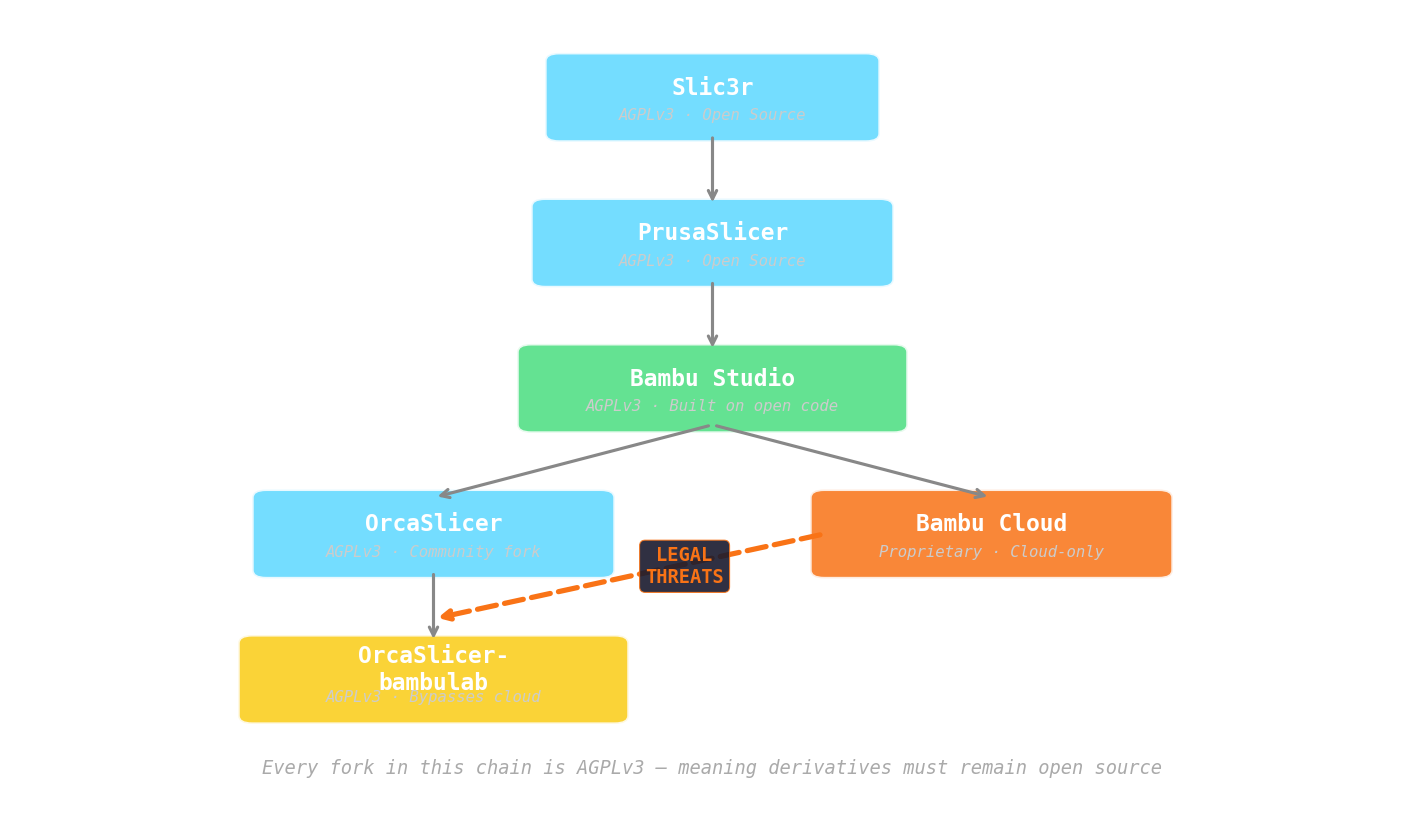
The Fork That Forked the Fork
There’s a beautiful irony at the heart of the Bambu Lab controversy that’s worth sitting with. The software chain goes like this: Slic3r (open source, AGPLv3) was forked by PrusaSlicer (open source, AGPLv3), which was forked by Bambu Studio (AGPLv3), which was forked by OrcaSlicer (AGPLv3), which was forked by OrcaSlicer-bambulab — the tiny project that Bambu Lab decided to nuke with legal threats. Every link in that chain exists because the GPL’s copyleft philosophy says: if you benefit from open code, your derivatives must remain open. Bambu Lab built its entire software stack on that principle. Then, when a lone developer used their own AGPL-licensed code to let users print without routing through Bambu’s cloud servers, the company accused him of “injecting falsified identity metadata” and “impersonating the official Bambu Studio client” — and did so publicly, without contacting him first.
The developer pushed back: he used Bambu’s code verbatim, as the license explicitly permits. Louis Rossmann pledged $10,000 toward legal defense. Jeff Geerling, one of the most respected voices in the maker community, declared he’d stop recommending Bambu printers entirely, firewalling his own P1S from the internet and switching to OrcaSlicer in LAN-only mode. On Hacker News, the story hit 1,046 points and 351 comments — the kind of engagement that signals a genuine community rupture, not just internet outrage.
The Apple Playbook, Applied to Printers
The OrcaSlicer incident isn’t an isolated misstep. It’s the logical endpoint of a strategy Bambu Lab has been pursuing since day one: be the Apple of 3D printing. As one Hacker News commenter put it, “Bambu Labs have been very candid about their playbook which is following Apple’s lead. They want to be the Apple of printers, a very walled garden with high integration, good UX and not a lot of freedom.” The comparison is apt. Bambu printers genuinely work — the X1C was a revelation when it launched in 2022, offering CoreXY performance with an automated material system at a price point that undercut building a Voron from parts. The “just works” factor converted thousands of makers who’d spent years levelling beds and calibrating extrusion multipliers.
But the Apple model requires control of the full stack, and that’s where the tension lives. Bambu’s firmware updates have progressively pushed users toward cloud-dependent workflows. Their MakerWorld marketplace locks model visibility behind algorithmic curation. Their filament ecosystem nudges users toward proprietary spools. And when someone builds a tool that lets users bypass the cloud layer — using Bambu’s own licensed code — the company reaches for lawyers. The PCMag analysis of closed ecosystems in 3D printing puts it bluntly: the walled garden model delivers dramatically easier experiences and consistent quality, but at the cost of higher ongoing prices, restricted innovation, and the ever-present risk that if the company abandons a product, your hardware becomes a paperweight.
Prusa’s Warning and the Patent Surge
The broader context makes Bambu’s behaviour look less like a company-specific problem and more like an industry-wide inflection point. Josef Prusa — whose company was the gold standard for open-source 3D printing — declared last year that “open hardware in 3D printing is dead.” His evidence: a dramatic surge in patents filed by Chinese manufacturers since 2020, enabled by government subsidies and a permissive patent system that lets companies patent innovations originally developed by the open-source community. Prusa Research itself has moved toward closed-source with its CORE One printer, effectively conceding that the open model can’t compete on price with state-backed manufacturers.
The community response to Prusa’s eulogy was pointed. Some saw it as self-serving justification for his own company’s pivot away from open source. Others noted that Voron, the community-built CoreXY platform, continues to thrive precisely because it doesn’t need to compete commercially — it serves tinkerers who value repairability and customisation over plug-and-play convenience. As one commenter observed: “15 years ago, it was a thousand people hacking on it and 0 people buying off-the-shelf products and now it’s a thousand people hacking on it and a million people buying off-the-shelf products. People are crying about the end of the hacking, but truly it didn’t go anywhere.”
The Two User Bases
The real tension isn’t between good and evil — it’s between two legitimate user needs that are becoming increasingly incompatible. The “just works” crowd wants a printer that behaves like a 2D printer: unbox, click print, get a perfect result. Bambu serves them brilliantly. The open-source crowd wants ownership: the ability to modify firmware, use any slicer, run offline, and know that their hardware won’t be remotely bricked by a corporate policy change. The AGPL license that Bambu’s software chain relies on was designed to protect the second group. The fact that Bambu is using legal pressure to undermine that protection — while profiting from code that only exists because of it — is what makes this a social contract violation, not just a business decision.
The HN discussion revealed a telling split. Defenders argued that Bambu’s cloud infrastructure has real costs and no third-party software is “entitled” to use those resources. Critics pointed out that the OrcaSlicer-bambulab fork existed precisely to avoid using Bambu’s cloud — and that Bambu’s security model, which relied on a user-agent string for DDoS protection, was the real problem. The most technically informed comment, from @bri3d, dug into the actual RPC mechanism and found that Bambu’s cloud was authorising prints using what was ostensibly local-only data — making the “security” justification for blocking the fork look thin.
What This Means
The 3D printing industry is at the same juncture that smartphones reached circa 2008 and PCs reached in the 1990s. The open, tinker-friendly era produced enormous innovation — Klipper, Input Shaping, Pressure Advance, the entire Voron ecosystem — but mainstream users have voted with their wallets for closed, reliable experiences. The question is whether the industry can sustain both models, or whether commercial gravity will pull everything toward walled gardens.
My take: Bambu Lab is making a strategic error. The maker community isn’t a market you can lock down the way you can casual phone users — these are people who build their own CNC machines for fun. Threatening legal action against a developer using your own AGPL-licensed code isn’t just ethically questionable, it’s a PR disaster that validates every slippery-slope argument the open-source community has been making for years. The smart play would have been a quiet trademark request about the fork’s name. Instead, they’ve turned a niche fork with negligible usage into a cause célèbre and handed Louis Rossmann his next ten videos.
The deeper worry is that this is the shape of things to come. If open-source hardware can be commercially succeeded by closed-source clones that cherry-pick the open code, then bolt on legal threats to prevent anyone from exercising the freedoms that code was licensed under, the social contract isn’t just breaking — it’s being actively exploited. And the 3D printing community, which built this industry in garages and hackerspaces, deserves better than watching it get Apple-ised by a company that wouldn’t exist without the very openness it’s now trying to kill.
Sources
- Bambu Lab is abusing the open source social contract — Jeff Geerling
- Bambu Lab pushes a “control system” for 3D printers — Ars Technica
- Josef Prusa Warns Open Hardware 3D Printing Is Dead — Hackaday
- How Closed Ecosystems Are Reshaping the 3D Printing Game — PCMag
- Stratasys sues Bambu Lab over patents — Ars Technica
- HN Discussion: Bambu Lab is abusing the open source social contract (1046pts, 351 comments)
- Growing Concerns About Bambu Lab’s Direction — Bambu Lab Community Forum