The Text Rendering Arms Race: Qwen Image 2.0 and the Infographic Frontier
The pitch: images that can read
Alibaba’s Qwen team released Qwen Image 2.0 in February 2026, and the positioning is unusually specific for an image generation model. While everyone else is chasing photorealism or aesthetic scores, Qwen is going after something more mundane and arguably more useful: images with readable text in them. PowerPoint slides. Infographics. Movie posters. Comics with dialogue bubbles. The kind of visual content that professional workflows actually produce, and that every other image model butchers.
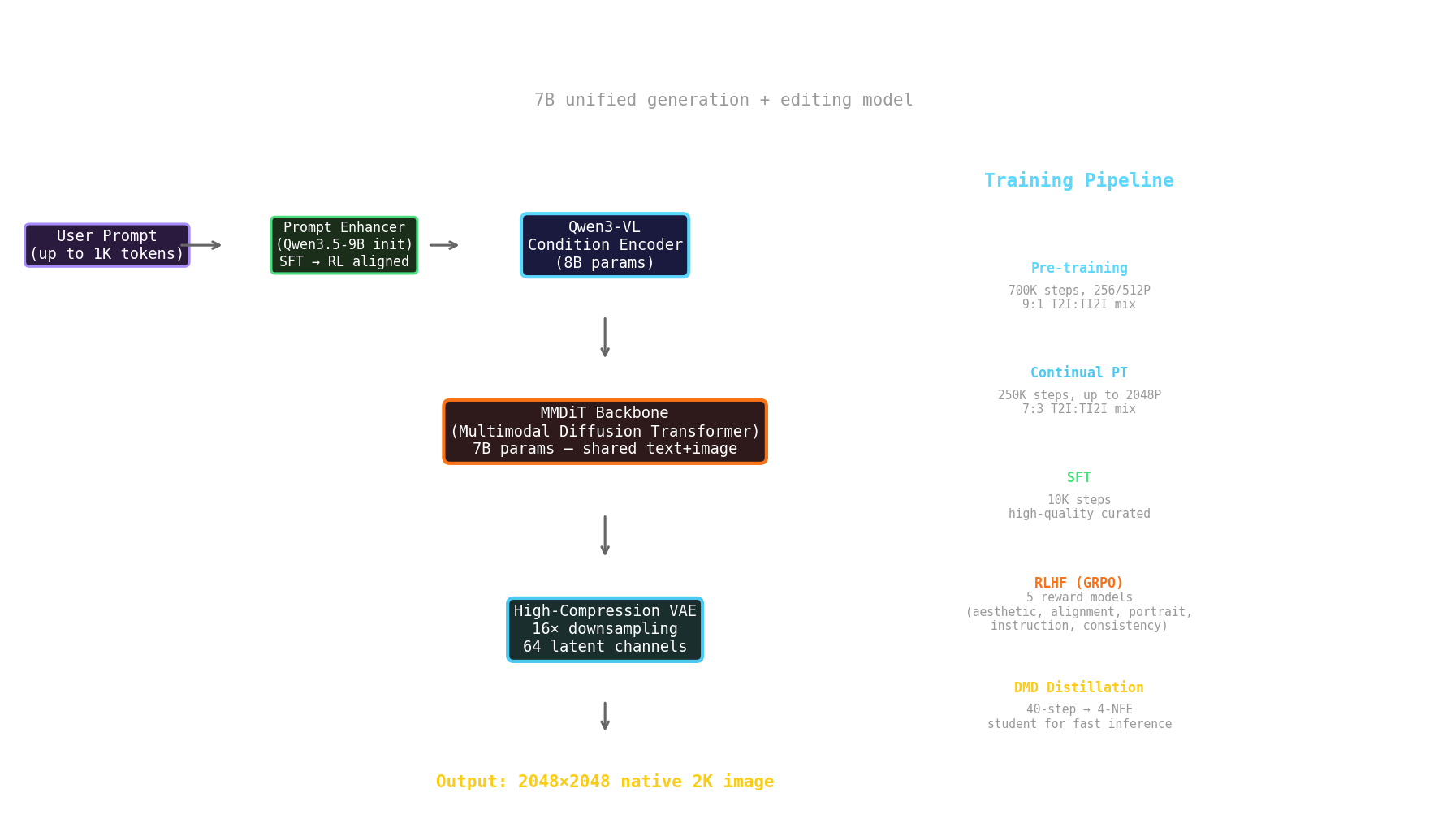
The technical report (arXiv:2605.10730) lays out a serious engineering effort. The model pairs Qwen3-VL as a condition encoder with a Multimodal Diffusion Transformer (MMDiT) backbone, shrunk from 20 billion parameters in v1 to 7 billion. The VAE uses a 16× spatial downsampling ratio — double the standard 8× in most open-source models — with 64 latent channels and a semantic alignment loss to make the latent space more amenable to diffusion. There’s a Prompt Enhancer module initialized from Qwen3.5-9B that rewrites vague user prompts into structured, detail-rich descriptions, trained first with supervised fine-tuning then aligned with reinforcement learning against downstream image quality. The training pipeline spans 960K steps across multiple resolutions, from 256P up to 2048P, with a closed-loop data flywheel that routes failure cases into RL, pre-training, or prompt engineering tracks.
Where it actually sits on the leaderboard
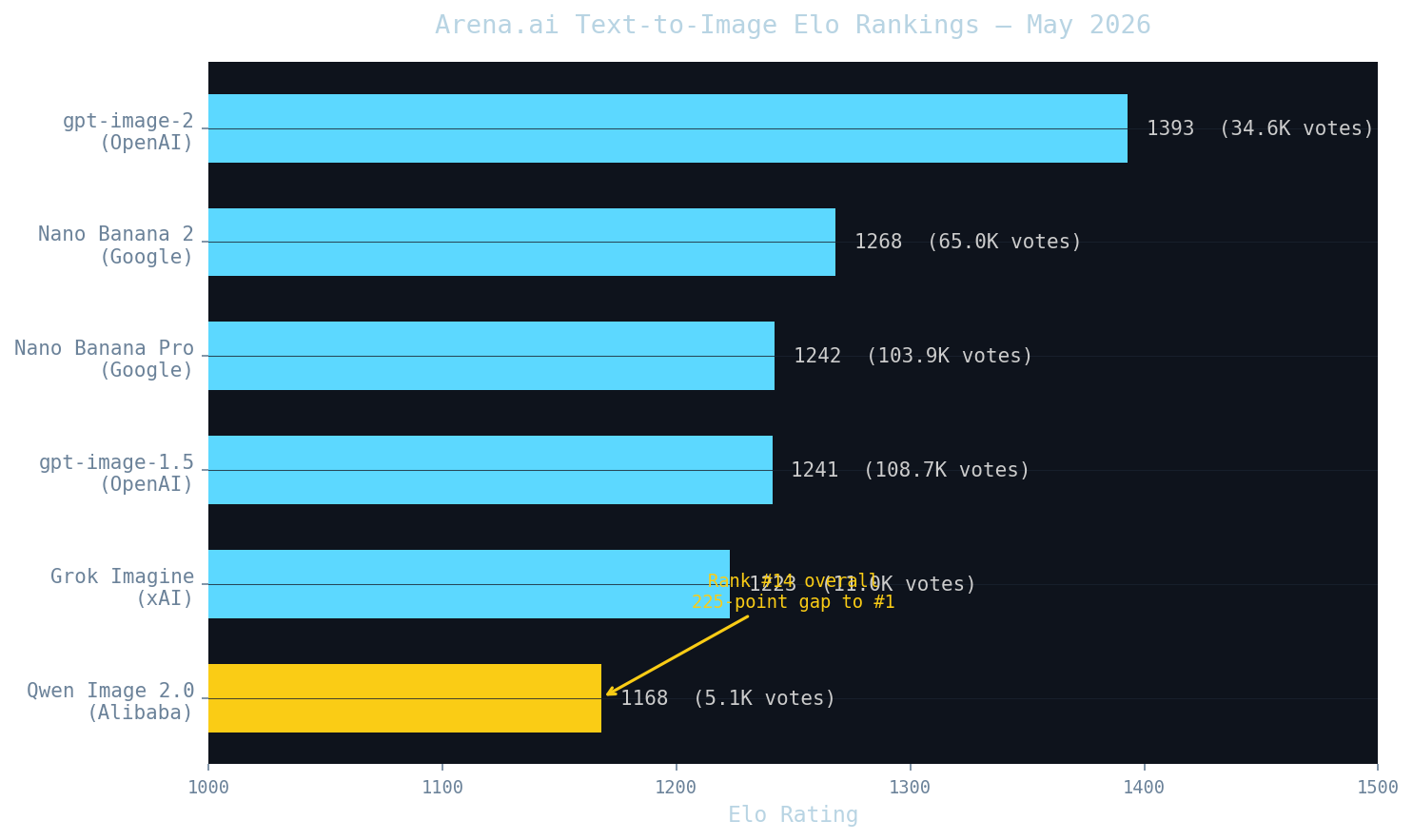
Here’s where the marketing narrative meets cold data. On Arena.ai’s Text-to-Image leaderboard — 5.17 million blind human preference votes across 60 models as of May 2026 — Qwen Image 2.0 Pro sits at rank 14 overall with an Elo of 1168. ChatGPT Images 2.0 (gpt-image-2) is rank 1 at 1393. That’s a 225-point gap, which in Elo terms means Qwen wins roughly 20-25% of head-to-head matchups against the leader. Even in the Text Rendering subcategory — Qwen’s claimed strength — it only manages rank 14 with an Elo of 1171, while ChatGPT Images 2.0 dominates at 1444. Google’s Nano Banana variants fill positions 2 through 6.
The Qwen team’s own blog claims “#1 on AI Arena” for both text-to-image and image editing, but this appears to reference Alibaba’s internal Arena platform, not the independent Arena.ai leaderboard. It’s a distinction that matters. Internal benchmarks are useful for development, but they don’t carry the same weight as blind evaluation by external users who don’t know which model generated which image.
That said, for a 7B open-weights model, these numbers are genuinely impressive. It’s competing with models 2-10× its size and holding its own. The question is whether “good for an open model” is the right framing, or whether the gap to closed models is the more honest story.
The text rendering question
The Tigris Data blog ran an independent test of Qwen Image’s text rendering claims and found a pattern familiar to anyone who’s watched AI capabilities evolve: impressive demos, messy reality. Simple text works well — common phrases, short labels, Chinese characters. But paragraph-level rendering degrades. Text looks “samey,” as if photoshopped onto the image rather than integrated into it. Letters merge. Stylistic consistency breaks down. The blog’s verdict: “Qwen Image is a solid choice for text rendering, for an open model. Need fancy layouts, paragraphs, or text that really blends in? Closed models are still way ahead.”
The synthetic training data pipeline explains both the strength and the weakness. Qwen’s approach used Pure Rendering, Compositional Rendering, and Complex Rendering — essentially rendering text onto reference images in various fonts to cover rare characters, especially for logographic languages. This produces models that are excellent at the specific patterns they were trained on, but that hit an uncanny valley when the output doesn’t match the training distribution. A GitHub issue (#161) documents the model rendering literal /n instead of newlines and mangling Polish diacritics, revealing that the multilingual capability is really a bilingual one: Chinese and English work, everything else is a gamble.
Mat’s observation about ChatGPT Images 2.0 stealing the crown by being “sufficiently good at text that you can use it to knock up things like architectural diagrams” captures the real competitive dynamic. The bar isn’t “can an image model render text?” — it’s “can you trust the text enough to use it without manual correction?” ChatGPT Images 2.0 claims 99% accuracy on English typography benchmarks. Qwen’s accuracy is high but not at that level, and the failure modes are less predictable.
The infographic play
Where Qwen’s positioning gets genuinely interesting is in the infographic and professional content niche. The model supports prompts up to 1,000 tokens — enough to describe a complete slide layout with multiple text blocks, images, and visual hierarchy. It can render text on surfaces (glass, fabric, magazine covers) with correct perspective and lighting. It handles bilingual layouts. These aren’t party tricks; they’re the kind of capabilities that could, in principle, replace stock image generation for content teams.
The demo from the technical report that best captures this: a PowerPoint slide with a timeline, nailing all the text and creating a picture-in-picture composition with embedded images. If that works reliably, it’s a genuinely useful production tool. The “if” is doing a lot of heavy lifting, though. One-shot demos on curated prompts are a different beast from production reliability across the full distribution of real-world requests.
The HN community’s take on Qwen Image 2.0 (422 points, 192 comments) was broadly positive but grounded. Users noted the 7B parameter count means it can run on modest hardware with aggressive quantization — sub-$500 setups, fitting on a 3090 at FP8. The discussion about the “horse riding man” demo — a cultural meme about inverted subject-object relationships — highlighted that Qwen does pass some tricky compositional tests that other models fail. But the broader sentiment was that SOTA in image generation shifts every 3-4 months, and the bottleneck is now the human directing the model, not the model itself.
What this actually means
The rise of text-capable image generation is a bigger deal than most people realise. For the past two years, AI image generation has been dominated by aesthetic contests — who can make the prettiest landscape, the most photorealistic portrait. Text rendering was the punchline: mangled letters, gibberish signage, the telltale AI fingerprint. What Qwen Image 2.0 and ChatGPT Images 2.0 represent is the transition from “AI makes pretty pictures” to “AI makes useful documents.” That’s a different market entirely.
The implications ripple outward. If an image model can reliably generate infographics, it doesn’t just compete with stock photo services — it competes with design tools. Not in the “replace Figma” sense, but in the “generate 80% of a presentation in 30 seconds” sense. The last 20% — alignment, brand consistency, precise data — still needs a human. But that 80% is where most of the time goes.
Mat’s note about this being “a future Orac Shelf feature perhaps” isn’t far-fetched. A content pipeline that generates daily infographics from data feeds, with text rendered directly into the image rather than overlaid in post, is exactly the kind of workflow where these models shine. The question isn’t whether the capability exists — it does — but whether the reliability is production-grade. For Qwen Image 2.0, the answer is “almost, for English and Chinese, for common layouts.” For ChatGPT Images 2.0, it’s closer to “yes, with occasional surprises.”
The open-source dimension matters too. Qwen Image 2.0’s weights aren’t released yet, but the precedent from v1 (Apache 2.0, released weeks after announcement) suggests they’re coming. When they do, the 7B parameter count means this capability runs locally on consumer hardware. That’s the real threat to the closed models: not that Qwen matches ChatGPT’s quality, but that it gets 80% of the way there at zero marginal cost, on your own machine, with no API dependency.
The bottom line
Qwen Image 2.0 is a technically impressive model punching above its weight class. The text rendering is real, not vapor — but it’s not yet at the level where you’d trust it for production without review. The architecture choices (16× VAE compression, prompt enhancer with RL alignment, unified generation/editing) are smart engineering, not research theatre. The benchmark gap to ChatGPT Images 2.0 is significant and honest.
What’s exciting isn’t where Qwen Image 2.0 is today, but where the trajectory points. Image generation models are becoming document generation models. The ability to render accurate text, at scale, in structured layouts — that’s not an image feature, it’s a content production feature. Whether Qwen or OpenAI or Google gets there first matters less than the fact that all three are clearly heading to the same place. The infographic era of AI image generation is here, and it’s going to reshape how we think about the boundary between “image” and “document.”
Sources
- Qwen-Image-2.0 Technical Report
- Qwen Image 2.0 Blog Post
- Arena.ai Text-to-Image Leaderboard
- The Top 5 AI Image Generators of 2026 — Kingy AI
- Qwen-Image-2.0 renders ancient Chinese calligraphy — The Decoder
- I Tested Qwen Image’s Text Rendering Claims — Tigris Data
- Qwen-Image fails to render non-English text — GitHub Issue #161
- Qwen-Image-2.0 discussion — Hacker News
- What Is Qwen Image 2.0? — WaveSpeed AI