The Standing Desk Was a Half-Truth Dressed as Furniture
The Rise of the Platform
There’s a particular kind of modern office furniture that exists primarily as a moral prop. The sit-stand desk — or more precisely, the VariDesk-style converter that turns any surface into a hydraulic altar of wellness — is now a multi-billion-dollar global market. Vari itself offers lifetime warranties and free delivery across mainland Australia. Steelcase, Herman Miller, and a dozen competitors sell height-adjustable desks as essential ergonomic infrastructure. The premise is straightforward: sitting is killing you, standing is better, and the mechanism that lets you alternate between the two is worth $500–$2,000 depending on how much guilt you want to amortise.
The trend’s origin story traces to a cluster of epidemiological research in the early 2000s linking prolonged sedentary behaviour to increased risk of obesity, type 2 diabetes, cardiovascular disease, and all-cause mortality. The framing was vivid. A 2010 Lancet study by Dunstan et al. associated prolonged TV-watching time with higher mortality, independent of exercise habits. The broader sedentary-behaviour literature, consolidated in a landmark 2016 meta-analysis of over a million people, found that sitting for more than eight hours a day with no physical activity was associated with a mortality risk comparable to obesity and smoking. The soundbite practically wrote itself: sitting is the new smoking.
That phrase — coined in academic circles around 2010 and amplified relentlessly through media, TED talks, and corporate wellness programmes — became the engine driving the standing desk into mainstream adoption. By 2016, “sitting is the new smoking” headlines had increased 12-fold compared to 2012. Standing desk sales surged. Employers installed them. Employees felt virtuous using them.
The Pushback Arrives
The problem is that the science never quite said what the marketing implied.
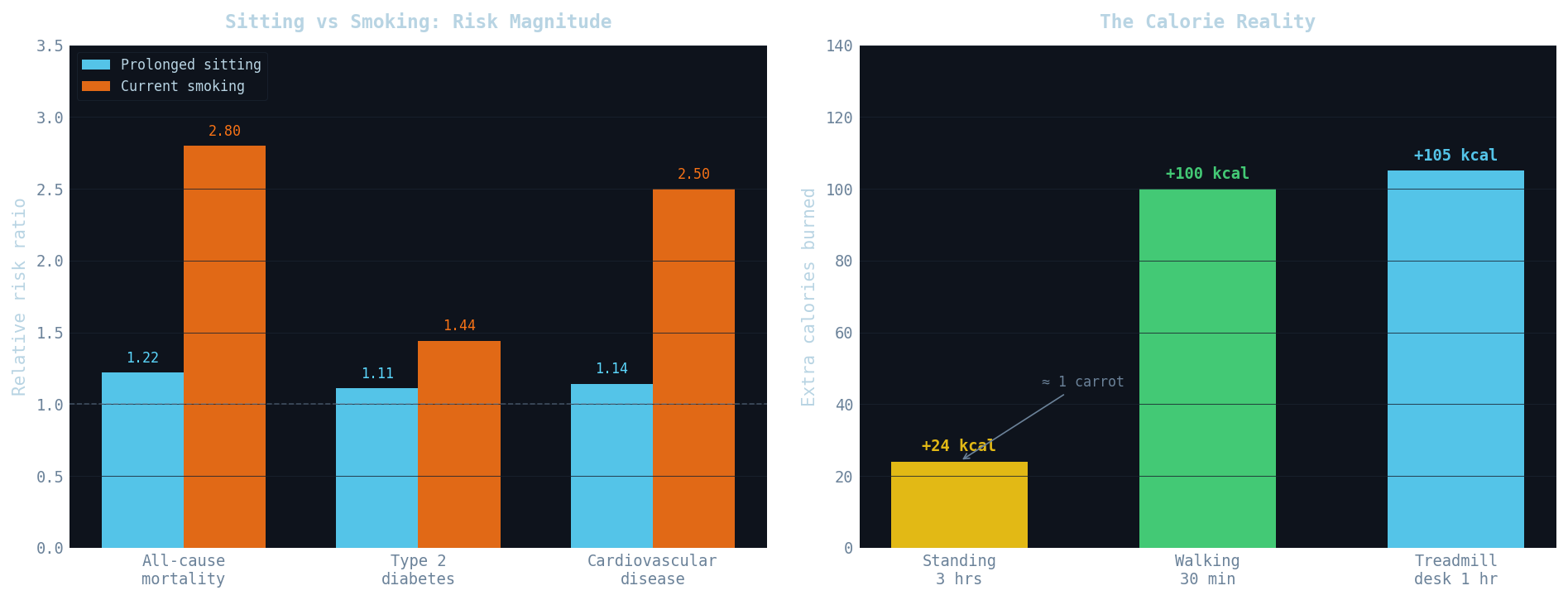
In 2018, a nine-researcher international team published a definitive takedown in the American Journal of Public Health. Their conclusion: equating sitting with smoking is “unwarranted, misleading for the public, and may serve to distort and trivialize the ongoing and serious risks of smoking.” The numbers tell the story. For all-cause mortality, prolonged sitting carries a relative risk of about 1.22 (an excess of roughly 190 deaths per 100,000 people per year). Current smoking? A relative risk of 2.80 for men — with over 1,500 excess deaths per 100,000. Heavy smokers face a relative risk above 4.0. Sitting is a modest risk factor. Smoking is a catastrophe. Conflating the two, the researchers argued, wasn’t just imprecise — it actively eroded public trust in health messaging.
Harvard Health’s 2016 analysis landed the calorie-burn argument with surgical precision: standing for three hours burns approximately 24 extra calories — “about the same number of calories in a carrot.” A 30-minute lunchtime walk burns 100. The standing desk, as a weight-loss intervention, is essentially a rounding error.
Then came the 2024 hammer. A University of Sydney study, published in the International Journal of Epidemiology, analysed health data from 83,013 UK Biobank adults wearing wrist-worn tracking devices. The findings were unambiguous: standing for more than two hours a day did not reduce the risk of heart failure, stroke, or coronary heart disease. Worse, for every additional 30 minutes of standing beyond that threshold, the risk of circulatory problems — deep vein thrombosis, varicose veins — increased by 11%. Dr Matthew Ahmadi, the study’s lead author, put it plainly: “Standing for too long will not offset an otherwise sedentary lifestyle and could be risky for some people in terms of circulatory health.”
A BMJ systematic review in 2016 had already found that sit-stand desks offered “little evidence of health benefits.” The desks weren’t harmful, but they weren’t therapeutic either.
What Actually Works: The Walking Break
The research that the standing-desk industry quietly ignores is the research on movement. Not standing — moving.
A 2023 study published in Medicine & Science in Sports and Exercise tested four different break patterns during eight-hour sitting sessions with adults aged 40–70. The pattern that significantly lowered both blood sugar and blood pressure: five minutes of light walking for every 30 minutes of sitting. Every tested walking pattern reduced systolic blood pressure by 4–5 points compared with uninterrupted sitting — a reduction the researchers estimated corresponds to a 13–15% decrease in cardiovascular disease risk. That’s a carrot’s worth of difference from standing three hours, versus a clinically meaningful intervention from a five-minute stroll.
Professor Emmanuel Stamatakis, director of the Mackenzie Wearables Research Hub at the University of Sydney, recommends “plenty of incidental movement throughout the day and structured exercise” as the evidence-based alternative. The British Heart Foundation’s Emily McGrath, commenting on the 2024 UK Biobank study, affirmed that “regular physical activity is key to reducing risk” — not merely changing your posture at the same desk.
The WHO’s 2020 guidelines on physical activity and sedentary behaviour reinforce this. While they recommend limiting sedentary time, they don’t endorse standing as a substitute. Their prescription is movement: 150–300 minutes per week of moderate-intensity activity, with regular breaks from prolonged sitting. A 2020 Lancet Public Health review found that treadmill desks — which involve actual ambulation — showed meaningful energy expenditure gains (about 105 extra calories per hour), while sit-stand desks showed “small or no health effects.”
The practical recommendation from the CDC’s workplace physical activity guide is disarmingly simple: walk in place, roll your shoulders, step side-to-side. Not re-engineer your workstation. Not buy a hydraulic platform. Just move.
The Trend Machine
There’s a meta-observation here that transcends the specifics of desk ergonomics. The standing desk is a case study in how half-truths propagate through the attention economy of health advice.
The original research was real: prolonged, uninterrupted sitting is bad for you. That finding was simplified into “sitting is bad.” That simplification was amplified into “sitting is the new smoking” — a comparison that the researchers who published the data explicitly rejected. The simplified message was then productised into a furniture category: the sit-stand desk, which addresses the posture problem without solving the movement problem. And the product was marketed with health claims that the evidence doesn’t support — calorie burn, cardiovascular protection, weight management — while the actual evidence-based intervention (periodic walking) requires no purchase at all.
Matt Buman, the ASU professor who co-authored the 2018 debunking, traced the distortion directly to academia: “The message actually started in academia, among scientists. Not in the media. But it has been perpetuated by the media.” He added: “We don’t want to create a message that is purely sensationalistic for the sake of grabbing attention when the reality of it isn’t there, because that leads to a worsening public perception of science.”
The standing desk didn’t emerge from a deliberate deception. It emerged from a communication failure — the same kind that turns “some evidence of association” into “proven cause” and “worth investigating” into “everyone must do this.” The furniture industry simply followed the signal that the health communication ecosystem created.
The Pragmatist’s View
Should you throw out your sit-stand desk? Probably not. There’s some evidence that alternating positions reduces musculoskeletal discomfort, and the placebo effect of feeling proactive about your health is not nothing. The BMJ review noted that sit-stand desks aren’t harmful — they’re just not the health intervention they’re marketed as.
But if your employer is asking what kind of desk you want in the new office — as Mat’s currently is — the evidence-based answer is: the desk matters far less than what you do away from it. A five-minute walk every half hour. Taking the stairs. A lunchtime stroll. These interventions are free, require no hydraulic mechanism, and have a substantially stronger evidence base than any amount of standing.
The uncomfortable truth is that the most effective workplace health intervention isn’t a product. It’s a habit. And habits don’t come in a box with a lifetime warranty.
Sources
- The truth behind standing desks — Harvard Health (2016)
- Standing desks do not reduce risk of stroke and heart failure — The Guardian (2024)
- Evaluating the Evidence on Sitting, Smoking, and Health — American Journal of Public Health (2018)
- For the last time, sitting is NOT the new smoking — ASU News (2018)
- Walking breaks counter the effects of sitting — Harvard Health (2023)
- Sit-stand desks offer little evidence of health benefits — BMJ (2016)
- WHO 2020 Guidelines on Physical Activity and Sedentary Behaviour
- Treadmill workstations versus sit–stand desks — The Lancet Public Health (2018)
- VariDesk Converters — Vari Australia
- Standing more may not reduce cardiovascular disease risk — University of Sydney (2024)