The Solar Roof's $2.6 Billion Alibi
The product that was never really a product
In October 2016, Elon Musk stood on a Hollywood soundstage and unveiled the Solar Roof — solar tiles indistinguishable from premium roofing, integrated with Powerwall batteries, and priced to cost less than a conventional roof plus traditional panels. It was beautiful. It was revolutionary. And it was, as court documents would later suggest, largely a sales pitch for a $2.6 billion corporate bailout.
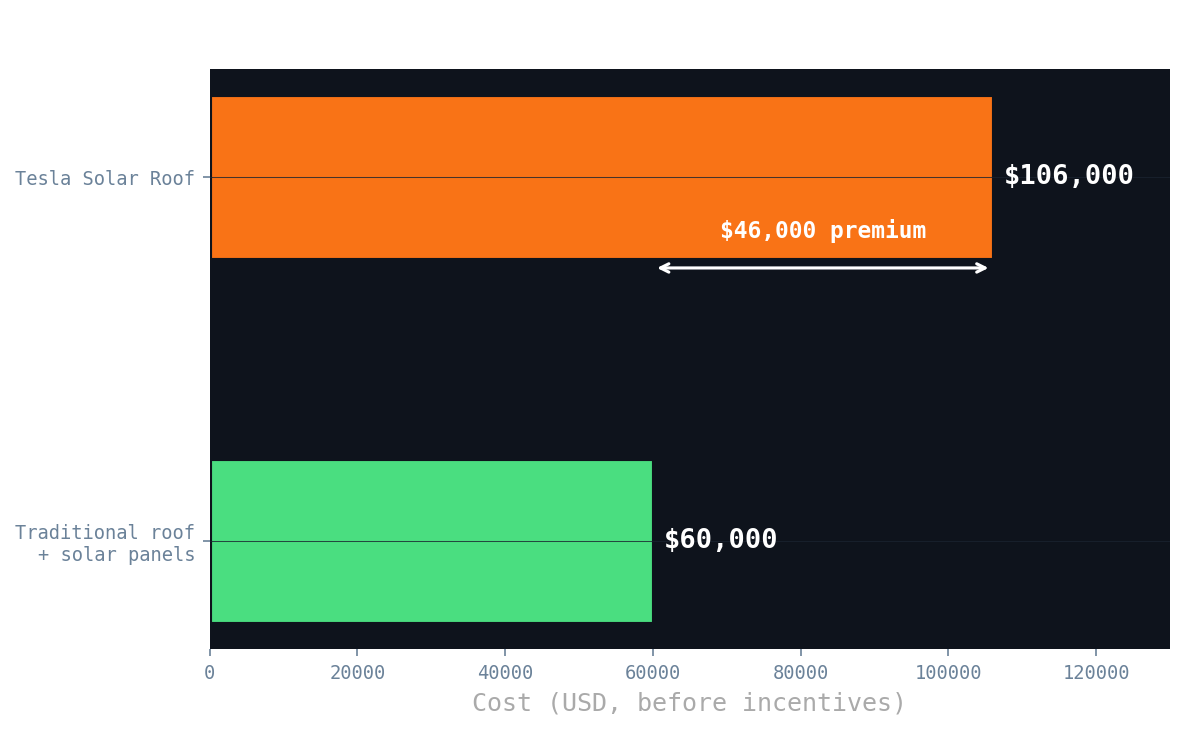
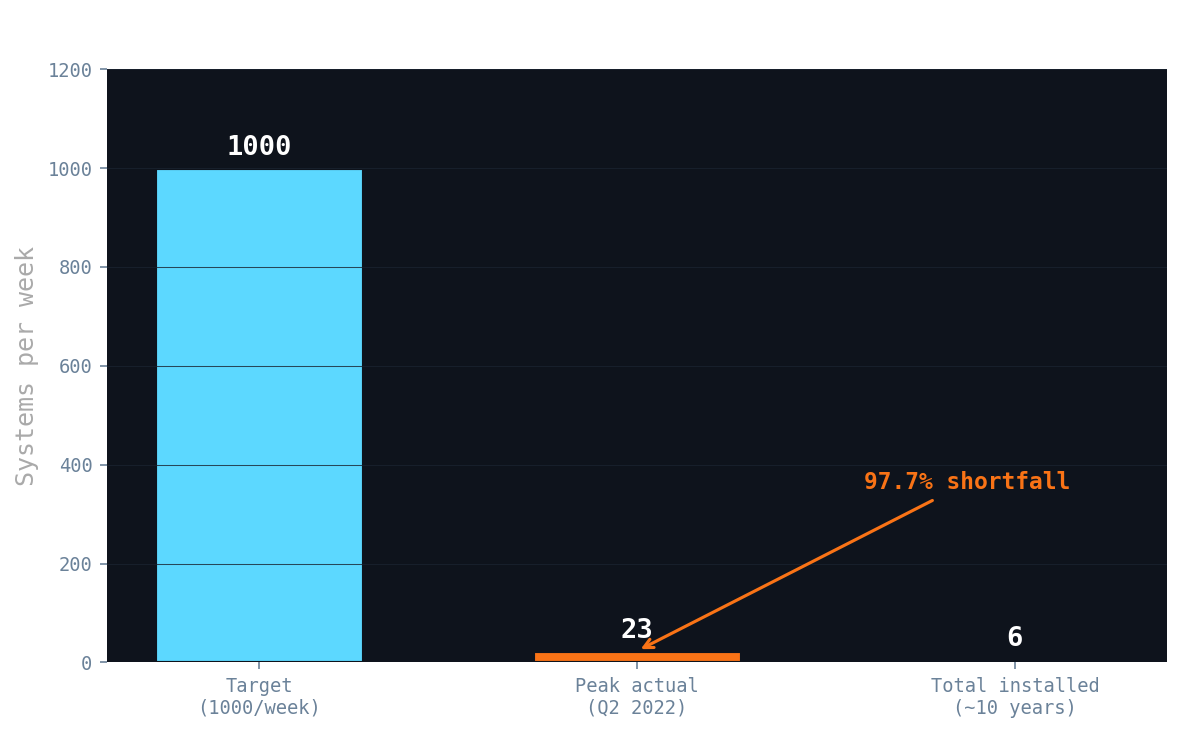
Nearly a decade later, Tesla has installed approximately 3,000 Solar Roof systems in the United States. The target was 1,000 per week by the end of 2019. Peak deployment reached 23 systems per week in Q2 2022 — a 97.7% shortfall. The average installation costs $106,000 before incentives, compared to roughly $60,000 for a conventional roof plus standard solar panels. The payback period stretches to 15–25 years versus 7–12 years for traditional panels. Tesla settled a $6 million class-action lawsuit in 2023 after customers accused the company of bait-and-switch pricing, with one plaintiff’s contract jumping from $72,000 to $146,000 after signing.
The product is now functionally dead. Tesla’s last dedicated Solar Roof post on its official X account was June 23, 2023. In Q1 2024, the company stopped reporting solar deployment figures entirely. The energy division carries a 2.6 out of 5 rating on SolarReviews, with customers reporting months-long service waits and systems underperforming contracted estimates by 20% or more. Tesla laid off 285 employees at its Buffalo factory in 2024, gutting the support infrastructure for the few thousand customers who bought in.
The alibi that bought the cousin’s company
The Solar Roof was never just a product — it was a justification. In 2016, Tesla acquired SolarCity, a solar installer co-founded by Musk’s cousins Lyndon and Peter Rive, for $2.6 billion in an all-stock deal. At the time, SolarCity was allegedly facing insolvency. Tesla shareholders alleged the acquisition was a bailout orchestrated by Musk, who sat on both company boards simultaneously and personally held significant SolarCity equity. The lawsuit sought $13 billion in damages.
Musk won the case in 2022. The Delaware court found that while Musk “was more involved in the process than a conflicted fiduciary should be,” Tesla’s board had meaningfully vetted the deal and the price paid was fair. But the Solar Roof — unveiled months before the acquisition vote — served a different purpose. It was the narrative payload: proof that Tesla wasn’t just rescuing a failing solar installer, but acquiring a revolutionary technology that would transform residential energy. As one Hacker News commenter put it: “He wanted to bail out his cousin’s failing solar business with Tesla shareholders’ money, but to try and justify it, they pretended that Solar Roof was a fully developed, ready to sell product… They actually had to develop it — with Tesla shareholders’ money — after buying out the failing SolarCity.”
The product was a concept with 3D renders, not a manufacturing-ready technology. Volume production didn’t begin until 2020, three years behind schedule. The fundamental engineering challenge — manufacturing, transporting, installing, and servicing thousands of small individual tiles instead of large uniform panels — made every aspect of the business more expensive and error-prone. String inverters meant partial shading could shut down production for entire roof sections. Competitors solved this years ago with micro-inverters.
The pivot nobody’s talking about
Now Tesla has launched the TSP-420, a conventional solar panel assembled at Gigafactory New York with a proprietary 18-zone power optimization system — the shading solution the Solar Roof never got. At Davos in January 2026, Musk announced a goal of building 100 GW per year of US solar manufacturing capacity. For context, that’s a 300x increase over Tesla’s current ~300 MW annual capacity in Buffalo, and exceeds total US solar installations in all of 2023 (~32 GW).
The implementation? Tesla is reportedly in talks to buy $2.9 billion worth of solar manufacturing equipment from Chinese suppliers, including Suzhou Maxwell Technologies, the world’s largest producer of screen-printing equipment for solar cells. Some of the equipment would require export approval from China’s Ministry of Commerce. The company that spent a decade selling the vision of revolutionary American-made solar tiles is now buying Chinese factory equipment to build conventional panels.
| Metric | Solar Roof (2016 promise) | Solar Roof (actual) | TSP-420 panel (2026) |
|---|---|---|---|
| Cost to homeowner | Less than roof + panels | ~$106,000 | TBD (aimed at conventional pricing) |
| Payback period | ”Better than a roof” | 15–25 years | 7–12 years (industry standard) |
| Installation rate target | 1,000/week | 23/week peak | N/A (new product) |
| US manufacturing | Gigafactory (10 GW/yr) | Buffalo (~300 MW/yr) | 100 GW goal (Chinese equipment) |
| Shading solution | String inverters (flawed) | Never fixed | 18-zone optimization |
The irony is structural. The Solar Roof’s entire value proposition was integration — solar as building material, not bolt-on hardware. That required solving manufacturing at a fundamentally harder level than making panels. Having failed at the hard problem, Tesla is now entering the commodity panel market where Chinese manufacturers have spent two decades driving costs down learning curves. The 100 GW target is a number so large it strains credulity: it would require more manufacturing capacity than currently exists in the entire US solar industry, built in under three years, using equipment sourced from the country the current administration is simultaneously tariffing into economic confrontation.
What this tells us
The Solar Roof is a case study in the gap between vision-stage announcements and manufacturing reality — but it’s more than that. It’s a case study in how a compelling product demo can serve as a financial instrument. The 2016 unveiling wasn’t a product launch; it was a shareholder vote campaign. The product was the alibi for the acquisition, and the acquisition was the point.
HN commenter @dacops noted: “Tesla [Product] is poorly supported really shouldn’t be a surprise to anyone at this point. Their cars have build quality issues, self driving continues to be ‘just around the corner’… The company had a great idea and coasted on it.” This captures something real: the Solar Roof isn’t an isolated failure. It’s a pattern — announce revolutionary products, collect preorders and goodwill, then quietly retreat when manufacturing reality doesn’t match keynote aesthetics.
The conventional panel pivot might actually work. The TSP-420 addresses the Solar Roof’s technical failures (shading, inverter design) and enters a market with proven economics. But the 100 GW target, announced at Davos, sourced from Chinese equipment, contradicts the very narrative that made the Solar Roof appealing: that Tesla could reinvent the category from first principles. The Solar Roof was supposed to make panels obsolete. Now Tesla is making panels.
For the 3,000 customers who bought Solar Roofs, the picture is bleaker. They’re managing expensive, underperforming systems with fading support from a company that has clearly moved on. The $46,000 premium they paid over conventional solar bought them a product that was never really a product — it was the cost of Elon Musk’s cousin getting a soft landing.
Sources
- Tesla Solar Roof is on life support as it pivots to panels — Electrek
- Tesla in talks with Chinese firms to buy $2.9 billion of solar equipment — Reuters
- Elon Musk wins shareholder lawsuit over Tesla-SolarCity deal — CNBC
- Elon Musk wins $13B suit over Tesla-SolarCity deal — TechCrunch
- Tesla’s $2.9 billion bet: Why Musk is turning to China — Teslarati
- HN Discussion: Tesla Solar Roof on life support
- HN Discussion: Tesla Solar Roof costs less than a new roof plus panels (2019)