Seven Letters and a Bitcoin: How Iran Is Trying to Monetise the Strait It Didn't Close
The strait that closed itself
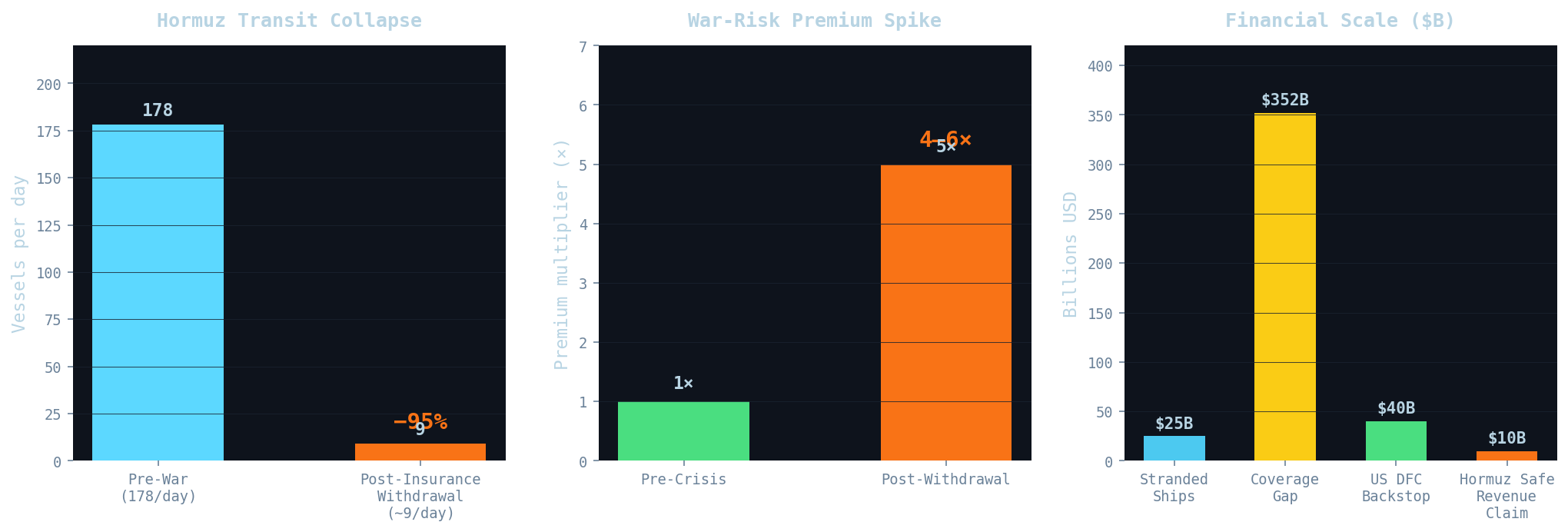
The Strait of Hormuz did not close because of mines, missiles, or warships. It closed because of paperwork. On March 5, 2026, seven P&I (Protection and Indemnity) clubs — the mutual insurance associations that underwrite the majority of global maritime liability — issued war-risk cancellation notices for the Persian Gulf. Within days, Lloyd’s Market Association designated the entire Gulf as a high-risk zone. Pre-war, roughly 178 vessels transited the strait daily. By mid-March, traffic had collapsed by approximately 95%. Not a single mine needed to detonate. The insurance market simply repriced reality out of reach.
The numbers are staggering. The Lloyd’s Market Association estimated the value of stranded ships alone — excluding cargo — at no less than $25 billion. War-risk premiums spiked four to six times their pre-crisis levels. Loss-of-hire exposure for 1,000 trapped vessels at $200,000 per day average reached $200 million daily. The total insurance coverage needed (hull, liability, pollution) for the ~330 vessels still operating in the Gulf was estimated at $352 billion — coverage that private markets were no longer providing. This wasn’t a military blockade in the traditional sense. It was an actuarial one.
Hormuz Safe: a crypto toll booth on a ghost highway
Into this vacuum, Iran has now launched “Hormuz Safe” — a state-backed, Bitcoin-settled maritime insurance platform announced by the IRGC-affiliated Fars News Agency on May 16, 2026. Backed by Iran’s Ministry of Economy and Finance, the platform promises “fast, cryptographically verifiable digital insurance” for Iranian shipping companies and cargo owners transiting the Persian Gulf and surrounding waterways. Iranian state media projects it could generate upwards of $10 billion in annual revenue. The platform’s website, hormuzsafe.ir, currently displays a “Coming Soon” landing page.
The strategic logic is transparent. Iran controls one side of a chokepoint through which roughly a fifth of the world’s daily oil supply once passed. Western insurance markets have already demonstrated that controlling insurance access is equivalent to controlling passage itself. Hormuz Safe is Iran’s attempt to flip that leverage: if insurance is the mechanism that closed the strait, then controlling insurance is the mechanism that reopens it — on Tehran’s terms, settled in a currency that doesn’t require SWIFT, dollar clearing, or Western regulatory permission.
Bitcoin, in this framing, isn’t a gimmick. It’s a deliberate circumvention of the dollar-denominated financial infrastructure from which Iran is largely locked out. Blockchain settlement means no correspondent banks, no OFAC-compliant intermediaries, no London arbitration. A signed digital receipt upon blockchain confirmation replaces the centuries-old system of P&I club letters of undertaking. It’s insurance-as-sovereignty, wrapped in cryptographic proof of concept.
The $10 billion fantasy
There’s just one problem: the entire premise is built on sand.
The HN commenter @skissane identified the core contradiction within hours of the announcement: “The problem with bitcoin for this — it is very traceable. The US government can declare paying Iran Hormuz ‘insurance’ to be a sanctions violation (they probably already have). Any Western company — even non-US — paying this ‘insurance’ will be faced with the full ire of the US government.” This isn’t theoretical. The U.S. Treasury’s Office of Foreign Assets Control (OFAC) has extensive precedent for secondary sanctions enforcement against entities transacting with Iranian state-backed bodies. A Western shipowner paying Hormuz Safe premiums in Bitcoin would be leaving a permanent, immutable, publicly auditable trail of sanctions violations on the blockchain. The pseudonymity that crypto offers retail users dissolves entirely at the institutional level, where vessel identities, cargo manifests, and port calls are all matters of public record.
For non-Western companies — Chinese, Russian, or Indian operators who might be less sensitive to OFAC exposure — the Bitcoin angle is even more puzzling. As @skissane noted, “I’m not sure what the advantage of bitcoin is in that case, as opposed to simply paying in yuan or rubles.” A bilateral currency arrangement would be simpler, cheaper, and wouldn’t create a blockchain record that any intelligence agency could monitor in real time. The choice of Bitcoin seems designed more for domestic propaganda value — positioning Iran as technologically sophisticated — than for actual financial utility.
The $10 billion revenue projection is fantasy. The platform has no public technical specifications, no disclosed underwriting capacity, no actuarial basis for premium calculation, and no mechanism for claims adjudication. The website is a landing page. Major ports like Rotterdam and Singapore have given no indication they would recognise Hormuz Safe certificates. Without port recognition, no cargo insurer or ship charterer would accept a Hormuz Safe policy as valid coverage. The platform would need to demonstrate solvency, reserves, and claims-paying ability to be taken seriously by any counterparty that matters — and there is zero evidence of any of that.
The real story: governments as insurers of last resort
The more significant development isn’t Iran’s crypto gambit — it’s what the US government has already done. In response to the insurance market collapse, the Trump administration directed the U.S. International Development Finance Corporation (DFC) to provide political risk insurance for Hormuz transit. The DFC partnered with Chubb and other leading insurers to create a reinsurance facility offering up to $40 billion in coverage on a revolving basis, spanning hull, cargo, and liability risks. The World Economic Forum characterised this as governments “not just stabilising markets, but actively underwriting them” — a fundamental shift in the relationship between sovereign power and commercial risk transfer.
This is the real precedent being set. When private insurance markets encounter risks they deem uninsurable — too correlated, too geopolitically charged, too large — sovereign balance sheets step in. The WEF analysis estimates that using the financial system for geopolitical aims could cost the global economy $0.6 to $5.7 trillion in lost growth. The Hormuz crisis has demonstrated that insurance markets are now a direct instrument of geopolitical power: the seven P&I club letters achieved what a naval blockade might have, at a fraction of the cost and with perfect deniability. Iran’s Hormuz Safe, for all its bluster, is an attempt to reclaim that instrument — but it’s playing a game whose rules were written in London and Washington, with a technology (Bitcoin) that paradoxically makes its transactions more visible, not less.
What this means
The Hormuz insurance crisis is a preview of 21st-century economic warfare. The critical infrastructure isn’t pipelines or ports — it’s the financial plumbing that makes global trade possible. Insurance, credit ratings, correspondent banking relationships, clearing houses: these are the chokepoints that matter when nations fight. The seven P&I clubs that closed the strait did so with letters, not torpedoes. The US DFC that partially reopened it did so with a $40 billion backstop, not aircraft carriers.
Iran’s Hormuz Safe will almost certainly fail as a commercial venture. Its Bitcoin settlement mechanism is a solution in search of a problem, its revenue projections are untethered from reality, and its customer base is constrained by the same sanctions architecture it’s trying to circumvent. But as a signal, it’s revealing. It tells us that states understand insurance is power, that crypto is being tested as a sanctions-evasion tool at the sovereign level (however clumsily), and that the post-war order’s financial infrastructure is now explicitly a theatre of conflict.
The strait didn’t close because Iran threatened to sink ships. It closed because seven actuaries in London decided the risk was unacceptable. That’s a more terrifying sentence than any missile threat.
Sources
- Iran Starts Bitcoin-Backed Shipping Insurance for Hormuz Strait — Bloomberg
- Iran launches Hormuz Safe, a Bitcoin-backed insurance scheme — Crypto Briefing
- Bitcoin Insurance for Persian Gulf Cargo: Iran Launches Hormuz Safe — Bitcoin.com
- Iran may be turning the Strait of Hormuz into a bitcoin insurance market — CoinDesk
- What stopping war-risk insurance in the Strait of Hormuz tells us — World Economic Forum
- Dire Straits: Commercial Policyholders Navigating Troubled Waters — Jones Day
- Strait of Hormuz report — Howden Re
- Naphtha Crisis in Japan 2026 — Plastic Pallet Co.
- HN Discussion: Iran starts Bitcoin-backed ship insurance for Hormuz strait — 235 points, 356 comments
- HN Discussion: Hormuz Minesweeper — 662 points, 452 comments