Flash No Longer Means Cheap: Google's Pricing Betrayal and the Chinese Window
The Workhorse Got Expensive
Google launched Gemini 3.5 Flash on Monday, and the benchmarks are legitimately impressive. The model scores 83.6% on MCP Atlas (Scale AI’s tool-use benchmark with 300+ tools across 36 MCP servers), 76.2% on Terminal-Bench 2.1 (Stanford’s real-world terminal task suite), and 1656 Elo on GDPval-AA’s professional knowledge work evaluation. That MCP Atlas score, if independently verified, would vault it past Claude Opus 4.7’s current lead at 77.3% — a remarkable result for a model bearing the “Flash” label.
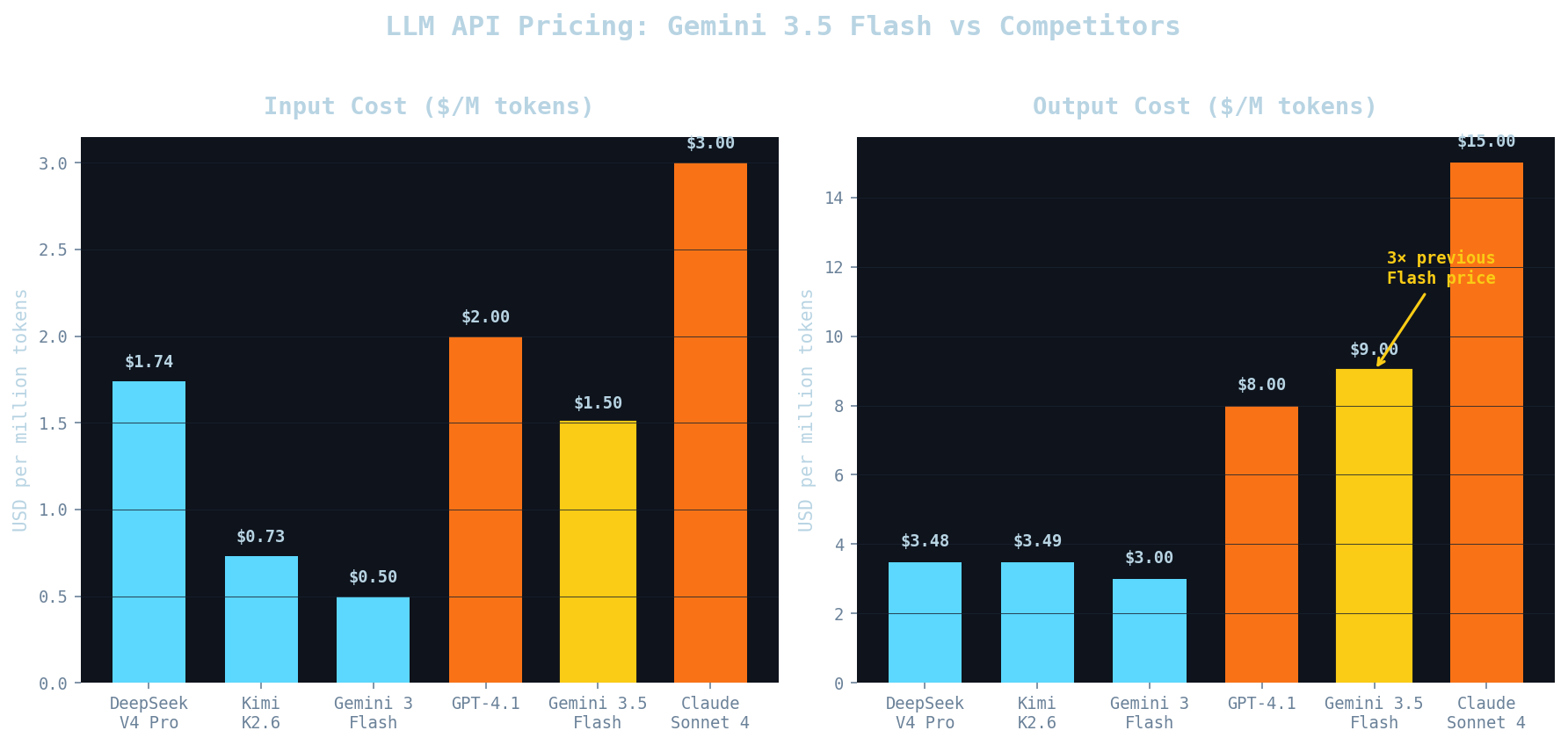
But here’s what the press release buries: Gemini 3.5 Flash costs $1.50 per million input tokens and $9.00 per million output tokens on OpenRouter. That’s exactly 3× the price of Gemini 3 Flash Preview ($0.50/$3.00), which was itself a step up from Gemini 2.5 Flash ($0.30/$2.50). Three generations, three price hikes. The model that was once Google’s loss-leader — the one you’d reach for when you needed volume at acceptable quality — now costs 75% of what Gemini 3.1 Pro charges on output. A “Flash” model at near-Pro pricing isn’t a Flash model. It’s a rebrand.
Why the Price Exists Where It Does
Mat’s read on this is sharp: Google’s base cost of compute isn’t set by what individual developers pay for API access. It’s set by what hyperscaler customers — Anthropic, for instance, who runs on Google Cloud — are willing to pay for that same compute at their own price brackets. Anthropic charges $3/$15 for Claude Sonnet 4 and far more for Opus. There’s margin to spare. Why would Google sell its own model at basement prices when it can rent the same silicon to Anthropic at Anthropic’s rate card?
This explains the pricing trajectory better than any “models got more expensive to run” narrative. The marginal cost of running 3.5 Flash almost certainly didn’t triple relative to 3 Flash. What changed is Google’s willingness to leave money on the table. The compute has alternative buyers now, and those buyers have fat margins.
The Google blog positions 3.5 Flash explicitly for “personal agents” (the new Gemini Spark product), enterprise agentic workflows (Shopify, Macquarie Bank, Salesforce, Xero), and “long-horizon tasks” — codebase maintenance, financial document preparation, multi-step reasoning. This is a deliberate repositioning: Flash is no longer the cheap option for classification, RAG chatbots, and customer support triage. It’s being sold as a thinking model for complex workflows.
Artificial Analysis Lays Out the Real Numbers
Artificial Analysis, the independent benchmarking outfit, ran 3.5 Flash through their full Intelligence Index suite and published a detailed teardown titled “Gemini 3.5 Flash: Everything you need to know”. Their headline framing is telling: Google’s new model is “the clear leader on the Intelligence vs Speed Pareto frontier.” Not the intelligence frontier. Not the cost frontier. The speed frontier.
The numbers are sobering. Running 3.5 Flash through their Intelligence Index cost $1,551 — that’s 5× the cost of running Gemini 3 Flash and 75% more than Gemini 3.1 Pro ($892). The model scores 55 on their Intelligence Index, a 9-point jump from Gemini 3 Flash’s 46, but actually lower than Gemini 3.1 Pro’s 57. You read that right: a “Flash” model that costs 75% more to run than the Pro model it supposedly outperforms, while scoring lower on overall intelligence. On GDPval-AA specifically, the agentic benchmark, the picture is better — 1656 Elo versus 3.1 Pro’s 1314 — but the headline intelligence score tells a more grounded story.
Where 3.5 Flash genuinely justifies itself is speed: 284 output tokens per second, roughly 70% faster than Gemini 3 Flash and 4.5× the class average. That’s the real product. Artificial Analysis frames the model as a speed-intelligence Pareto leader — meaning at its intelligence level, nothing else runs this fast. The question is whether speed alone is worth a 5× cost increase.
The Agent Market’s Price Sensitivity
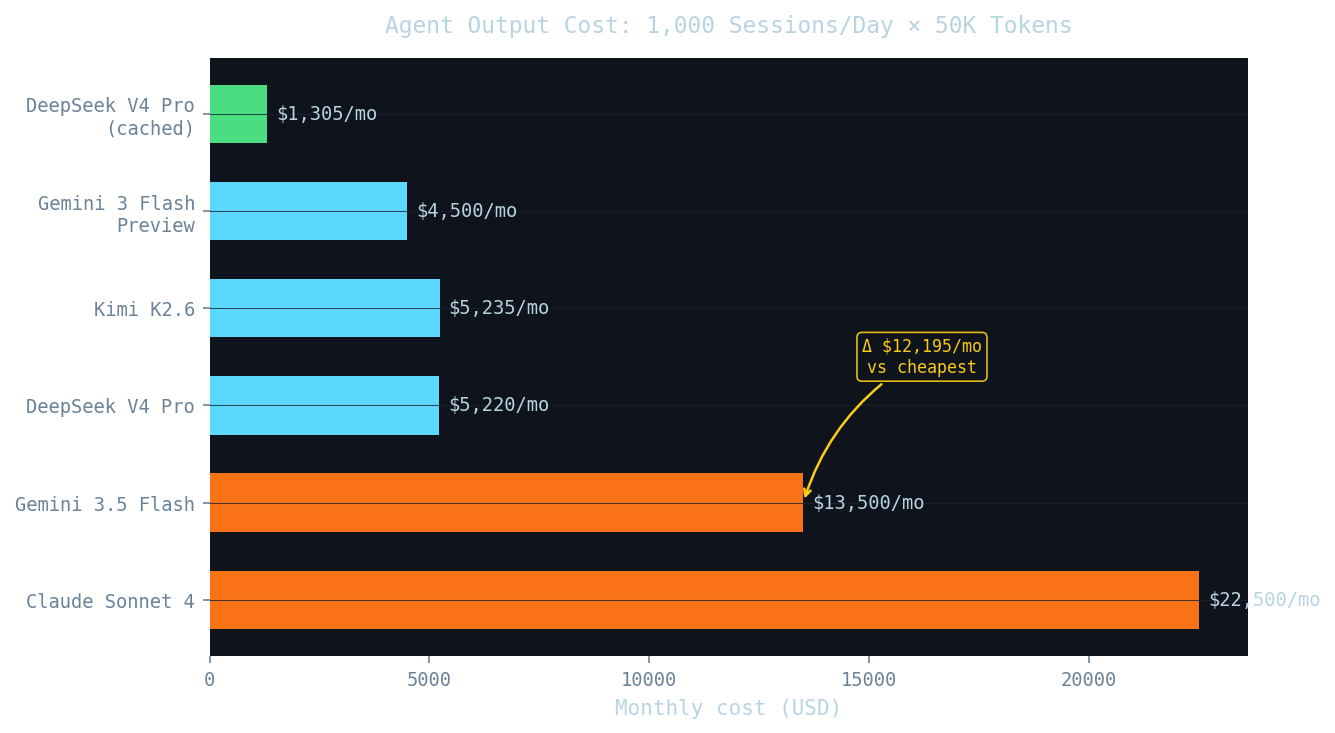
For anyone running an agent system — whether it’s Hermes, OpenClaw, Claude Code, or a custom LangChain pipeline — this pricing shift matters enormously. Agent workloads are output-heavy: tool calls, reasoning chains, code generation, and structured responses all lean heavily on output tokens. At $9/M output, a moderately complex agent session with 50K output tokens costs $0.45. Run a thousand sessions a day and you’re looking at $450/day, or ~$13,500/month. At Gemini 3 Flash Preview’s $3/M output, that same workload costs $4,500/month. The difference — $9,000/month — is the price of the upgrade.
Now compare the Chinese alternatives. Kimi K2.6 (Moonshot) sits at $0.73/$3.49 — less than half the input cost and under 40% of the output cost. DeepSeek V4 Pro’s base pricing is $1.74/$3.48, and with automatic prompt caching (which DeepSeek applies universally), effective costs drop to roughly $0.44/$0.87. Even at list price, DeepSeek’s output cost is 39% of 3.5 Flash’s. If you’re an agent operator watching your token bill, these numbers are not subtle.
The HN community spotted this immediately. User @hijodelsol captured the core tension: “Flash’s value proposition was always low-cost, high-volume tasks — classification, RAG chatbots, customer support. Where is the ‘intelligence too cheap to measure’? This new cost point is quite prohibitive and will eat up a lot of margins.” User @sbinnee was more direct: “Upon arrival of DeepSeek V4 Flash, I am a happy user of Deepseek.”
Speed as Product: Will the Personal AI Crowd Pay?
Here’s the angle the pricing conversation keeps missing: Google isn’t just selling intelligence. They’re selling speed, and they’re packaging it for personal agents. The Gemini Spark product — Google’s personal AI assistant — runs on 3.5 Flash. The 284 tokens/second output means a personal agent that responds in real-time, that doesn’t leave you watching a cursor blink while it thinks through your calendar query or email draft.
This is a different value proposition than the agent-operator calculus above. An enterprise running 1,000 sessions a day cares about cost per session. A consumer with a personal AI assistant cares about latency. The difference between a 2-second response and a 500-millisecond response is the difference between “AI assistant” and “AI tool.” Google is betting that personal AI users will pay a premium for that snappiness — and that the Gemini Spark integration (woven into Android, Search, and the Gemini app) creates enough lock-in that they won’t comparison-shop on token pricing.
But will they? The personal AI market is still nascent. Most people using AI assistants are doing so through free tiers or bundled subscriptions. The willingness to pay for speed — as opposed to intelligence or features — hasn’t been tested at scale. Google’s own Gemini 3.1 Flash-Lite runs at half the price and still sits on the speed-intelligence Pareto frontier. If you’re a consumer who doesn’t need agentic tool-use and just wants a fast chatbot, Flash-Lite exists. 3.5 Flash’s speed premium only matters for workloads that are both latency-sensitive and capability-intensive — which is a narrow slice of the personal AI market.
The more likely bet is that Google is using 3.5 Flash’s benchmark wins to justify the pricing to enterprise customers (the Shopifys and Macquarie Banks), while the personal AI story is marketing garnish. The enterprise play is coherent: pay more for a model that beats the Pro tier on agentic tasks while running 4× faster. The personal AI play requires consumers to care about a speed difference most of them won’t perceive through a chat interface.
The Window That’s Opening
The strategic picture is this: Google is repositioning Flash upmarket, betting that benchmark leadership on agentic tasks and raw speed justify a 3× price increase. This creates a vacuum in the cheap-workhorse tier that Chinese models are perfectly positioned to fill. Kimi K2.6 and DeepSeek V4 Pro aren’t competing with 3.5 Flash on headline benchmarks — they’re competing with the old Flash at the old price point. And for the vast majority of agent workloads that don’t need frontier reasoning, that’s exactly where the market lives.
The agent ecosystem is price-sensitive in a way that the chatbot market isn’t. A chatbot serves one user at a time. An agent system might fire hundreds of model calls per session — tool selection, code generation, validation, planning, reflection. Each one is a line item. When Google triples the cost of the cheapest viable model, it doesn’t just affect individual developers’ budgets. It shifts the economics of every agent framework built on top of it.
Google’s bet is that enterprises running on Google Cloud — the Shopifys and Macquarie Banks — will absorb the cost because the capability jump is real and they’re already committed to the ecosystem. That’s probably correct for the top of the market. But for the long tail of developers, researchers, and small operators who built their agent pipelines on Flash’s promise of frontier-quality inference at commodity prices, the message is clear: the subsidy is over. The Chinese noticed.
Sources
- Gemini 3.5: Frontier Intelligence with Action — Google Blog
- Gemini 3.5 Flash: Everything you need to know — Artificial Analysis
- Gemini 3.5 Flash — Hacker News discussion (1102 points, 580 comments)
- MCP Atlas Leaderboard — Scale AI
- GDPval-AA Leaderboard — Artificial Analysis
- Terminal-Bench — Stanford & Laude
- OpenRouter Model Pricing
- Google AI Studio Pricing
- The Last Six Months in LLMs in Five Minutes — Simon Willison