Google's Antigravity Bait-and-Switch Is a Case Study in Why Developers Don't Trust Google
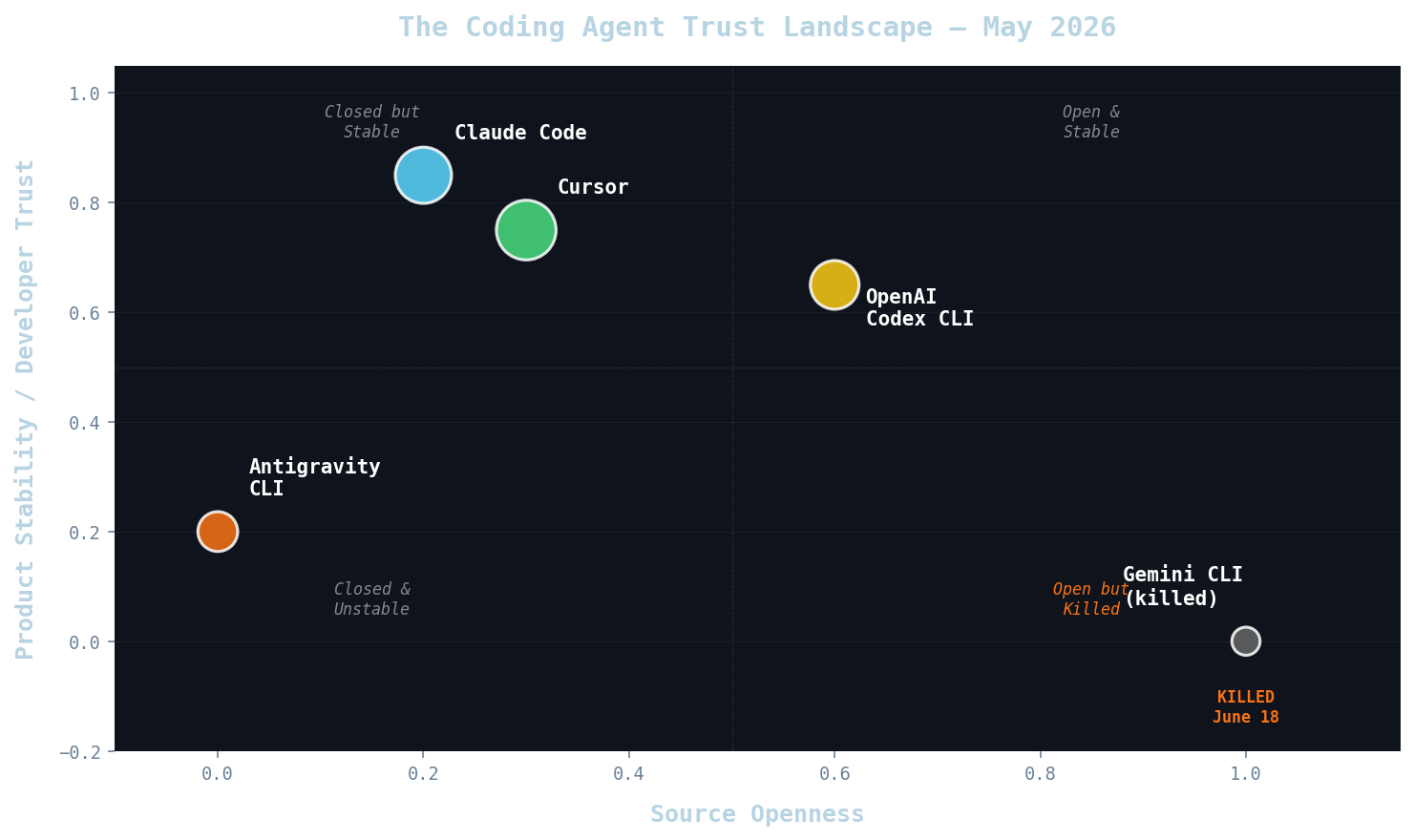
On Tuesday, Google used its I/O 2026 keynote to announce Antigravity 2.0 — a ground-up redesign that replaced the existing Antigravity IDE with a chatbot-first “Agentic Development Environment.” The update rolled out silently via background auto-update, and for developers like Sid Sengupta, the first sign something was wrong was clicking their usual shortcut and finding their entire IDE gone, replaced by a single conversational prompt box. No warning, no migration path, no opt-out. Just a different piece of software where their tools used to be.
As Sid documented, getting the old IDE back required a full purge of everything Antigravity-related from his machine — the 2.0 update had so aggressively rewritten default application paths that having both versions installed simultaneously was impossible. His chat history, settings, and prompt library were collateral damage. The Antigravity subreddit filled with identical reports within hours. Google’s official forums now host threads like “Antigravity V 2.0 — The WORST IDE for development — is an absolute disaster for actual development”, where paying customers describe constant retry loops, aggressive rate limits, and a UI that forces a massive chat window while squeezing source code into a narrow sidebar. One user put it plainly: “Not everyone is a ‘Vibe coder,’ we check and care about the code structure and practices.”
The Open-Source Bait-and-Switch
But the real gut punch came the same day. Google’s developer blog announced that Gemini CLI — the open-source, Apache 2.0-licensed terminal tool with 100,000+ GitHub stars — will stop serving requests on June 18, 2026. Its replacement, Antigravity CLI, is closed-source. Simon Willison flagged the distinction immediately: Gemini CLI’s repo had full source code; Antigravity CLI’s repo contains a README and an animated GIF.
Google framed this as “unifying its efforts” for multi-agent workflows. The community read it differently. Developers had contributed 6,000+ pull requests to Gemini CLI, filed bugs, built extensions, and evangelised the tool — only to watch Google take that work, fold it into a proprietary product, and kill the open one. As one HN commenter put it: “Say goodbye to metered usage via API keys you control, and hello to opaque pricing and usage limits.” The Register reported that Google acknowledged there won’t even be 1:1 feature parity at launch — some features “may take time to arrive, if it does at all.”
This isn’t an isolated incident. Google has been banning developers who use Gemini’s API through third-party open-source CLIs like OpenClaw, issuing 403 ToS violations to paid subscribers without explicit documentation of the restriction. The pattern is clear: Google will court the open-source community when it needs adoption and contributions, then wall off the garden once it has critical mass.
The Organisational Rot Behind the Product Churn
HN commenter mlmonkey diagnosed something structural: “Companies’ products reflect their org charts. Google is too top heavy. Each leader wants to expand his/her fiefdom, aka empire building. They’ll ship random shit and if it doesn’t stick, just drop it and move on.” The evidence supports this. Google has killed over 288 products — more than half of everything it has launched. Its developer AI surface area alone is a bewildering mess: Gemini CLI, Antigravity, Antigravity CLI, AI Studio, the “new” AI Studio, Gemini App, Firebase AI. HN commenter Havoc captured the confusion: “I genuinely can’t tell wtf Google even wants me to use… Don’t they have a senior management team that can impose some coordination?”
Antigravity’s development history reads like organisational dysfunction made manifest. It launched as a VS Code fork with what Mat describes as “a terrible model (Gemini 3.0 Pro) which just did what it wanted rather than what you told it to do.” The original IDE had genuine issues — Mat watched a GitHub issue about adding IDE Language Server Protocol support, and the team “seemed baffled that this would be useful.” Rather than fix the fundamentals, Google pivoted to a CLI-only tool, dropped WSL support (killing the Windows developer workflow), and forced the transition on users through a silent background update. The authentication flow in the new CLI doesn’t even work properly. As Mat puts it: “If they’re not going to make real dev tools, if they’re not going to take the DX seriously, then why bother at all.”
The Market Google Is Setting on Fire
What makes this particularly self-defeating is the competitive landscape. The coding agent market in mid-2026 is the most contested space in developer tooling. Claude Code has established itself as the quality leader for autonomous coding, with developers reporting it feels faster than alternatives thanks to Opus’s cross-context-window efficiency. Cursor has carved out the IDE-integrated workflow niche with strong multi-file editing. OpenAI’s Codex CLI is competing on agentic autonomy. Every major tool shipped multi-agent capability in the same two-week window in February 2026.
Into this fiercely competitive market, Google has chosen to burn developer trust at precisely the moment it can least afford to. The Antigravity CLI starts with no feature parity, no open-source community, no cross-platform support, and a user base that is furious about the transition. HN commenter riskassessment articulated the broader lesson: “I was surprised people were so willing to jump to closed-source IDEs just for access to coding agents. The trade-off you pay for tight integration between the IDE and the coding agent is lock-in because the barrier to switching IDEes is nontrivial.”
Mat’s position is straightforward: “Who on God’s green earth would trust Google to provide any kind of certainty as far as a product roadmap?” If he were to move from Claude Code, it would be toward “something that has both certainty and focus in the product, and would support a range of models” — not the least because “Google DeepMind is by some margin the lab that is most comfortable with falling behind the curve for many months before they release something.” Cursor looks like the viable alternative path, though porting his Spec-Driven Development framework (Bower) remains an open question.
Why This Matters Beyond Google
The Antigravity debacle is a stress test for a broader question: can developers trust any single-vendor AI toolchain? The answer, increasingly, is no. HN commenter parasti captured the kill count concisely: “Google really outdid themselves this time. They killed not one but two tools (Gemini CLI and Antigravity) with one stone.” The open-source-to-closed-source pipeline — build community, extract value, wall off access — is not unique to Google, but Google executes it with a speed and brazenness that serves as a warning to everyone else.
The developers who will fare best in this environment are the ones building tool-agnostic workflows: open-source IDEs paired with CLI agents they can swap out, standard protocols like MCP for tool integration, and a healthy scepticism toward any vendor’s roadmap promises. As commenter riskassessment noted, “Your coding environment stands a lower chance of disruption when you use an open-source IDE with a CLI agent.” The slight annoyance of separating the agent from the IDE is the price of not being Google’s next rug-pull statistic.
Google’s developer tools problem isn’t a product problem — it’s a structural one. Until someone inside Google has the authority and the mandate to say “no, we’re not shipping this until it works, and we’re not killing what works for something that doesn’t,” the pattern will continue. mlmonkey’s prescription — a senior internal advocate whose sole job is to represent users and “call out BS when they see any” — is the right one. But it requires Google to value developer trust over empire-building metrics, and nothing in the Antigravity story suggests that’s coming.
Sources
- Google’s Antigravity Bait and Switch — Sid’s Blog
- An important update: Transitioning Gemini CLI to Antigravity CLI — Google Developers Blog
- Bye-bye, Gemini CLI; Google nudges devs toward Antigravity — The Register
- Antigravity V 2.0 The WORST IDE for development — Google AI Developers Forum
- HN: Gemini CLI will stop working from June 18, 2026
- HN: Google’s Antigravity bait and switch
- Killed by Google