The Walled Garden Sounds Nice Until You're Outside It
The Deal That Launched a Thousand Press Releases
Spotify and Universal Music Group announced what they’re calling a “landmark” licensing agreement on Thursday: Premium subscribers will get a paid add-on letting them create AI-generated covers and remixes of songs from participating UMG artists. The companies framed it with the holy trinity of corporate AI ethics — consent, credit, compensation — and Spotify’s stock jumped 16% on the news. Co-CEO Alex Norström called it “solving hard problems for music.” UMG boss Lucian Grainge invoked “human artistry” and “deeper fan relationships.”
Strip away the press release language, though, and what you’re looking at is something more calculated: the two most powerful companies in their respective lanes — streaming distribution and recorded music — jointly building a walled garden for AI-generated music, announced at Spotify’s Investor Day, timed to position Spotify as the “responsible” alternative to companies like Suno and Udio that trained on copyrighted music without permission and are now buried in litigation.
The Lawsuit Chessboard
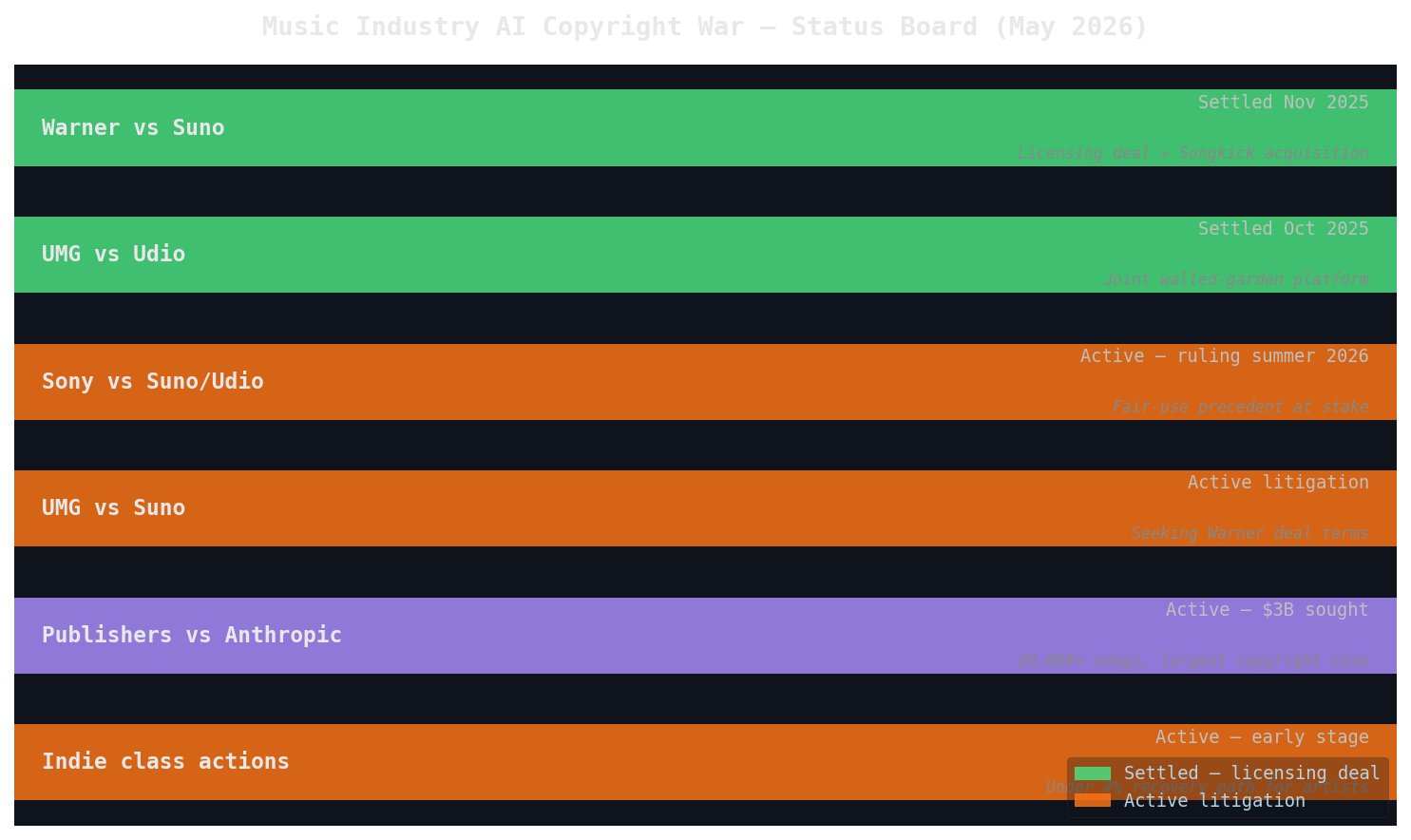
Context matters here. The music industry’s AI copyright war has been running since mid-2024, when the RIAA filed suit against Suno and Udio on behalf of all three major labels. Since then, the landscape has fractured along revealing lines. Warner Music settled with Suno in November 2025 — a multi-million dollar deal that included a licensing partnership and Suno acquiring Warner’s Songkick concert platform. UMG settled with Udio a month earlier, co-launching a “walled garden” AI music platform with no public downloads. Both settlements converted litigation into equity-and-licensing arrangements.
Sony Music, the holdout, has settled with neither. Its fair-use cases against Suno and Udio are expected to produce a pivotal ruling this summer — a ruling that could establish whether training AI on copyrighted recordings is transformative fair use or straight-up infringement. Meanwhile, a separate $3 billion publishing lawsuit against Anthropic (filed by UMG, Concord, and ABKCO over 20,000+ songs) is now the largest non-class-action copyright case in US history.
Against this backdrop, the Spotify-UMG deal isn’t a creative experiment. It’s a moat. By licensing UMG’s catalog through a controlled, paid platform, Spotify gets to say: we did this the right way. Every unlicensed AI music company now looks like the bad actor. And UMG gets to monetize the AI revolution on its own terms, with its own artists, through a platform it has leverage over.
Who’s Left Outside the Garden
The “consent, credit, compensation” framework sounds principled until you ask who it applies to. It applies to UMG’s roster — Taylor Swift, Ariana Grande, Billie Eilish, and whoever else opts in. It does not apply to the estimated hundreds of thousands of independent artists whose music was likely scraped into AI training datasets before mid-2024. According to Chartlex’s analysis, under 4% of independent artists whose recordings were likely used in training data have any practical recovery path, with expected per-artist payouts typically below 5% of original master royalty value.
The Future of Music Coalition’s Kevin Erickson has been sounding this alarm for years: Spotify already pays less than half a penny per stream, already uses algorithmic gatekeeping that favors established artists, and already penalizes tracks with fewer than 1,000 plays — a policy that disproportionately hits independent musicians. Adding a premium AI remix feature that only works with major-label catalogs doesn’t democratize anything. It creates a two-tier system where AI-generated fan content amplifies the artists who least need amplification.
And there’s a darker possibility Erickson flags: streaming platforms could eventually use AI to generate cheap “functional” music — background playlists, sleep sounds, study beats — and use their algorithmic power to direct listeners there, reducing payouts to human artists entirely. The Spotify-UMG deal doesn’t do this today. But it builds the infrastructure and normalizes the premise.
The Responsible AI Brand
Spotify’s strategic positioning is clever. By partnering with the biggest label rather than scraping without permission, they get to brand themselves as the ethical AI music platform — right as the legal landscape threatens to make the alternative untenable. If Sony wins its fair-use case this summer, every AI music company that trained without licenses faces existential exposure. Spotify, with its upfront agreements, would be sitting pretty.
But “responsible” is doing a lot of heavy lifting in that sentence. The consent framework only works if artists can meaningfully refuse — and for most working musicians, the choice is between accepting whatever terms the platform offers or being invisible. The compensation structure hasn’t been disclosed. The list of participating artists hasn’t been announced. The pricing for the add-on is unknown. What we know is that Spotify’s stock went up 16%, and that’s usually a sign that the deal is very good for shareholders and will be evaluated for artists later.
The Real Game
What’s actually happening is the music industry’s AI future is being carved up by the same players who carved up its streaming past. The major labels are converting lawsuits into licensing partnerships. Spotify is converting a regulatory threat into a product feature. And the independents — artists, small labels, AI startups — are being presented with a fait accompli: the walled garden is open, the rules are set, and if you want in, you’ll play by terms you had no hand in writing.
The Sony fair-use ruling this summer could change the calculus. If the court finds that training on copyrighted music without a license is infringement, it validates the walled-garden model and forces every AI music company to license or die. If it finds fair use, the Spotify-UMG deal still works — they’re just ahead of the curve. Either way, the deal announced on Thursday isn’t a beginning. It’s the consolidation phase of a war that’s already been fought. The question isn’t whether AI music will be regulated. It’s whether the regulation will be written by courts, by Congress, or by the companies with the biggest catalogs.
Sources
- Spotify and Universal Music agree deal to let subscribers create AI remixes — The Guardian
- Spotify and Universal Music strike deal allowing fan-made AI covers and remixes — TechCrunch
- Spotify and Universal Music Announce Agreements for Fan-Made Covers and Remixes — Variety
- Music Industry AI Lawsuits Tracker 2026 — Chartlex
- The Future of Music and AI: A Conversation with Kevin Erickson — Accountable Tech
- Suno fights to keep Warner Music settlement terms away from UMG and Sony — Music Business Worldwide
- Spotify and UMG Investor Day announcement — Spotify Newsroom