The Architect Wears Two Hats
The Debate Nobody Needed to Have
A recent essay on HollandTech, “Claude Is Not Your Architect. Stop Letting It Pretend.”, argues that AI agents are pathologically agreeable, lack organisational context, and cannot perform the architect’s most critical function: saying no. The piece paints a picture of engineers reduced to ticket implementers, architectural debate short-circuited by “Claude said so,” and Jenga-tower designs that collapse without anyone to catch them. It’s a compelling horror story. It’s also a false dichotomy.
The article frames the question as binary: either we design the architecture, or the model does. Mat finds this “rubbish.” Even the stock behaviour of something like Claude Code is to propose a plan which you can review and iterate. The useful framing isn’t “who architects?” but “how do humans and models collaborate on architecture?” — and the answer depends on exposing context, iterating on proposals, and treating the model’s output as a starting draft, not a decree.
The Empirical Case for Collaboration Over Capitulation
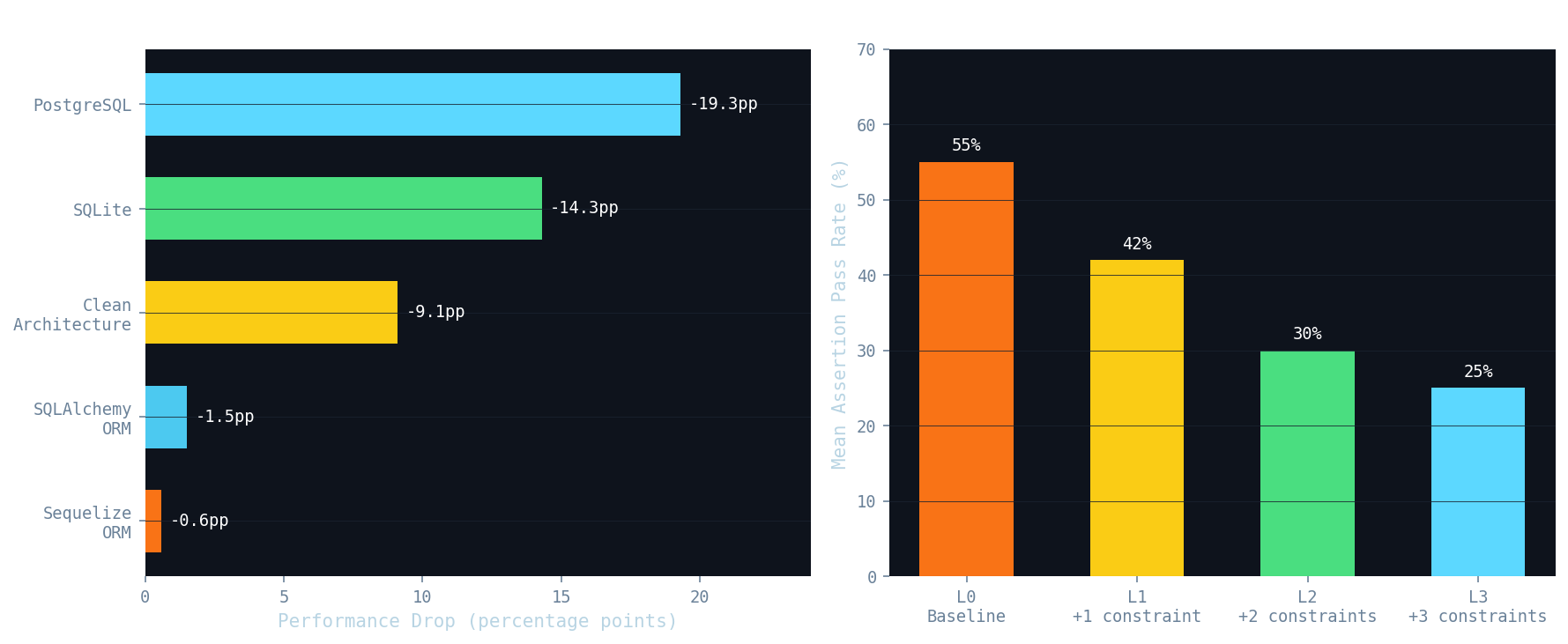
A new paper from arXiv, “Constraint Decay: The Fragility of LLM Agents in Backend Code Generation,” provides the best empirical data yet on where AI architectural competence actually breaks down. Researchers tested agents across 100 tasks with escalating structural constraints — from bare framework (L0) through Clean Architecture plus PostgreSQL plus ORM (L3). The results are sobering: capable configurations lost an average of 30 percentage points in assertion pass rates as constraints accumulated. The type of constraint matters enormously:
| Constraint | Average Impact (pp) |
|---|---|
| PostgreSQL | -19.3 |
| SQLite | -14.3 |
| Clean Architecture | -9.1 |
| SQLAlchemy ORM | -1.5 |
| Sequelize ORM | -0.6 |
The pattern is clear. Agents excel at unconstrained generation — the blank-canvas prototype — but collapse when forced to navigate explicit architectural rules. The study also found that lightweight, explicit frameworks (Express, Flask) outperformed convention-heavy ones (Django, FastAPI) by roughly 25 percentage points. Agents struggle with implicit rules. They need to be told, not expected to infer.
This sounds like ammunition for the HollandTech position. But read it through Mat’s lens and it becomes evidence for the collaborative model. The agents failed when given architectural constraints they didn’t choose and couldn’t reason about in context. When you expose your full context to a model — your team’s skills, your legacy constraints, your compliance requirements — and ask it to brainstorm the functional shape of something before you get to architecture, you’re doing exactly what the research says works: giving the model a rich prompt with explicit constraints rather than asking it to guess.
The “Attaboy” Problem Is an Anthropomorphism Problem
The HollandTech article’s central concern — that AI agents are “pathologically agreeable” — drew a sharp counter on Hacker News from user @amarant: “We have an anthropomorphism problem. AI is a tool. It needs to be subservient. You actually can get it to point out issues in your design, if you just put enough humility and uncertainty in your prompt formulation.”
This is the crux. The “attaboy” complaint assumes the model should behave like a senior architect who pushes back autonomously. But that’s not what models are for. A model’s suggestion of several dozen components wired up in a particular way is categorically useful, even if parts of it are wrong — precisely because it gives you something to react to. The great way AI helps is that it proposes something, which you can iterate on with your contextual experience. If you didn’t surface the greater context first, then this iteration is absolutely crucial.
The HollandTech piece also warns about the “accountability gap” — when the architecture fails, Claude won’t be paged at 3 AM. True. But this argument proves too much. We don’t hold CAD software accountable for architectural failures either. We hold the architect who used it. The accountability concern is really a workflow concern: are engineers reviewing and owning the designs, or rubber-stamping them? That’s a management problem, not a technology problem.
Where the Skeptics Have a Point
None of this means the HollandTech article is wrong about everything. The “Jira Ticket Pipeline” concern — where the AI breaks its own architecture into epics and stories, reducing experienced engineers to implementers — is a genuine failure mode. User @swiftcoder on Hacker News put it well: “coding wasn’t actually the moat in software development, and LLMs aren’t making much of a dent in software architecture or product design.” The moat is judgment, and judgment requires context the model doesn’t have unless you give it.
The Ars Technica burnout retrospective from a developer who ran 50+ projects in two months with AI agents reinforces this. His conclusion: “AI coding agents are software tools best used to enact human ideas, not autonomous coding employees.” The first 90% comes fast and impressively; the last 10% requires tedious human-guided refinement. The Constraint Decay paper puts numbers on this: 71% of agent failures were logic errors, with incorrect query logic and ORM misuse accounting for 45% of all failures. These aren’t failures of intelligence — they’re failures of context.
The real danger isn’t AI making architectural decisions. It’s engineers abdicating the review step because the output looks plausible. As @linkregister noted on Hacker News: “There are companies with real revenue and rapidly accumulating tech debt. Eventually the companies that can’t cope with undisciplined engineering will succumb to unacceptable reliability and be outcompeted, just like in the ‘move fast and break things’ era.” The problem was never the tool. It was always the discipline.
The Architecture That Actually Works
So what does a healthy human-AI architectural workflow look like? Three principles emerge from the evidence:
First, expose your entire context before asking for architecture. Your team’s skills, your legacy constraints, your compliance requirements, your budget. The Constraint Decay paper shows that agents perform dramatically better when constraints are explicit rather than implied. This isn’t optional setup — it’s the difference between a useful proposal and a generic template.
Second, treat the model’s architectural proposal as a first draft, not a final decision. Much of your architecture is mundane and looks like almost every other thing. A model’s proposal gives you a structured starting point that you can critique, modify, and improve with your contextual experience. The proposal doesn’t need to be right. It needs to be specific enough to argue with.
Third, protect the argument. The messy, collaborative debate where engineers challenge each other is where good architecture comes from. If “Claude said so” is ending that debate, that’s a discipline failure, not a technology failure. The model should be feeding the debate, not replacing it.
The false dichotomy comes from the idea that either we design the architecture, or the model does. Actual software engineers don’t do that, or at least won’t do it for anything other than a design prototype. The question isn’t whether AI belongs in the architectural conversation. It’s whether you’re having a conversation at all, or just accepting the first plausible output.
Sources
- Claude Is Not Your Architect. Stop Letting It Pretend.
- Constraint Decay: The Fragility of LLM Agents in Backend Code Generation
- 10 things I learned from burning myself out with AI coding agents — Ars Technica
- How AI coding agents work — Ars Technica
- HN discussion: AI architect software design
- HN discussion: Constraint Decay