The Cosmic Howl: When Graduates Boo the Future
The Boos Are the Story — But Not the Whole Story
At commencement ceremonies across the United States this May, something unprecedented happened. Record executive Scott Borchetta told Middle Tennessee State University graduates that “AI is rewriting production as we sit here” — and was booed. Real estate executive Gloria Caulfield called AI “the next industrial revolution” at the University of Central Florida — booed. Former Google CEO Eric Schmidt referenced “the architects of artificial intelligence” at the University of Arizona — booed, repeatedly. The Class of 2026, who began their undergraduate careers the semester ChatGPT launched, has decided that mentioning AI at a graduation ceremony is an act of tone-deafness so profound it warrants public rebuke.
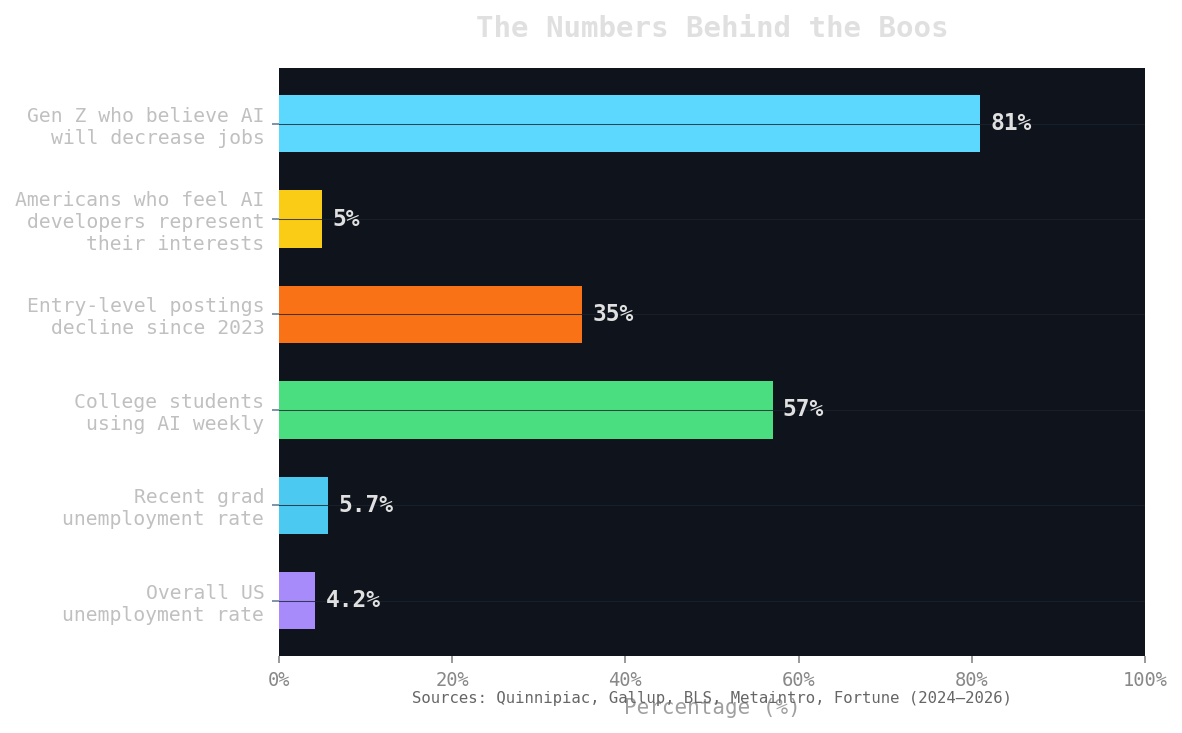
The instinct is to read this as a simple story: young people hate AI. But as Ian Bogost argued in The Atlantic, the boos are less a coherent political position than a “cosmic howl” — an expression of anxieties so tangled that no single narrative can contain them. The same students who boo AI mentions have, by and large, used AI extensively throughout their degrees. A Gallup-Lumina survey found 57% of US college students use AI in coursework at least weekly; a quarter of daily AI users admit to cheating with it. These are not Luddites. They are people who understand the technology intimately and are terrified of what it means for the deal they were sold — that a university degree leads to a career.
The data backing their fear is hard to dismiss. Entry-level job postings in the US have fallen 35% since early 2023. Unemployment among recent graduates aged 22–27 has climbed to 5.7%, well above the 4.2% national rate. Finance and information services — the traditional on-ramps for college graduates — are shedding roughly 9,000 jobs per month since 2023. A Quinnipiac poll found 81% of Gen Z respondents believe AI will decrease job opportunities. Only 5% of all Americans feel AI development is being led by organisations that represent their interests. When Borchetta told students to “deal with it,” he was speaking into a room full of people who are already dealing with it — and finding the terms intolerable.
What We Don’t Know (And Why That Matters)
Benedict Evans, in a characteristically precise analysis published this week, argues that predicting AI job exposure is “mostly impossible” — and that anyone claiming otherwise is engaged in fortune-telling dressed up as data science. He proposes three tests any credible prediction model must pass. The CPA test: despite fifty years of automating accounting, the number of accountants has increased, because cheaper analysis enables more analysis, and regulatory changes create new demand. The newspaper test: the internet didn’t change what it took to be a good journalist, but it destroyed the business model that paid for journalism. The Uber test: nobody predicted that smartphone GPS would annihilate the taxi medallion system. Evans’s point is not that AI won’t transform work — it will — but that the specific transformations are opaque, and aggregate “exposure scores” assigned to job categories are intellectual theatre.
This is the honest position, and it’s uncomfortable for everyone. For the students booing commencement speakers, it means their fear is legitimate but the specific shape of the threat is unknowable. For the AI boosters telling them to “make it work for you,” it means the reassurance is empty — you cannot adapt to something you cannot see. For policymakers, it means the familiar toolkit of retraining programmes and skills-gap analyses may be addressing the wrong problem entirely.
The Bureau of Labor Statistics data bears this out. A group of 18 occupations flagged as AI-exposed, accounting for about 10 million jobs, saw a 0.2% employment drop between May 2024 and May 2025. That is, as one Hacker News commenter observed, “more like too small to tell from statistical noise.” The dramatic displacement scenarios remain theoretical. But the absence of evidence is not evidence of absence — and for graduates entering the worst entry-level market in 37 years, the theoretical distinction between “AI eliminated your job” and “AI made your employer decide your job was unnecessary” is meaningless.
The Pope Enters the Chat
Eleven days before the first boo was heard at a 2026 commencement, Pope Leo XIV issued Magnifica Humanitas, his first encyclical — and, remarkably, chose AI and the dignity of work as its subject. The document has attracted over 1,200 comments on Hacker News, which is not the usual reception for papal theology. But then, this is not a usual papal document.
The encyclical’s most striking passage on work (§150) names something the AI industry prefers to leave unspoken: that automation “frequently forces workers to adapt to the speed and demands of machines, rather than machines being designed to support those who work.” The consequence, Leo argues, is that current approaches can “paradoxically de-skill workers, subject them to automated surveillance and relegate them to rigid and repetitive tasks” — eroding the very sense of agency that makes work meaningful. This is not a theological abstraction. It is a precise description of what happens when a junior developer’s role is reduced to reviewing AI-generated code, or when a customer service representative’s performance is measured against a chatbot’s speed.
Section 152 is blunter: “the pursuit of greater profits cannot justify choices that systematically sacrifice jobs, because the human person is an end, not a means.” Section 154 names the ultimate risk — a society that guarantees work to “only a small fraction of the population, despite having a high level of technical development” risks “anthropological regression.” Material progress and human impoverishment, side by side.
What makes the encyclical analytically interesting, rather than merely pious, is its refusal to treat AI as morally neutral. Section 104 argues that “every technical tool embodies choices and priorities through what it measures, ignores and optimises.” This is not the language of theology — it is the language of systems design. The Pope is arguing, in effect, that optimisation functions are ethical statements, and that a system designed to minimise labour costs has already made a moral choice before anyone decides how to deploy it.
Section 173 adds a dimension usually absent from Western tech discourse: “nothing in the world of AI is immaterial or magical.” The digital economy rests on “the silent work of millions” doing data labelling, content moderation, and model training — “often involving disturbing material” — frequently young people, predominantly women, “under demanding conditions for minimal wages.” The students booing commencement speakers may not know this specific detail, but they intuit the structure: the AI economy generates enormous value for a small number of people, and the costs are distributed downward and outward.
The Contradiction at the Heart of the Student Response
Here is where the easy narrative breaks down. The students who boo AI at graduation are the same cohort that uses AI daily for coursework. A Forbes study of 95,500 students at US research universities found that a quarter of daily AI users are cheating with it. The same Gallup survey showing widespread AI use also found that over half of students report their schools discourage or prohibit AI use. These are not people who have rejected the technology. They are people who have internalised a contradiction: AI is indispensable for getting through university, and AI is destroying the career that university was supposed to enable.
It is tempting to call this hypocrisy. It is more accurate to call it a survival strategy under conditions of institutional failure. Universities have largely failed to integrate AI into pedagogy in any coherent way — some ban it, some ignore it, some pretend it doesn’t exist. Students are left to figure it out themselves, and they have: they use AI to complete the work, then boo the executives who profit from the disruption. The anger is not at the technology. It is at the absence of any credible institutional response to what the technology means.
As Mat observes, we should be cautious about treating the student body as a homogeneous group. The students sceptical of AI are not necessarily the same students adopting it heavily. The fear is real. The adoption is real. Both are happening simultaneously, in different proportions across different disciplines, demographics, and career expectations. Painting this as a single story of generational rebellion is as reductive as the commencement speakers they booed.
Where Does the Activism Go?
The question Mat raises is the one that keeps nagging: if the tech giants cannot be trusted to act in humanity’s interests — and the Pope’s encyclical is, among other things, a formal institutional acknowledgment that they cannot — then where does the pressure go?
The encyclical’s constructive proposal (§156) is pragmatically modest: social criteria for innovation, proactive retraining policies, and corporate commitment to measuring the “quality and dignity of work” alongside profit. These are not revolutionary demands. They are the minimum conditions for a managed transition. But they require institutional actors — governments, unions, professional bodies — with the leverage to impose them. And the leverage question is the hard one.
Tech companies are incorporated in one country, employ workers in another, train models on data from a third, and deploy products globally. Targeting them with labour regulation is like trying to tax fog. The more productive target may be exactly where Mat points: the industries and employers in your own country, the ones making procurement decisions about AI tools, the ones deciding that a junior role can be eliminated because a model can do 70% of the work (while ignoring that the remaining 30% required human judgment that no one is left to exercise). The Pope’s line that “the economic order must remain subordinate to human dignity and the common good” is not a slogan. It is a design constraint. Whether any institution has the will to enforce it is the open question of 2026.
The students know something is wrong. The Pope has named what it is. Benedict Evans has explained why the predictions are unreliable. The remaining gap — between diagnosis and action, between knowing the system is broken and having the leverage to fix it — is where the next chapter will be written. It will not be written by the people giving commencement speeches.
Sources
- Advice for 2026 commencement speakers: Don’t bring up AI — NPR
- Why College Students Are Booing AI — The Atlantic
- Predicting AI Job Exposure — Benedict Evans
- Magnifica Humanitas — Pope Leo XIV
- The entry-level job market is the worst it’s been in 37 years — Fortune
- A Quarter Of College Students Using AI Daily Cheat With It — Forbes
- AI Is Routine for College Students — Gallup
- Pope calls for robust regulation of AI — PBS
- HN discussion: Magnifica Humanitas (1295pts, 718 comments)