The Flood, the Funnel, and the Firehose Vendor
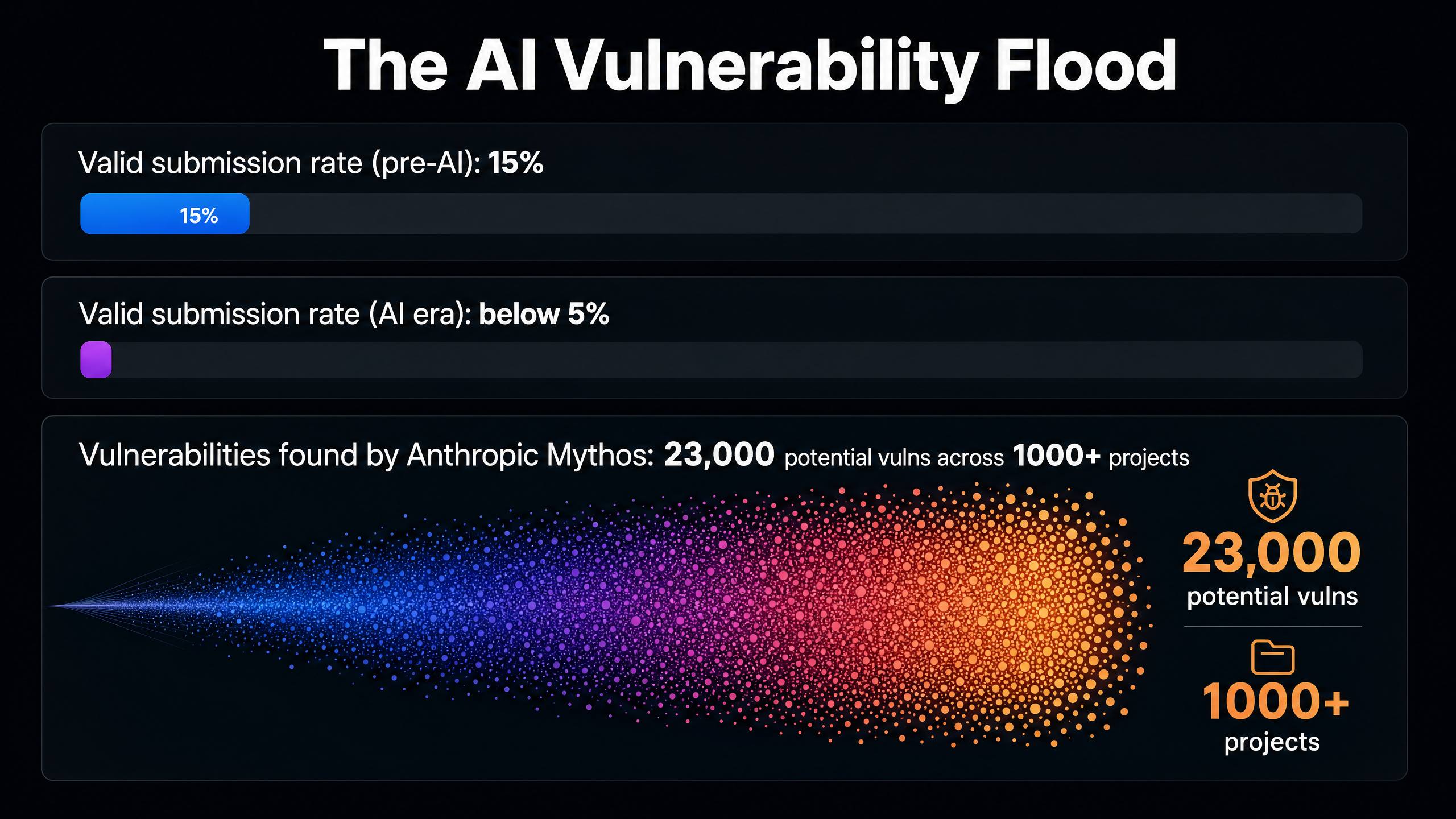
On May 12, OpenAI launched Daybreak, a cybersecurity initiative built on GPT-5.5 and Codex, designed to help organisations find and patch vulnerabilities before attackers do. Partners include Cloudflare, Cisco, CrowdStrike, Palo Alto Networks, and Oracle. The pitch is seductive: AI-driven secure code review, threat modelling, patch validation, and dependency risk analysis — all embedded directly into the development lifecycle. It arrives three weeks after Anthropic committed $100 million in usage credits to Project Glasswing, its own restricted-access program for Claude Mythos, a model that found 23,000 potential vulnerabilities across more than 1,000 open-source projects. The sales copy writes itself. The backstory is darker.
AI has not merely accelerated vulnerability discovery — it has shattered the pipeline that once connected discovery to remediation. The bottleneck was never finding bugs. It was always the humans downstream: the triage engineers, the volunteer maintainers, the overstretched security teams tasked with separating signal from noise and then actually shipping patches. AI compressed the first stage to near-zero and left every subsequent stage exactly as slow as it always was. The result is what John Morello, CTO of Minimus, described to Dark Reading as a fundamental inversion: HackerOne’s Internet Bug Bounty program saw its valid submission rate collapse from roughly 15 percent to below 5 percent as AI-generated reports flooded the queue. The programme paused new submissions entirely on March 27. Node.js followed, citing loss of funding. cURL killed its bounties outright, and lead developer Daniel Stenberg reported that the moment the money disappeared, “the slop situation is not a problem anymore” — the AI-generated junk dried up overnight because there was no longer a financial incentive to spray it. But the quality reports kept coming, and Stenberg warned of a different crisis: an avalanche of genuine findings that small teams still cannot process at scale.
The discovery-to-exploit timeline has collapsed in parallel. Security researcher Himanshu Anand documented a case where eleven independent researchers reported the same critical vulnerability in six weeks — all assisted by LLMs converging on the same code paths. He also demonstrated that a published React patch could be turned into a working exploit in thirty minutes using AI. “The 90 day window is not protecting users,” he wrote. “It is giving everyone who already has the bug a 90 day head start.” Anthropic’s own red team acknowledged that “industry-standard 90-day windows may not hold up against the speed and volume of LLM-discovered bugs.” Meanwhile, the Linux kernel endured two back-to-back critical vulnerabilities — Copy Fail (CVE-2026-31431) and Dirty Frag (CVE-2026-43284) — the first of which was found by Xint Code using about an hour of AI-assisted scanning against the kernel crypto subsystem. A 732-byte Python script gave root on every Linux distribution shipped since 2017. Linus Torvalds described the kernel’s security mailing list as “almost entirely unmanageable, with enormous duplication due to different people finding the same things with the same tools.”
The structural problem is a Goodhart’s Law catastrophe playing out in real time. Bug bounties optimised for discovery, so AI industrialised discovery. Nobody funded remediation, so remediation broke. Now the same companies whose models created the flood are selling themselves as the levee. OpenAI’s Daybreak offers three tiers of increasingly permissive GPT-5.5 access — standard, Trusted Access for Cyber, and GPT-5.5-Cyber for red teaming — gated behind sales calls and partner agreements. Anthropic restricted Mythos to roughly fifty organisations. As Bruce Schneier observed in The Globe and Mail, Anthropic is “making unilateral decisions about which pieces of our critical global infrastructure get defended first, and which must wait their turn.” The security company Aisle was able to replicate many of Anthropic’s published findings using smaller, cheaper, public models — suggesting the moat around these capabilities may be narrower than the marketing implies. The premium is not in finding the bugs. It is in triaging them, validating them, and shipping fixes — the unglamorous, human-intensive work that neither bounties nor AI vendors have yet committed to funding at scale.
This is a genuine structural shift, not a hype cycle. The old model assumed discovery was the bottleneck and built every incentive — bounties, disclosure timelines, researcher reputation — around that assumption. AI eliminated the bottleneck and exposed the fact that the rest of the pipeline was held together with volunteer labour and good faith. The industry now faces a choice: fund remediation with the same urgency it once funded discovery, or accept that the vulnerability disclosure ecosystem will increasingly resemble what it already looks like from the maintainer’s chair — a firehose of plausible-sounding findings arriving faster than any human team can evaluate, while the companies that built the firehose charge rent for the umbrella.