The USB-C of AI Has an Architecture Issue
In the high-velocity theatre of generative AI developers, few protocols have enjoyed as rapid a rise—or as swift a backlash—as Anthropic’s Model Context Protocol (MCP). Ostensibly designed as the “USB-C of the AI ecosystem” to standardize how large language models (LLMs) connect to data sources and enterprise tools, MCP is facing a mounting wave of disillusionment. What was hailed six months ago as a frictionless universal bridge is being reframed by early-adopter engineers as an architectural tax. Critics are increasingly claiming “MCP is dead,” advocating instead for a return to simple, pre-trained Command Line Interfaces (CLIs) or a lazy-loading “Skills” architectural pattern.
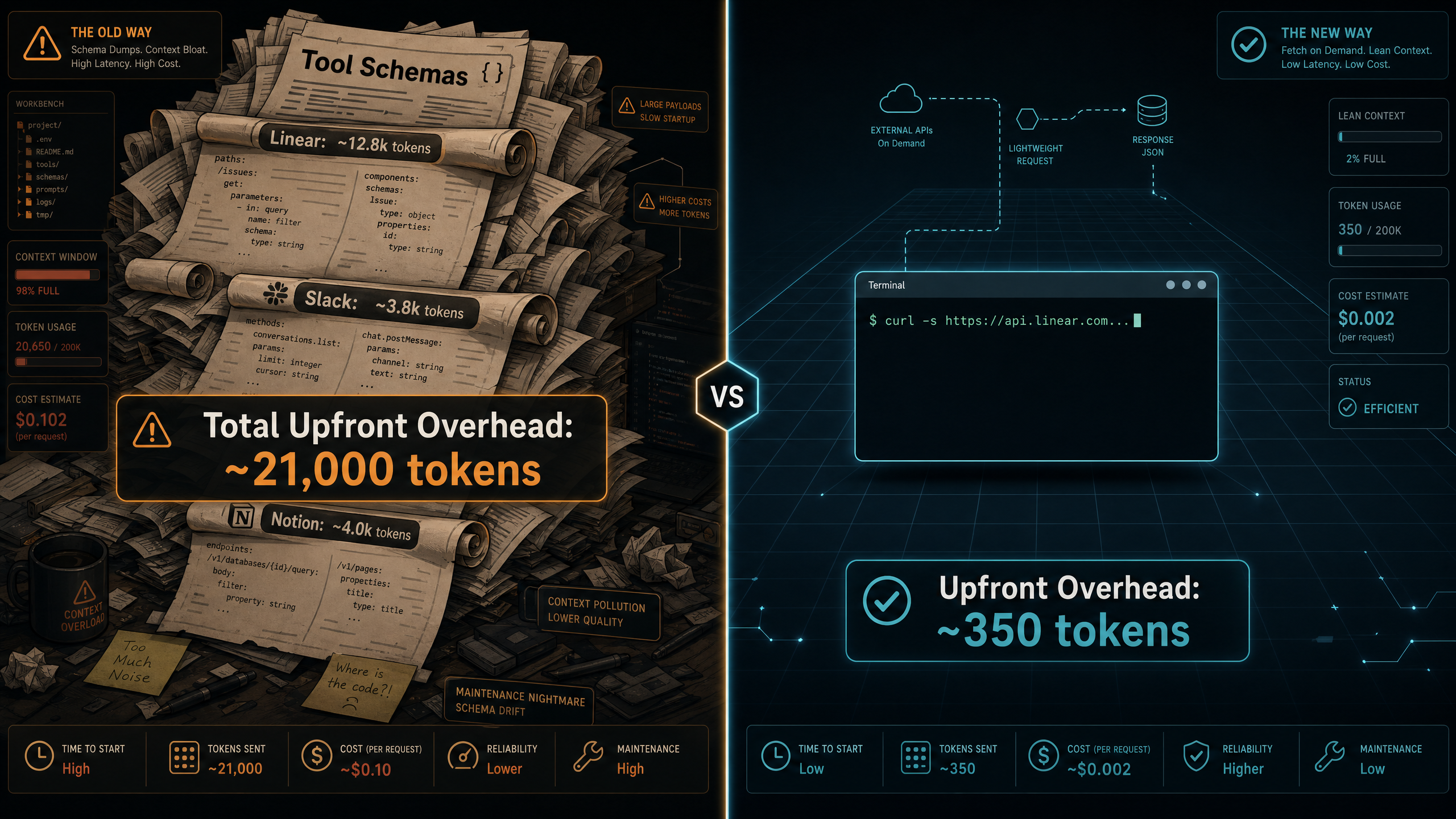
Under the hood, the standard implementation of MCP suffers from a glaring design tax: it is an absolute context hog. When an agentic tool like Claude Code or a custom system initializes an MCP server, it retrieves the schemas for all available tools up-front and stuffs them directly into the context window. An engineering audit conducted by Vancouver-based automation firm Quandri revealed the staggering real-world toll of this approach. Connecting just four default MCP servers (Linear, Notion, Slack, and Postgres) consumes over 21,000 tokens of upfront overhead before the model has written or read a single line of your actual code. If you are using Claude’s 200,000-token context window, that is a permanent 10.5% tax on your “desk” space; on GPT-4o’s 128,000-token window, it spikes to 16.5%. Looking up a single issue on Linear via its standard MCP server—which loads 42 separate tool definitions—demands roughly 65 times more tokens than directing the LLM to call the Linear GraphQL API using a basic, localized curl command.
The pushback inside the developer community, however, reveals a deeper tension between individual programmers and enterprise architects. On Hacker News, critics argue that the “MCP is dead” narrative is an overreaction driven by the developer hype cycle. “Isn’t MCP just a way to give agent tools?” asked user @big-chungus4. “When you are building your own agent, you can define the tools manually, but if you’re using something existing… how do you add new tools? Saying MCP is dead is kind of like saying tools are dead.” Furthermore, as Charles Chen of Motion notes, many individual “vibe-coders” miss the point of MCP’s enterprise utility. While a single developer operating locally can easily delegate raw shell access to an agent so it can leverage curl, jq, or grep, this “cowboy” approach is a security and telemetry disaster in an enterprise environment. An enterprise requires strict audit logs, structured schema definitions, centralized authorization, and standard transport envelopes—administrative guardrails that MCP over HTTP solves, even if it comes at the price of some performance overhead.
Recognizing the context-bloat criticism, the ecosystem is already pivoting toward dynamic loading rather than total abandonment. Recent versions of tools like Claude Code have begun rolling out “Tool Search with Deferred Loading,” which dynamically searches and loads MCP tool definitions on demand rather than dumping the full registry into the primary context payload. This has reportedly slashed initial context consumption by upwards of 85%. Yet, the debate highlights a critical lesson in AI systems design: pre-trained knowledge is always cheaper than raw, in-context specification. When an LLM is already intimately familiar with generic tools (git, grep, psql) and API patterns from its massive training corpus, force-feeding it highly explicit JSON-RPC wrappers is often redundant. The architecture of the future is not a binary choice between a raw terminal and a bureaucratic protocol; it is a hybrid where the LLM is treated as a reasoning engine with a library card, rather than a clerk who must carry the entire library on their back.