The Silicon Interrogation: How Turnstile Turned from Privacy Defender to Hardware Inquisitor
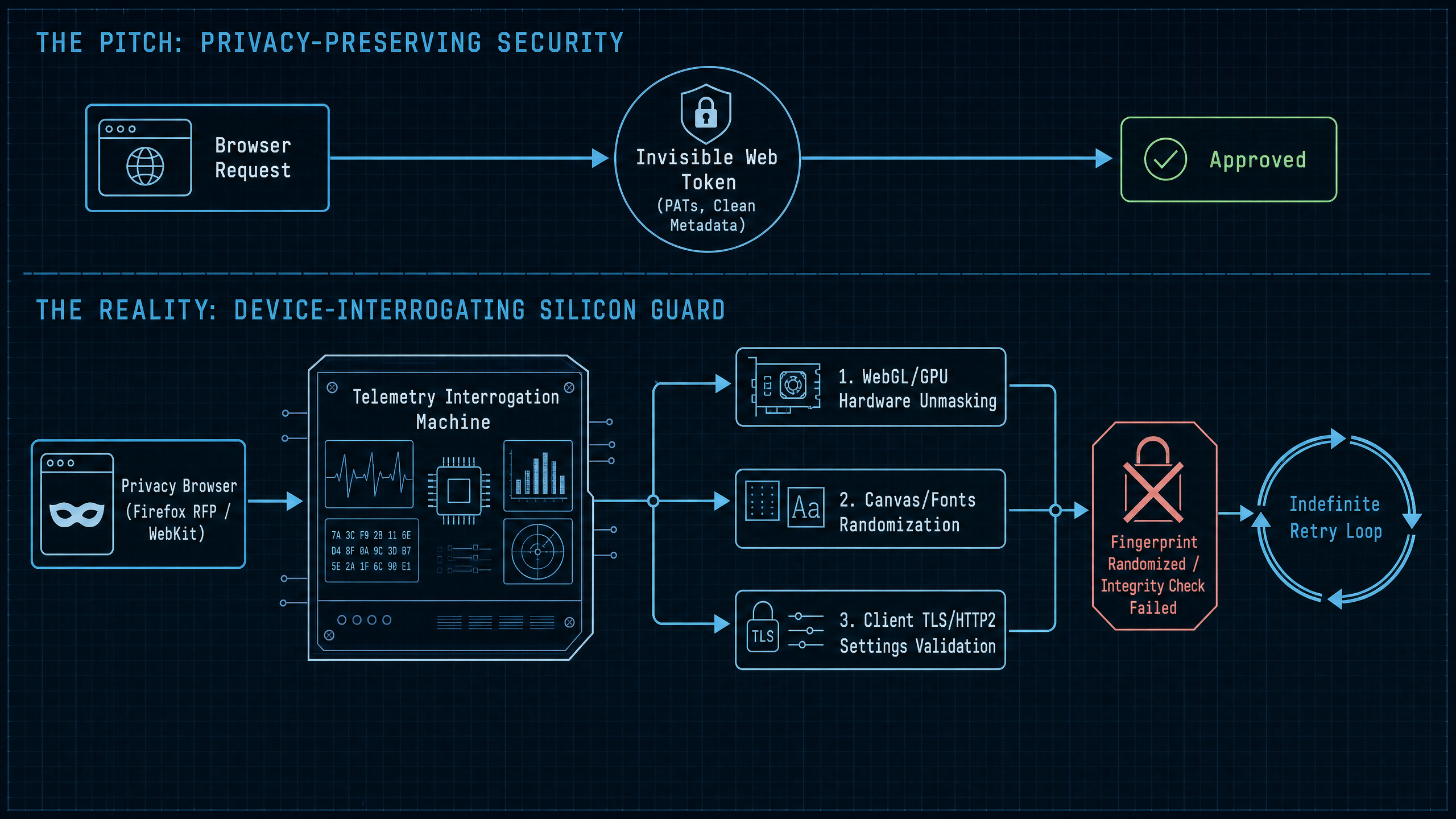
When Cloudflare launched Turnstile in September 2022, it was marketed as a “user-friendly, privacy-preserving alternative to CAPTCHA.” It positioned itself as a ethical response to Google reCAPTCHA, which privacy advocates long criticized for tracking users across the broader web. Fast-forward to mid-2026, and that pristine marketing has run head-first into the brutal reality of the bot-vs-mitigation arms race. Today, Turnstile’s increasingly aggressive verification checks rely heavily on browser fingerprinting. For users who value their privacy—running hardened browsers like WebKitGTK, LibreWolf, or Firefox with advanced privacy-hardening configurations—Turnstile has transformed from an “invisible solution” into a hostile, looping gatekeeper that refuses to let them pass until they strip down their digital self-defense.
To combat highly sophisticated AI-driven scrapers, Turnstile has descended past basic browser headers and into the silicon itself. The script actively queries low-level hardware characteristics, demands canvas rendering outputs, and probes the WebGL API via the WEBGL_debug_renderer_info extension to extract the unmasked GPU vendor and model. Because bot frameworks are notoriously difficult to emulate perfectly under these constraints without throwing hardware mismatches, Cloudflare uses this telemetry to construct a unique device profile. However, if a user’s browser randomizes canvas pixels to block tracking (like CanvasBlocker or Safari/WebKit’s built-in anti-fingerprinting) or returns sanitized graphics information, Turnstile triggers a silent block or triggers diagnostic errors such as webglSpoofed. What was once a check on “human behavior” has become an inspection of mechanical authenticity.
This shift has created an absurd paradox: to prove you are a human being to the internet’s largest gatekeeper, you are forced to compromise your privacy. In a recently surfaced internal Cloudflare diagnostics document, users who fail the Turnstile check due to Firefox’s privacy.resistFingerprinting (RFP) setting are offered explicit step-by-step instructions to type about:config into their address bar and change privacy.resistFingerprinting to false. Turnstile openly admits this in its own error prompts: “Turnstile uses browser fingerprinting to verify you’re human. Privacy tools that block or randomize fingerprinting make your browser look like a bot trying to hide its identity. Temporarily allowing fingerprinting for this site will fix the issue.”
The tragic irony is that this aggressive interrogation does little to stop sophisticated, well-funded bot operators while disproportionately locking out legitimate, privacy-respecting humans. As Hacker News commenter @jchw points out, standard anti-fingerprinting checks such as TLS JA3 fingerprints and WebGL scripts are easily bypassed by scrapers that leverage actual, high-level automation interfaces: “You can even just use an actual Chrome instance with the devtools protocol, seems to pass as long as you don’t use headless mode.” Consequently, the bulk of the friction is absorbed by average power users who simply do not want their hardware configurations logged and tracked as they navigate GitLab, Discord, or any of the millions of sites sitting behind Cloudflare’s proxy.
Ultimately, Turnstile’s evolution highlights the death of the “privacy-preserving” security compromise. In an era where AI agents and scraping networks can comfortably mimic human mouse paths and keystroke timing, security architects have abandoned trying to verify who is sitting at the keyboard. Instead, they are verifying what machine is drawing the pixels. If your browser refuses to let them audit your graphics card, your operating system, and your monitor’s rendering quirks, you are automatically categorized as an attacker. By prioritizing absolute corporate mitigation over personal privacy, Cloudflare has forced a false dichotomy upon the web: you can have a private browser, or you can have an accessible internet, but you can no longer have both.
Sources
- Cloudflare Turnstile requiring fingerprintable WebGL - lanodan’s cyber-home
- Announcing Turnstile, a user-friendly, privacy-preserving alternative to CAPTCHA - Cloudflare Blog
- Cloudflare says my browser is unsupported - GitHub issue #30709
- Hacker News: Cloudflare Turnstile requiring fingerprintable WebGL
- Friendly Captcha: Cloudflare Turnstile GDPR and Privacy Compliance Analysis