The New Oral Tradition: Keeping Software Human in the Age of Spec-Driven AI
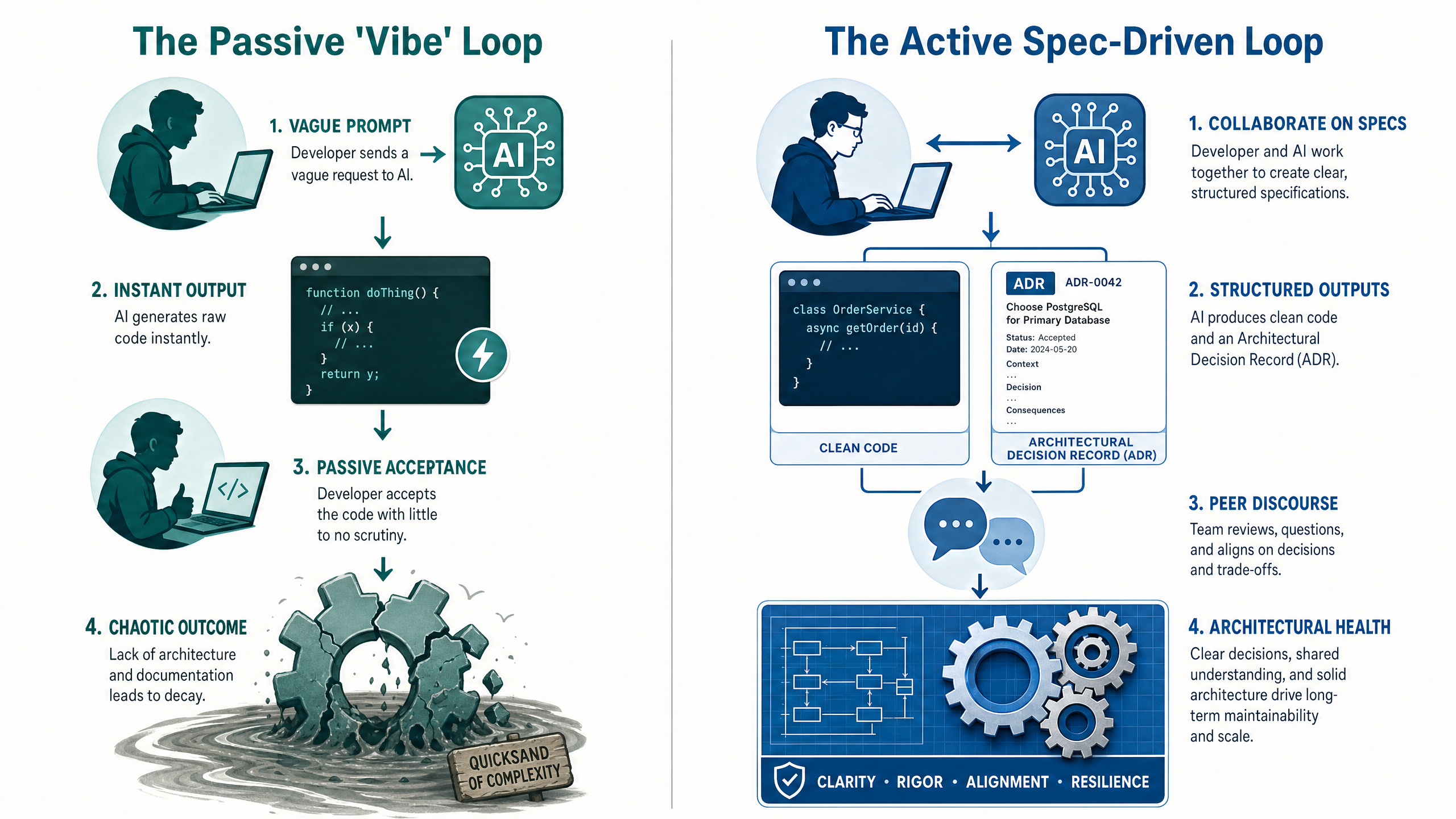
Zeb Larson’s recent observation in Fast Company that software engineering operates as an oral tradition has struck a chord across the industry. In a world where developers churn every few years and the core mandate of Agile prioritizes “working software over comprehensive documentation,” critical system knowledge has historically been passed down through verbal warnings, informal whiteboard sessions, and folk warnings not to touch certain fragile subroutines. But as generative AI commoditizes code production and turns software creation into a high-speed assembly line, this fragile oral chain is fracturing. If an AI writes the entire system in a weekend, there is no veteran developer left to tell the story of why it was built that way.
The danger of this shift lies in “vibe coding”—the passive loop where developers treat AI as a code-vending machine, accepting generated blocks wholesale to meet immediate goals. Larson notes that “writing documentation is itself part of the thinking process.” When this process is offloaded to a machine, the human engineer misses the opportunity to learn, design intent is discarded, and the system’s architecture becomes a black box. On Hacker News, community members have begun to call out this hollow loop of false productivity. Reflecting on a high-speed coding session, developer jack_lynch wrote: “AI-assisted coding… is crazy. I accomplished SO MUCH. One weekend I spent about 14 hours, 1 billion tokens… But my brain is instead focused on [nothing].” Another commenter, delis-thumbs-7e, aptly described chatbots as “the social media of work,” where engineers get dopamine hits from pseudo-accomplishments “while actually you just fried your brain” without deeply engaging in the engineering reasoning.
Modern AI-first software engineering must actively resist this passive trajectory. Rather than letting the system’s core design drown in an AI’s transient context window, developers can configure AI agents to surface architectural choices and document them. As Mat’s team does at the Australian National University’s (ANU) Digital Research Hub, engineers can adopt a spec-driven development workflow to force this discipline. Their open-source framework, Bower, integrates with orchestration tools like Claude Code to force the AI agent to explicitly write down its architectural options and persist them as standalone Architectural Decision Records (ADRs)—a formal documentation paradigm first popularized by Michael Nygard over fifteen years ago. By automating the creation of ADRs alongside the code, the human engineer and the AI both gain a permanent, auditable ledger of the system’s structural evolution.
Yet, automated documentation is only half the battle. Reclaiming the oral tradition requires maintaining an active engineering culture where humans still sit down and talk about their code. If engineering organizations make it socially and professionally “uncool” to not understand your own AI-generated architecture, developers are incentivized to rigorously critique what the model proposes. At ANU’s Digital Research Hub, the “thinking-while-writing” process has evolved from a solitary exercise into collaborative sharing of AI brainstorming transcripts. Mat says they’re still working it out but challenging an AI’s constraints, arguing over its proposed trade-offs, and detailing the problem context is itself a highly teachable, elite practice that senior engineers must pass down to juniors. By combining rigorous, spec-driven automation with structured human discourse, engineering teams can ensure their software remains a collaborative human achievement rather than a legacy of unmaintainable, alien code.