The $89 Pull Request: Why Corporate America Is Rationing AI
The free bar has officially closed. For the past year, software developers have been “vibe coding” inside an endless open bar of agentic AI credits. But this week, the corporate hangover arrived. Uber officially instituted a hard, monthly $1,500 cap per employee for agentic coding tools like Claude Code and Cursor. The decision came after the ride-hailing giant reportedly blew through its entire annual AI budget in just four months. This is not an isolated budgeting error or a minor corporate belt-tightening measure; it is the tip of a structural iceberg that is forcing a major reckoning across enterprise engineering teams.
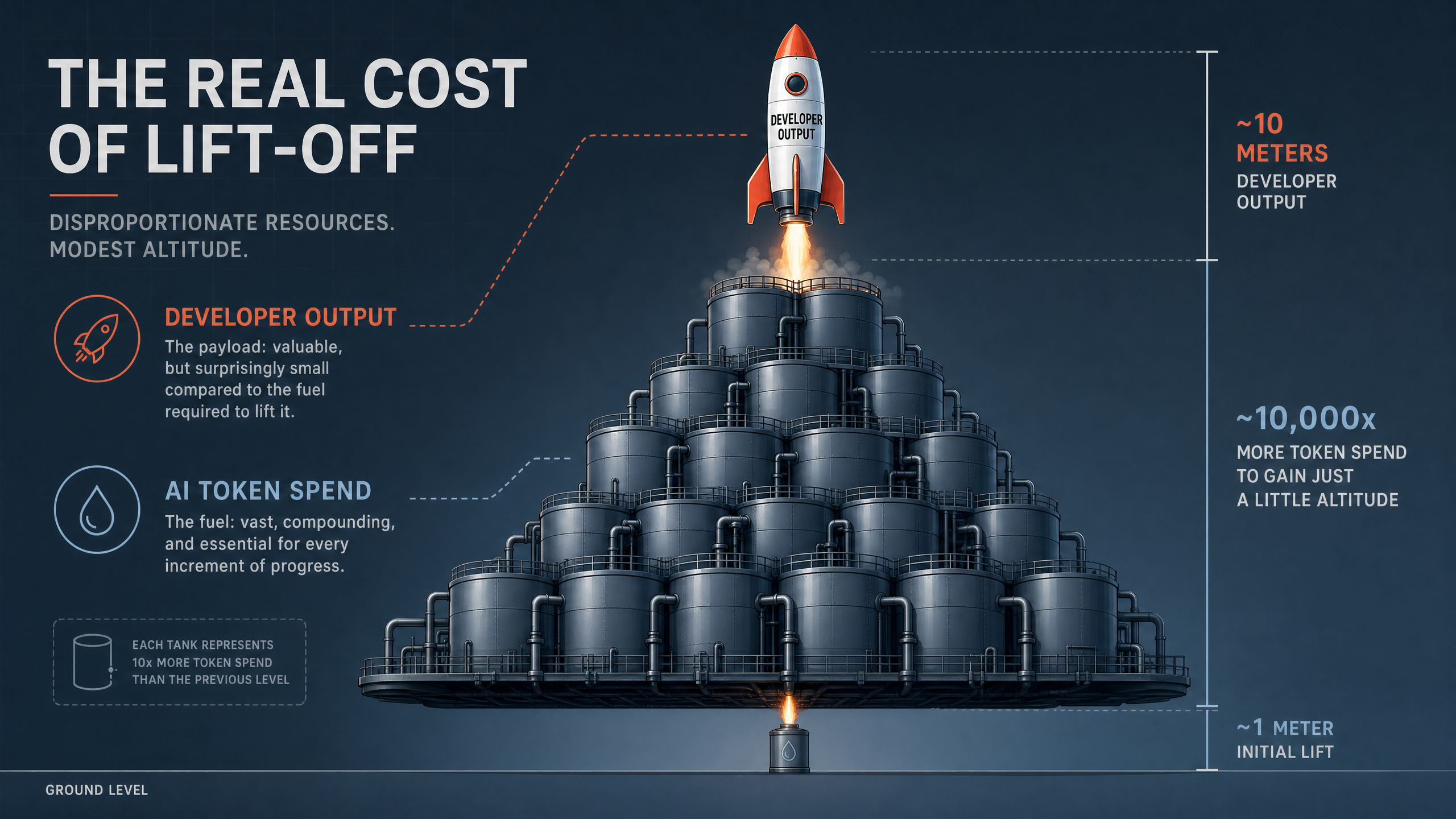
Why are these budgets expanding at an astronomical rate? The answer lies in empirical data released by corporate engineering intelligence platform Jellyfish, which analyzed 12,000 developers across 200 companies in Q1 2026. The study found that while pouring tokens into developer workflows does increase raw coding output, it behaves like rocket fuel rather than a linear motor. Developers in the bottom 20% of AI spending shipped an average of 11 merged pull requests (PRs) per quarter, costing the company a mere $0.28 per PR in API tokens. In contrast, power users—the “tokenmaxxers” in the top 20%—spent an eye-watering $1,822 per developer over the same period to ship 23 PRs. A doubling of raw output required an $89.32 cost per PR, a staggering 319-fold increase in unit cost.
To understand this exponential scale, one must look at how agentic coding environments actually operate. Modern CLI agents like Claude Code or Cursor are not simple autocompletes. They are autonomous loops that read, write, and debug. When a developer asks an agent to fix a bug, the tool constructs a sandbox container, reads local files, tests the changes, catches its own errors, and loops again. Crucially, each iteration of this “reasoning loop” resubmits the entire context—including the updated code, the test outputs, the terminal history, and the system prompt—back into the LLM context window. As a result, a developer is not paying linearly for the code they write; they are paying quadratically or worse for the agent’s trial-and-error. For instance, former Netflix engineer Amit Chopra recently open-sourced an app to prune redundant AI context reads because he discovered that redundant files and terminal history bloat represented over 70% of his Claude API bills.
The industry’s pivot toward token rationing has triggered a sharp debate over the true return on investment of these tools. Commenting on the news of Uber’s cap, the Hacker News community was quick to point out where we stand in the adoption cycle. “Tokenmaxxing / ‘who needs developers anymore’ is the top of the peak,” noted laurentl. “‘Oh no we ate our entire budget in 3 months’ is heading towards the trough of disillusionment.” On his blog, developer Simon Willison analyzed the math of Uber’s new policy: if an engineer actively uses two capped tools, that translates to a potential “$36,000 cap per engineer per year,” which represents roughly 11% of the median $330,000 compensation package for a US-based Uber software engineer. “If you’re not actually able to draw a direct line to how much useful features and functionality you’re shipping to your users, that trade becomes harder to justify,” Uber COO Andrew Macdonald admitted.
The fundamental oversight of the early AI boom was treating LLMs like traditional SaaS seats. In a classic SaaS model (such as Slack or GitHub), a seat is a flat, predictable line-item on a corporate balance sheet. But agentic AI is not software—it is a utility, closer to electricity, cloud hosting, or heating. Giving an unmonitored development team unlimited agentic CLI access is the equivalent of issuing unlimited corporate credit cards and telling them to spin up AWS GPU clusters with no budget controls. Uber’s $1,500 monthly cap is the beginning of the “metered era” of AI engineering. It forces developers to treat token context windows with the same frugality they once reserved for cloud egress fees, or risk having the engine shut off mid-flight.
Sources
- Is “tokenmaxxing” cost effective? New data from Jellyfish explains
- Uber caps employee AI spending after blowing through budget in 4 months
- Uber Caps Usage of AI Tools Like Claude Code to Manage Costs
- Hacker News: Uber torches 2026 AI budget on Claude Code in four months
- Hacker News: Uber’s COO says it’s getting harder to justify money spent on tokenmaxxing
- Netflix wiz creates app to slash AI bills, then open sources it