The Symmetric Noise of AI Engineering
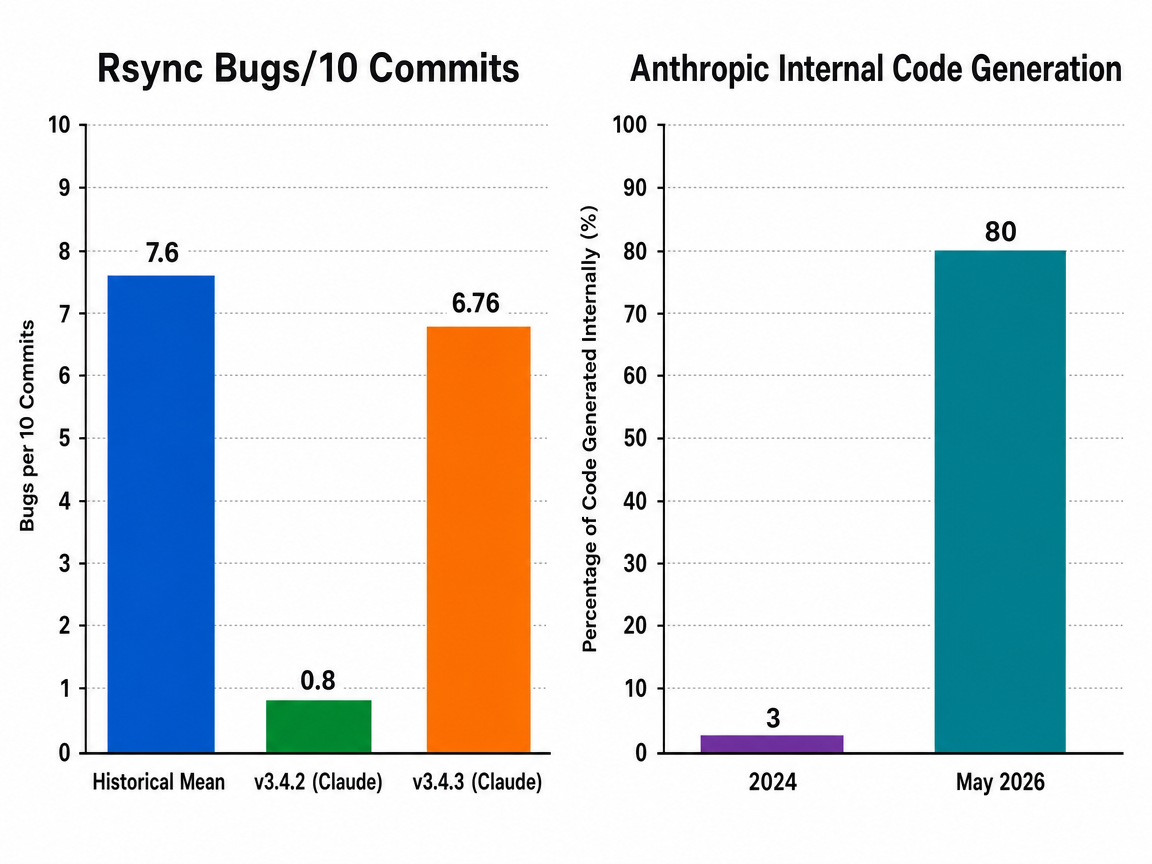
The contrasting developments of this week reveal a deep, systemic fissure in the software industry. In a widely discussed whitepaper, The Anthropic Institute proudly declared that eighty percent of its internal production code is now written by Claude, hailing an eight-fold increase in engineering velocity as the first steps toward autonomous “recursive self-improvement.” Meanwhile, a few digital streets over, the independent open-source community erupted in existential dread. When users discovered that legendary systems programmer Andrew Tridgell (creator of Samba and rsync) had shipped a series of backup-breaking security updates co-authored by “tridge and claude,” they flooded the repository with a vitriolic thread titled “Please Do Not Vibe Fuck Up This Software.” While the venture-backed AI vanguard treats hyper-velocity code generation as an unalloyed milestone toward AGI, the engineers maintaining the internet’s literal basement view the onslaught of synthetic code with rising panic.
Yet, a forensic inspection of the rsync controversy reveals that the “vibe-coding disaster” was not a failure of AI code quality, but rather a symmetric loop of AI-generated noise. In his defense, Tridgell noted that open-source maintainers are currently being drowned in a “flood of security reports,” many of which are automated, AI-generated CVE probes. To defend a thirty-year-old C codebase, Tridgell used Claude to automate the grueling task of migrating the project’s ancient shell-script test suites to Python and adding defense-in-depth protections. A statistical study of rsync’s release history by software analyst Alexis Purslane proves that the Claude-authored commits were entirely normal. The Claude-assisted releases (v3.4.2 and v3.4.3) generated 0.80 and 6.76 bugs per 10 commits respectively—both sitting comfortably within the historical middle 50% of the project’s distribution, and collectively averaging less than rsync’s historical mean of 7.60 bugs per 10 commits. Claude did not break rsync; writing more code to handle a deluge of AI-generated security reports caused normal, statistically predictable regressions.
Nevertheless, software security is built on trust, and trust is notoriously non-linear. The systems utility community—where a single stateful bug can silently corrupt decades of enterprise backups—gasped at the sight of an LLM in the commit history. The thread quickly mutated from a technical dispute into harassment, highlighting the exhausting lack of resources at the heart of the open-source ecosystem. As Hacker News commenter amluto noted: “Tridge is an excellent programmer… but the author and long-time maintainer has the same problem as every other maintainer: not enough time to deal with every [issue].” Meanwhile, user zos_kia pointed out the supreme irony of the outrage: “From a cursory look, it looks like a security fix in response to a CVE surfaced a coding error which has been present in the code since 2007. This is so banal that it’s actually hilarious to see people lose their shit over it.” When automated scanners fabricate industrial quantities of homework for unpaid humans, maintainers are forced to employ automated assistants just to survive.
This brings us to the core delusion of Anthropic’s “8x velocity” metric. A venture-backed SaaS company can afford a high-velocity, high-regression environment; a broken front-end feature is patched silently in the next deployment cycle. But foundational utilities cannot operate under the same cargo-cult philosophy. System programming is bounded not by how fast a developer can type syntactically valid lines of code, but by how thoroughly they comprehend the state machine. If an eight-fold increase in velocity is achieved by using Claude to bypass the cognitive friction of reading and deeply understanding a codebase, we are not witnessing “recursive self-improvement.” We are witnessing an inflationary event: a massive, automated expansion of the software attack surface that our human auditing capabilities cannot possibly hope to govern.
The industry is currently conflating typing speed with architectural wisdom. When an engineer of Tridgell’s caliber uses Claude to draft tests, the output is guided by forty years of expert, human context. However, when the AI vanguard talks about “closing the loop” on recursive self-improvement, they envision a world where models review, merge, and upgrade their descendants in an isolated, automated vacuum. This is a statistical fantasy. AI-engineered code does not exist in a vacuum; it still generates bugs, and more code demands more maintenance. If we continue to treat software engineering as a raw throughput contest, we will drown in a sea of average, lightly-understood code. The rsync panic warns us that the physical layers of our digital world cannot survive an uncritical, “vibe-coded” transition—not because the models write worse code than mediocre humans, but because the scale of their output will inevitably break our ability to oversee it.
Sources
- The Anthropic Institute: When AI builds itself
- Alexis Purslane: Did Claude Increase Bugs in rsync?
- The Register: ‘Please do not vibe f$%& up this software’: Broken backups spark AI coding row in rsync project
- LWN: Tridgell: rsync and outrage
- Hacker News: Did Claude increase bugs in rsync?
- Hacker News: Please Do Not Vibe Fuck Up This Software