The Grand Neocloud Arbitrage: Why the S&P 500 Refused to Underwrite the AI Loop
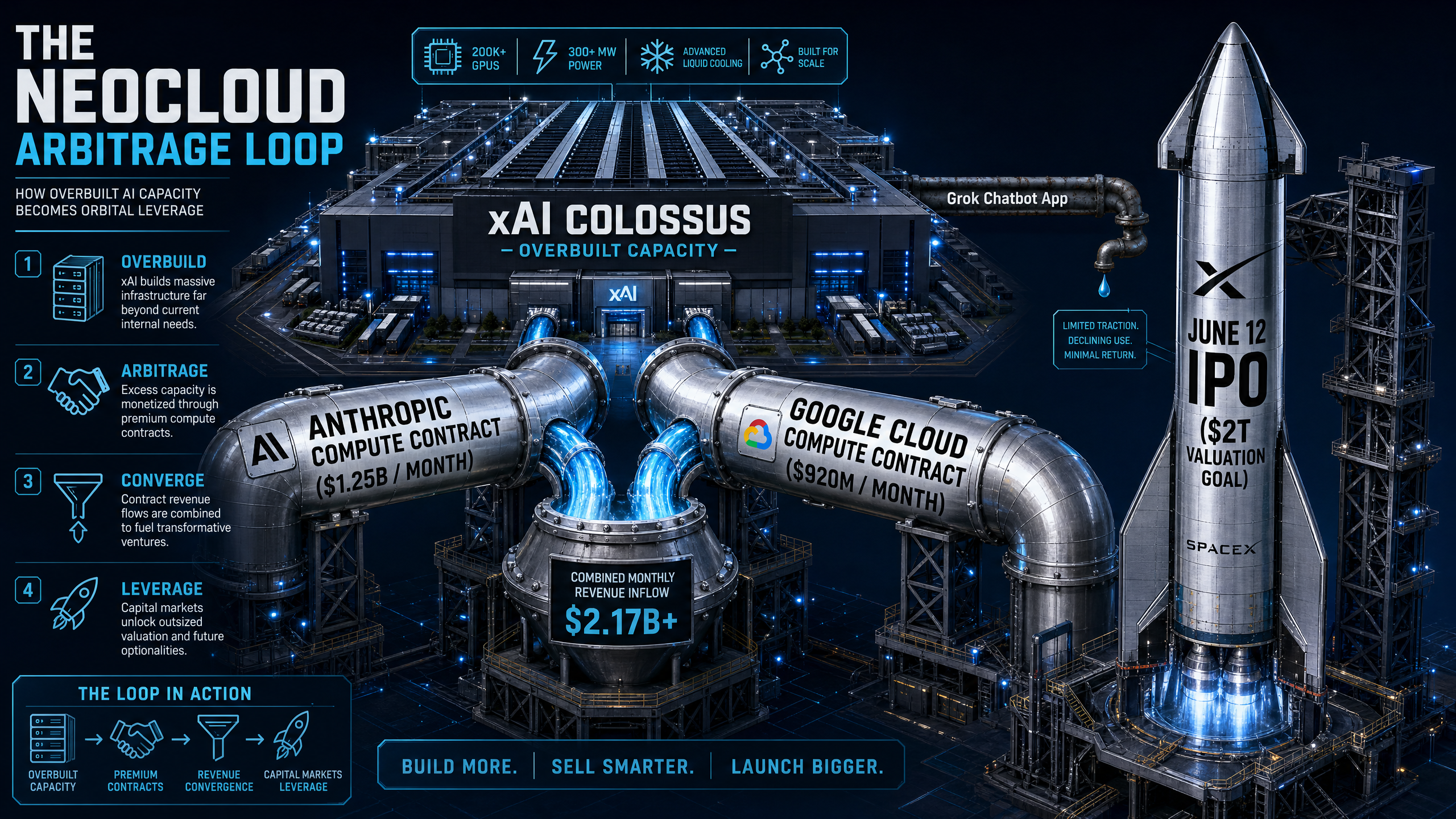
Less than a week before its scheduled stock market debut—billed as the largest IPO in history with a $1.77 trillion target valuation—SpaceX has finalized a jaw-dropping financial transformation. By signing a $920 million-per-month cloud services agreement with Google, on top of its recent $1.25 billion-per-month deal with Anthropic, SpaceX has quieted critics of its capital-intensive rocket programs by turning itself into an AI computing juggernaut. Combined, these two rival frontier-model builders are injecting a staggering $2.17 billion per month ($26 billion annually) into SpaceX. This is the ultimate “neocloud arbitrage.” Elon Musk’s xAI, which was quietly acquired and merged into SpaceX earlier this year, built massive computing structures like the 300-megawatt Colossus 1 cluster in Memphis, only to watch consumer engagement with its Grok chatbot decline. Instead of letting its highly prized, scarce silicon sit idle, SpaceX has reinvented its AI unit as a merchant cloud provider, renting raw compute pipelines back to the very competitors it once aimed to displace.
Yet, this masterclass in pre-IPO balance sheet engineering has run headfirst into Wall Street’s old guard. Just as SpaceX, backed by its underwriting banks, attempted to lobby for a fast-tracked entry into major market indices, the S&P Dow Jones Indices Committee delivered a blunt rejection. The committee declined to rewrite its eligibility rules for “MegaCap” companies, which would have slashed the mandatory stock-listing wait times and waived the requirement for cumulative GAAP profitability over the prior four quarters. Had the committee yielded, passive index funds tracking the S&P 500 would have been forced to immediately absorb not only highly volatile, capital-shredding AI giants, but also OpenAI and Anthropic upon their respective listings. This defensive stance protects Main Street retail investors from the highly volatile capex cycles and internal feedback loops of the AI frontier, signaling that the gatekeepers of modern passive investing remain deeply skeptical of paper profits generated inside tech’s most insular circle.
The rejection highlights the highly cooperative, almost incestuous nature of today’s tech bubble. Google, which holds a diluted equity stake in SpaceX stemming from a $1 billion investment in 2015, is now sending $920 million of cash back to SpaceX every month to lease 110,000 Nvidia GPUs. Meanwhile, Anthropic, which counts Google as a major financial backer, is paying SpaceX $1.25 billion a month. This creates a dizzying circular loop of capital. On Hacker News, the community was quick to spot the financial gymnastics, with user tristanj calculating how these massive B2B revenues artificially boost SpaceX’s paper valuations, noting: “Google spends 10 billion to gain a massive chunk of value in its equity stake.” Others, like user amazingamazing, pointed out the sheer, raw constraint of physical supply chains: “All it means is that SpaceX has compute and Google does not… For such an important commodity there are shockingly few players ready for scale.” In this gold rush, the ultimate shovel-maker is no longer just Nvidia; it is the entity that was crazy enough to secure the electrical grid connections and cooling pipes first.
This shift signals the dawn of “merchant infrastructure” as the dominant business model for frontier AI. Operating a sovereign, vertically integrated chatbot company is proving to be a punishingly expensive game, as evidenced by xAI posting a brutal $2.5 billion operational loss in Q1 2026 on organic revenues of only $818 million. By pivoting to a “neocloud,” SpaceX can offset the immense depreciation of its hardware while offering other labs the raw silicon oxygen they need to survive. However, this model is built on shaky ground. Both the Google and Anthropic agreements feature incredibly fragile terms, allowing either side to terminate on just 90 days’ notice. If Google brings enough of its own TPU infrastructure online, or if Anthropic faces capital constraints, SpaceX’s multi-billion-dollar merchant cloud revenue could collapse as quickly as it materialized.
Ultimately, SpaceX’s neocloud pivot is brilliant, opportunistic corporate positioning. By turning idle, over-provisioned consumer infrastructure into high-margin B2B compute leases, Musk has successfully rebranded a highly speculative aerospace play into the world’s most crucial AI utility directly before listing on Nasdaq. But the S&P 500’s refusal to bend its rules is a vital sanity check. The index committee understands what the hype machine tries to paper over: a financial loop where three tech titans sit in a room renting the same microchips to each other does not constitute a sustainable, diversified macroeconomic index. By forcing these mega-caps to prove actual, unassisted GAAP profitability over a mature timeline, the S&P 500 is protecting public markets from a systemic contagion if the AI capex bubble finally pops.
Sources
- Google will pay SpaceX $920M per month for compute - TechCrunch
- Anthropic will pay xAI $1.25B per month for compute - TechCrunch
- S&P 500 rejects SpaceX, also blocking entry for OpenAI and Anthropic - Ars Technica
- Hacker News discussion on the S&P 500 decision
- Hacker News discussion on the Google SpaceX compute contract
- SpaceX SEC FWP Cloud Service Agreement Filing