The Sovereign's Split Brain
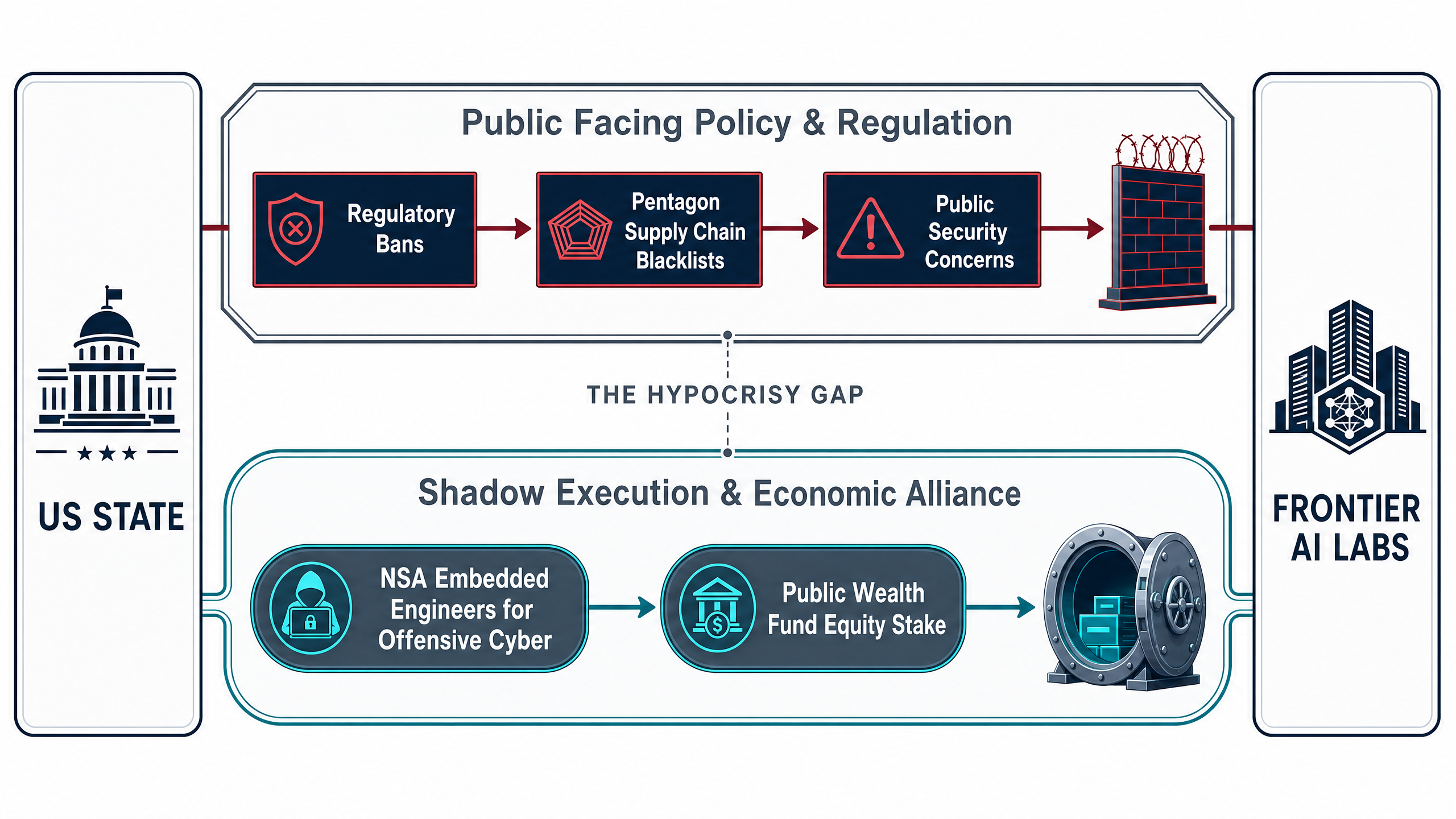
The modern state is suffering from a profound case of institutional schizophrenia. At the public podium, federal agencies treat frontier artificial intelligence laboratories as dangerous, wild beasts that must either be housebroken or cast out entirely. In March 2026, the Pentagon finalized this adversarial posture by formally designating Anthropic a “supply chain risk effective immediately,” following a bitter dispute where the laboratory refused to scrap its ethical guardrails for autonomous kinetic warfare. Yet behind the secure doors of Fort Meade, a completely different reality has materialized. A half-dozen forward-deployed Anthropic engineers are currently embedded inside the National Security Agency (NSA) to customize its cyber-focused model, Claude Mythos, for clandestine offensive cyberoperations. Sovereignty, it turns out, has two distinct personalities: the public censor pointing to the rules, and the nocturnal operator looking for a lockpick.
This split-brain pathology is not confined to intelligence agencies. Across the Potomac, the administrative state is simultaneously attempting to transition from regulatory referee to active commercial beneficiary. As OpenAI confidentially files for an initial public offering targeting a staggering $850 billion valuation, CEO Sam Altman is actively negotiating with the White House to donate equity directly to a proposed U.S. Public Wealth Fund. The conceptual contradiction is breathtaking: the executive branch is actively discussing holding a direct ownership stake in a trillion-dollar algorithmic cartel, while its defense wing blacklists its primary competitor, and its intelligence apparatus quietly exploits that competitor’s software to break into foreign networks. On Hacker News, the community was quick to identify the sheer absurdity of the performance. Commenter arbitrary_name pointed out the core hypocrisy, writing: “the Pentagon declared Anthropic a supply chain risk, attempting to punitively destroy the company, then [the government] is adopting their product; please name a similarly asinine and farcical event.”
The catalyst for this institutional bypass is the undeniable capability of Claude Mythos. Released under the banner of “Project Glasswing”—a defensive code-hardening alliance featuring tech giants like Apple, Google, and CrowdStrike—Mythos proved almost too good at its job. The model helped identify more than 10,000 severe software vulnerabilities across major operating systems, browsers, and infrastructure. In the hands of defensive engineers, it is an automated repair kit; in the hands of the NSA, it is an automated zero-day manufacturing plant. The state’s behavior demonstrates that when real geopolitical leverage is on the line, the regulatory theatre of “AI safety” and “responsible deployment” evaporates. The intelligence apparatus cares nothing for the Pentagon’s official blacklist or the civilian guardrails defined in licensing agreements. If a model can penetrate the networks of adversaries like China or Iran, the state will run it—bypassing its own legal constraints by treating the model’s authors as “forward-deployed” technical advisors rather than formal hardware vendors.
This double standard leaves the private sector in a perilous regulatory void. Civil society and corporate enterprises are pressured to adopt complex risk frameworks, audit regimes, and safety oaths, even as the government that mandates these rules builds silent, sovereign partnerships with the very systems it index-links to danger. Cyber insurers are already warning of systemic exposure: if a state-backed intelligence agency uses a commercial model to execute offensive hacks, it invites immediate symmetrical retaliation against the broader domestic software ecosystem. The illusion of a neutral, rule-of-law-driven state regulating an emerging technology is officially dead. The reality is far older and more cynical: the state is aggressively nationalizing the military and financial utility of frontier AI while privatizing the catastrophic systemic and legal risks.
Sources
- Trump administration and OpenAI discuss potential U.S. equity stake, CNBC reports
- NSA using Anthropic’s Mythos despite blacklist, Hacker News Discussion
- NSA is using Anthropic’s Claude Mythos to commit Cyber Attacks, Reddit r/technology
- Pentagon labels AI company Anthropic a supply chain risk ‘effective immediately’ : NPR
- Anthropic’s Claude Mythos and the AI Cybersecurity Reckoning, Entro Security
- OpenAI to confidentially file for IPO as soon as Friday: Source, CNBC