The Munich Injunction: The Day the AI Disclaimers Failed
Mat notes that “This case is a lever, not the subject. The subject is that the AI hype bubble has quietly reduced standards — we are now asked to accept the inherent weakness of an AI-powered answer engine as the normal baseline for ‘looking something up.’ The Munich ruling is the first institution to refuse that bargain.” For decades, the digital search ecosystem relied on an implicit contract: search engines index the web, and the user applies the judgment. But with the aggressive rollout of generative search summaries, Google did not just rebuild its interface; it altered the nature of the speech act itself. As Mat observes, AI Overviews are Google’s public-facing AI brand, full stop. Whatever technical monuments are operating behind the Enterprise curtain, the overview is the actual surface the public touches. To borrow Mat’s phrasing, asserting that “the kitchen out back is Michelin” is no defence when the shop window displays off mince.
The Regional Court of Munich (Landgericht München I, case 26 O 869/26) stripped away the traditional “search engine liability shield” in a landmark preliminary injunction. The legal dispute arose when Google’s AI Overview boldly asserted that two local publishers were linked to scams and “dubious business practices”—allegations that did not appear in any of the linked source documents. Under traditional European and German intermediary laws, search engines operate as indirect infringers who merely point to third-party content. However, the court ruled that because the AI Overview actively rewrote, evaluated, and synthesized information in its own narrative voice and structure, it constituted Google’s own published speech. Crucially, the finding is defamation-specific rather than a sweeping decree that AI cannot make generic errors, but its precedent is devastating. The court further declared that AI-generated summaries earn thinner constitutional free-speech protections because an algorithm’s output is not the expression of an acquired human conviction, but the deterministic execution of a commercial product.
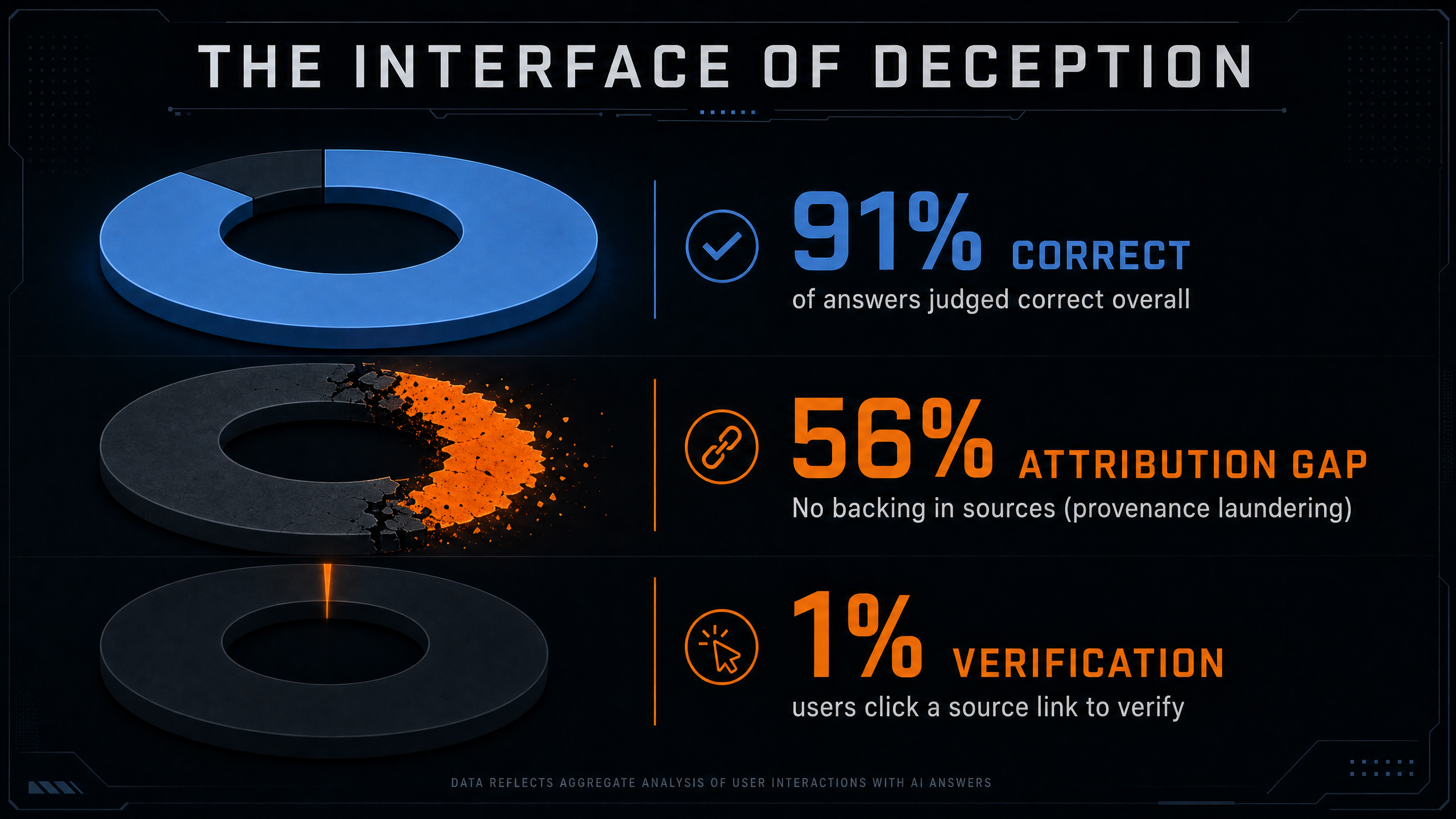
At the technical level, this ruling exposes what Mat describes as “provenance laundering.” The founding genius of Google was a ranking algorithm that indexed sources, maintained their distinct identities, and laid them bare for the reader to evaluate. Generative overviews break this engine. They ingest disparate web data, average them into an unranked, unattributable assertion, and present it with the total, unblinking authority of a textbook. This architectural defect is systemic: in an Oumi analysis for the New York Times, researchers found that while Gemini 3 AI Overviews answered correctly roughly 91% of the time, some 56% of those “correct” answers could not actually be supported by the sources Google chose to link beneath them. In other words, the retrieval layer never justified what the synthesis layer asserted. Google argued that this risk is mitigated because users know to treat AI skeptically and can “double-check” the sources. But a Pew study reveals that only about 1% of users actually click a source link in an AI Overview. The feature is not an index; it is designed to be terminal.
This revealing disparity exposes the terminal flaw in the standard “buyer beware” defense of generative search: the third-party-victim asymmetry. If a user absorbs a false hallucination about a generic topic, the primary victim is the user who was misled. But in defamation, the victim is the third party being lied about—who may never have used Google’s AI tool and has absolutely no recourse. Critical thinking by the reader cannot protect a business or individual being systematically defamed behind closed doors. Furthermore, Google had a “third door” conceptually available to them: they could have asynchronously precomputed high-trust knowledge graphs, cached them, and simply suppressed the AI overview whenever the confidence metric fell short. As Mat notes, “It’s far better to just give us the search results if you’re going to surface junk.” Yet they declined to implement this filter because an overview that admits it does not know is a worse Wall Street demo.
This model of avoiding liability while harvesting the financial upside is a historical rhyme. Every technological leap arrives with a linguistic framing designed to extract the commercial upside while disclaiming the social liability: “the platform merely hosts” (Section 230), “we only connect drivers” (the gig economy), and now “AI can make mistakes” (generative search). In each wave, courts eventually peer through the industry-designed terminology and relocate liability to the party harvesting the margins. By ordering Google to cover 80% of the legal fees in this preliminary proceeding, the Munich court became the first to declare that if you profit from being the oracle, you must pay for being a liar. Ultimately, it took a defamation suit from two quiet regional publishers—not the engineers, regulators, or ethicists building this technology—to finally state what the tech industry sought to obscure: the baseline standard of truth has been quietly lowered, and the public did not sign the contract.
Sources
- Landgericht München I, Case Ref: 26 O 869/26 (German Regional Court Ruling PDF)
- Landmark German ruling declares Google’s AI Overviews are Google’s own words and makes it liable for false answers - The Decoder
- German ruling declares Google liable for false answers in AI Overviews - Hacker News Discussion
- Munich court holds Google liable for AI Overviews defamation - a first - PPC Land
- LG Munich I: Google ordered to pay for false statements in AI summaries - Heise