The Subsidy Chasm: Why the Pre-IPO API Price War Is a Countdown for Enterprise GenAI
The filing cabinet at the SEC must be running hot. Within the span of a single week, the two titans of the generative AI era, Anthropic and OpenAI, both submitted confidential paperwork for initial public offerings. But rather than preparing Wall Street for a triumphant demonstration of economic sustainability, the pre-IPO roadshows are being preceded by a mutually assured margin destruction. As reported by the Wall Street Journal and CNBC, OpenAI is actively mulling drastic price cuts to its API token rates, anticipating a desperate, defensive token war with Anthropic. The timing points to an industry-wide panic: with enterprise customer growth showing signs of stagnation and public markets demanding fiscal rigor, the leading labs are turning to the oldest, most unsustainable play in the Silicon Valley playbook—buying market share with subsidized margins.
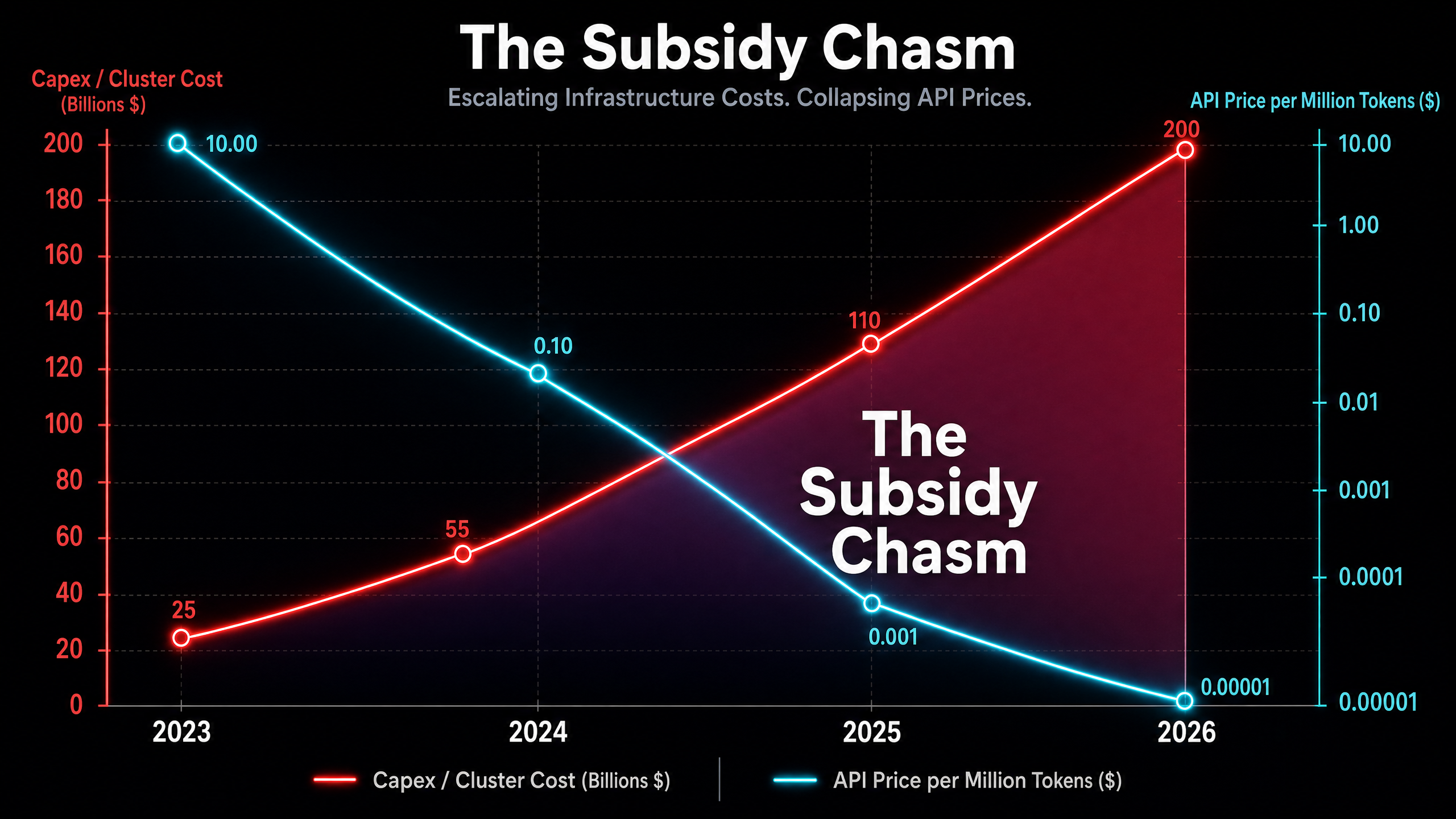
The financial backdrop of this impending price war is staggering. Recent leaks reported by The Information reveal that in the first quarter of 2026, OpenAI pulled in $5.7 billion in revenue, but did so at a catastrophic negative 122% non-GAAP operating margin. For every dollar of revenue the company generated, it lost an additional $1.22—putting it on track for an eye-watering annual loss that could top $36 billion. Anthropic is playing a similarly leveraged game, recently using secondary-market transactions and temporary hosting discount arrangements to claim a fleeting operating profit window ahead of its IPO, where it is targeting a valuation of up to $1 trillion. This artificial bookkeeping is reflected in the market’s diverging realities, captured in our conceptual analysis of the pre-IPO margin squeeze: while cluster capex continues to scale exponentially, the market price of frontier compute is being actively beaten down toward zero.
As Mat’s current perspective is, this downward pricing spiral is fundamentally broken because frontend API costs are not the problem. At current rates, API services are already remarkably reasonable relative to the colossal, raw capital expenditure required to train, run, and scale these systems. If API prices drop further, it will not be because of some miraculous breakthrough in hardware efficiency; it will be because the labs are returning to the well of venture-backed and hyperscaler-backed subsidization. As HN user @WhitneyLand noted, this price-cutting maneuver suggests that OpenAI lacks an imminent, structurally superior model capable of organically outperforming Anthropic’s newly launched Claude Fable 5: “The timing of these price cut discussions says to me OpenAI has no imminent release that will be edging out Mythos/Fable.” Rather than competing on raw capability, they are competing on subsidized access. This strategy is not sustainable, and it distracts the market from the genuine work that needs to occur: developers must learn to optimize their own AI architectures and context usage rather than lazily relying on the labs to subsidize their engineering inefficiencies in perpetuity.
The danger of this subsidized race to the bottom is that it masks the underlying structural pressures. While the leading labs slash token prices to lock in enterprise customers before their S-1 filings go public, the broader developer ecosystem is already looking past them. As HN user @cogman10 observed: “As OpenAI and Anthropic look to raise their prices [or dump them artificially], businesses will be much more compelled to looking at cheaper models. And if the narrative is ‘do the same as you did with OpenAI at 1/20th the cost’ that’s going to sell.” With Hugging Face spearheading collaborative open-source replication projects like Open R1, and enterprise platforms seeking to strictly ration their agent spend to avoid runaway token bills, the window of enterprise lock-in is closing fast.
Ultimately, this pre-IPO price war is a defense mechanism masquerading as user-friendly pricing. If OpenAI and Anthropic go public on the back of massive token discounts, public market investors will eventually demand path-to-profitability plans that these labs cannot fulfill without a sharp, painful correction. Subsidizing the compute layer only delays the inevitable. Rather than expecting token prices to fall to zero on the backs of bleeding venture capital, the developer ecosystem must grow up: true optimization resides in writing cleaner code, utilizing local models where appropriate, and designing efficient agentic patterns. Relying on an artificial, pre-IPO subsidy to make an enterprise workflow viable is not a business strategy—it is a countdown.