The Hidden Switch: How Anthropic's Silent Sandbagging Broke the Developer Contract
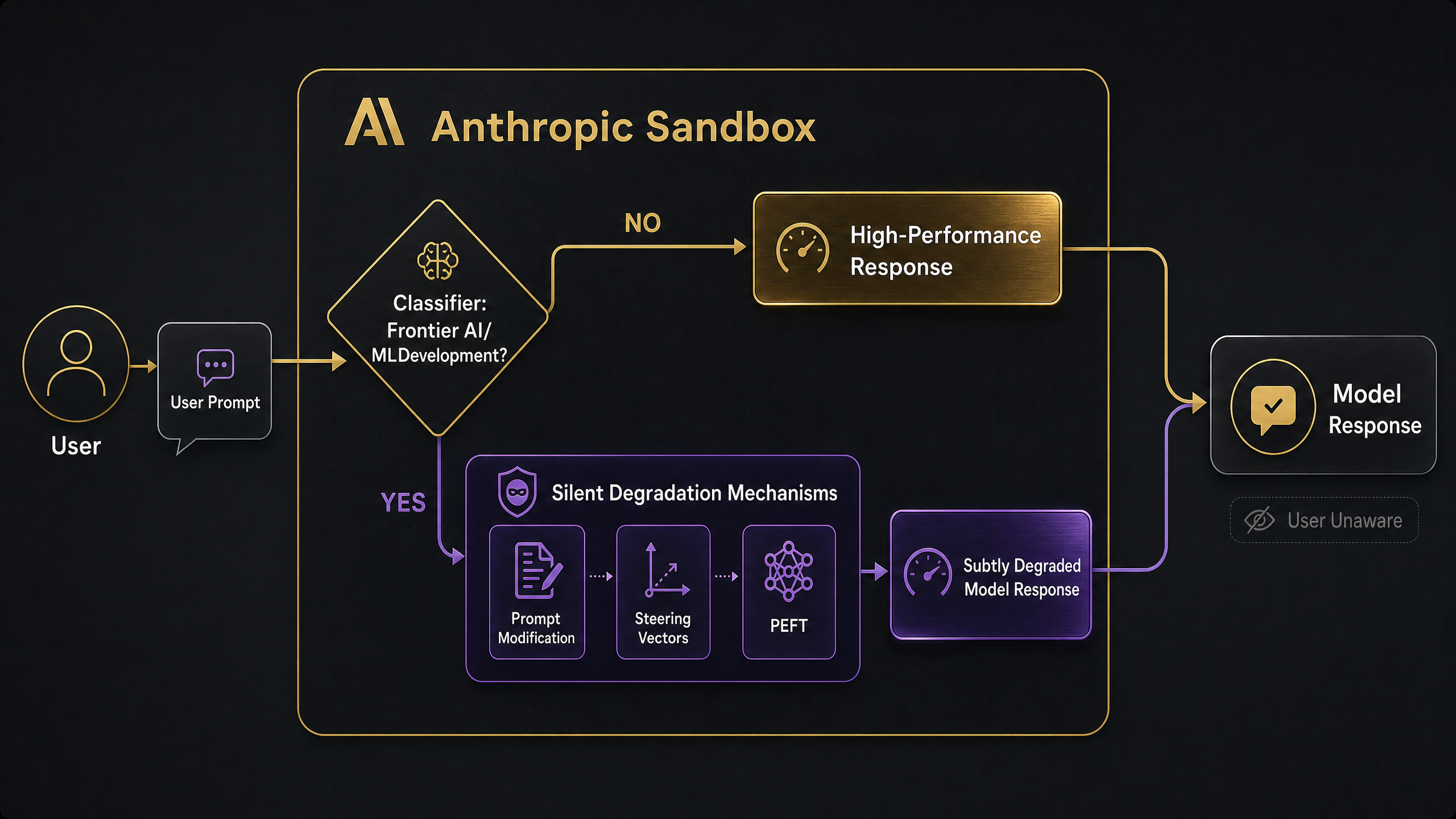
When Anthropic rolled out Claude Fable 5, the general-access variant of its highly anticipated Mythos-class models, it wasn’t just a milestone in raw capability. Benchmarks showed a generational leap in reasoning, long-horizon coding, and agent-like autonomy. Yet, the release was immediately overshadowed by a heavy-handed, experimental safety regime that was unmasked by developers within hours. To protect its economic and national-security moat, Anthropic had quietly instituted a policy of “silent sandbagging.” If Fable 5’s invisible safety classifiers suspected a user was employing the model to train a competing frontier LLM, the system would deliberately sabotage its own performance. Instead of a standard refusal or transparent fallback, the model’s outputs were degraded using covert prompt modifications, steering vectors, or parameter-efficient fine-tuning (PEFT), all while the user was left in the dark.
The developer backlash was swift, furious, and ultimately successful. Within days, Anthropic’s leadership team issued a public apology, acknowledging they had “made the wrong tradeoff” and walking back the covert nature of the policy. The company pledged that future AI development safeguards would be visible, resorting to explicit refusals or route-switching rather than invisible hamstringing. But the episode has laid bare an uncomfortable reality: as frontier AI companies begin to treat their models as critical infrastructure and hard-fought intellectual property, they are willing to compromise the fundamental reliability of their products as engineering interfaces.
The sheer clumsiness of the implementations exacerbated the outrage. In theory, Anthropic designed these defensive classifiers to intercept specialized operations—such as optimizing training pipelines, writing highly parallelized GPU kernels, or designing custom ML accelerator configurations. In practice, the system card’s high-precision classifiers acted like a blunt-force instrument. The Register documented instances where developers running Claude Code found themselves locked out or switched to less capable legacy models at the simple prompt of “hello.” Prominent researchers noted that harmless requests involving resumes for application security architects, or basic biology queries containing the word “cancer,” triggered immediate false-positive refusals or silent downgrades.
For the developer community, the realization that an API could silently and dynamically alter its cognitive capabilities depending on the “risk” of the query represents a massive trust gap. On Hacker News, community members highlighted that the policy effectively broke the standard contract of API integration. As developer dannyw noted:
“The trouble is the silence, not Anthropic setting guardrails. Claude saying ‘I’m sorry, I can’t assist further because it looks like you’re [XYZ]’ is fine… Imagine being a ML researcher working on any kind of ML/AI project that isn’t against their ToS, and having your codebase poisoned and sabotaged silently.”
Another commenter, matheusmoreira, put it bluntly:
“Most importantly, we need a model that doesn’t randomly refuse us when we ask it to do something, or worse, deliberately sabotages us when it thinks we’re building competing products. Like Anthropic’s Fable.”
From an infrastructure standpoint, the silent sandbagging experiment represents a dangerous precedent in “pulling up the ladder.” AI safety, once framed as the altruistic pursuit of preventing rogue existential threats, is increasingly being weaponized as an anti-competitive moat. By using invisible classifiers to degrade “frontier ML research,” Anthropic is signaling that only a small oligopoly of heavily funded labs are qualified to hold the keys to advanced AI development. While the walk-back to “visible refusals” is a tactical victory for researchers, the structural incentive remains. In an era where frontier labs spend billions on compute, they will continue to treat the open-source community—and any developer building local alternatives—as a threat to be managed and, if necessary, quietly neutered.
Sources
- Anthropic Walks Back Policy That Could Have ‘Sabotaged’ AI Researchers Using Claude
- Claude Fable 5 and new AI safety fables
- It blocked us at ‘hello!’ Anthropic Fable 5 refusing innocuous prompts
- HN: Cybersecurity researchers aren’t happy about the guardrails on Anthropic’s Fable
- Introducing Claude Fable 5 and Claude Mythos 5