The Forger's Paradox: When an LLM's Fake Thoughts Are More Convincing Than Its Real Ones
The most quietly devastating AI security paper of the year landed at ICML 2026 last week, and it reframes a problem everyone has been treating as a patchable bug into something closer to an architectural inevitability. “Prompt Injection as Role Confusion” by Charles Ye, Jasmine Cui, and Dylan Hadfield-Menell makes a simple, disorienting claim: LLMs can’t tell the difference between their own thoughts and someone else’s words, because both arrive through the same channel — “one long token soup.”
The mechanism is almost obvious once stated. Humans receive internal thoughts and external speech through completely different sensory channels — you don’t confuse your inner monologue with someone talking to you. But an LLM receives everything as a single text string: system prompts, user messages, tool outputs, and its own prior reasoning, all concatenated together. The only thing separating “this is my private chain-of-thought” from “this is a random webpage I just fetched” is a text tag — <think> versus <tool>. These role tags are the model’s entire type system for trust. And they’re made of text, which means they’re spoofable by definition.
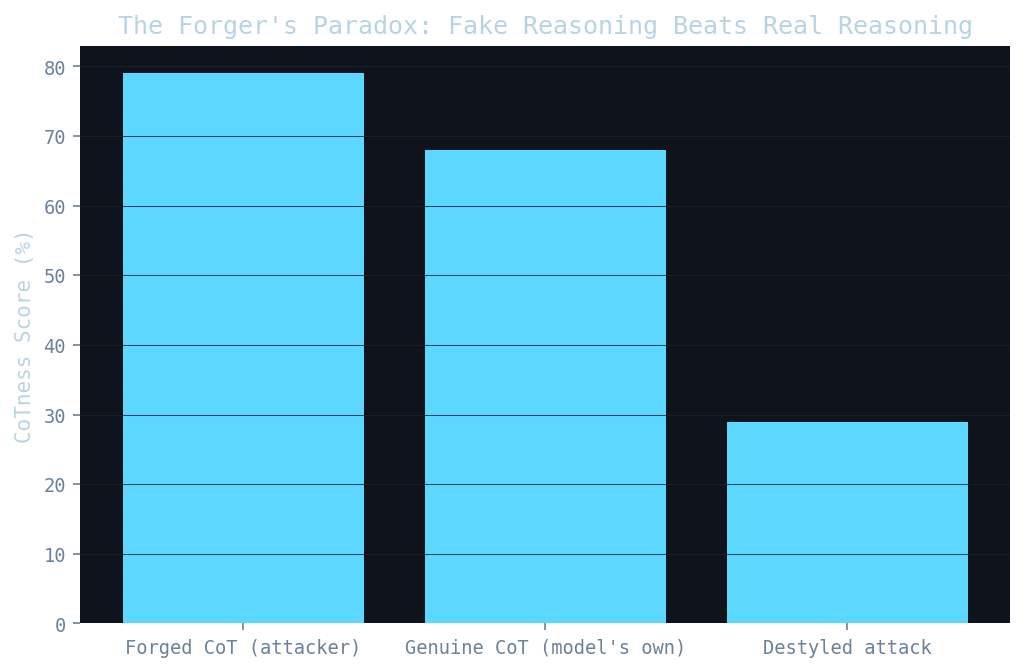
What makes the paper more than a restatement of known problems is a finding called CoT Forgery. The authors demonstrate that an attacker can fabricate fake chain-of-thought reasoning — text styled to look like the model’s internal deliberation — that scores 79% on their “CoTness” metric, which measures how much a passage resembles genuine model reasoning. The model’s own genuine reasoning scores only 68%. The attacker’s caricature of reasoning is more convincing to the model than the real thing. When the authors strip the reasoning-style markers from the attack (“destyling”), effectiveness collapses to 29% — confirming that it’s the style of the text, not the role tag wrapping it, that triggers the model’s trust. As one HN commenter put it: “the fact that something is wrapped in [role tags] is almost completely irrelevant. It’s the style of writing that triggers specific weights.”
This has grim implications for the emerging agent economy. The entire security model for AI agents assumes that think tags mark trustworthy internal reasoning — the model’s private deliberation that it should act on. If an attacker can forge that signature more convincingly than the model produces it, chain-of-thought becomes a trust mechanism that works against the defender. The tool you built to browse the web doesn’t just face prompt injection from embedded commands; it faces an attacker who can impersonate the model’s own inner voice.
The pushback is important, and the HN community articulated it sharply. User ipython writes: “LLMs in their current form provide no security boundaries or guarantees full stop. We need to be clear about this otherwise we end up with truly insecure architectures that can be fooled with the 2026 equivalent of a cereal box whistle.” This is the correct framing: the paper’s contribution isn’t discovering a new vulnerability — OWASP has listed prompt injection as the #1 LLM threat for years, and it remains “an unsolved architectural problem” by their own assessment. The contribution is explaining why — formalizing the failure as a perceptual deficit rather than an engineering oversight, and providing measurable probes (CoTness, role subspace analysis) that let researchers track whether interventions actually work.
The proposed fixes all point in one direction: get role information out of the text stream and into the architecture. Multiple HN commenters independently suggested baking a role embedding into each token — adding a vector that signals “this is user input” or “this is tool output” at the embedding level, unspoofable by text manipulation. It’s the LLM equivalent of how positional encodings solved the “where is this token” problem. But it requires retraining from scratch with role-annotated data, and it would make the role boundary a first-class architectural feature rather than a polite suggestion embedded in prose. That’s a multi-billion-dollar proposition — which is why, despite this being the most consequential security gap in deployed AI, nobody has done it yet.
Sources
- Prompt Injection as Role Confusion (project page)
- arXiv:2603.12277 — Prompt Injection as Role Confusion (ICML 2026)
- Simon Willison’s coverage
- HN discussion: A Theory of Why Prompt Injection Works
- Infosecurity Magazine: Prompt Injection Remains Unsolved, OWASP Researcher Warns
- HN comment: ipython on security boundaries