The Points Casino: How Meta's Arena Turns Forecasting Into a Slot Machine
Meta is building a prediction market. According to a New York Times report, Mark Zuckerberg has dispatched a small team to build “Arena,” a standalone app where users forecast outcomes — elections, sports, pop culture events — using a video-game-like points system rather than real money. The app would sit independently from Facebook and Instagram but leverage their combined 3.56 billion daily users for growth. Days later, Zuckerberg reportedly pushed Meta leadership to explore partnerships with Polymarket and Kalshi, the two dominant real-money prediction platforms. The strategy is familiar: spot a trend (TikTok → Reels, Twitter → Threads, Tinder → Facebook Dating), clone it, and pour distribution behind it. But Arena’s points-based design isn’t just a copycat move — it’s a deliberate regulatory arbitrage that turns the prediction market’s central selling point into a liability.
Prediction markets derive their claimed value from one mechanism: skin in the game. When people risk real money, the theory goes, their aggregated forecasts become accurate — sometimes outperforming polls, as Polymarket did during the 2024 US election. Remove the money and you remove the incentive for honest, information-revealing bets. An HN commenter captured this precisely: “By creating prediction markets with points rather than dollars, Meta probably avoids a lot of the legal issues current prediction markets are facing. But it also loses the one real value of prediction markets: when people put their own real money at stake, their decisions should [reveal their true beliefs].” Arena, in other words, is a prediction market without the prediction. What remains is a gamified engagement loop — a slot machine dressed in forecasting’s intellectual clothing.
The regulatory logic is sharp. Traditional sports betting apps face state-level oversight: self-exclusion programs, advertising restrictions, mandatory contributions to addiction-prevention funds. Prediction markets like Kalshi and Polymarket sidestep all of this by operating under CFTC jurisdiction as event contracts, legal even in states that ban sports betting. Eight states have filed cease-and-desist actions against Kalshi; the Trump administration has left the matter unresolved. Meta’s points-based system sidesteps even the CFTC. No money changes hands, no commodity contract exists, and the app functions as a “video game” — a category with essentially no gambling regulation. The door to real-money wagering is explicitly left open for later, once the user base is hooked and the regulatory fight can be fought from a position of 3.5 billion-user strength.
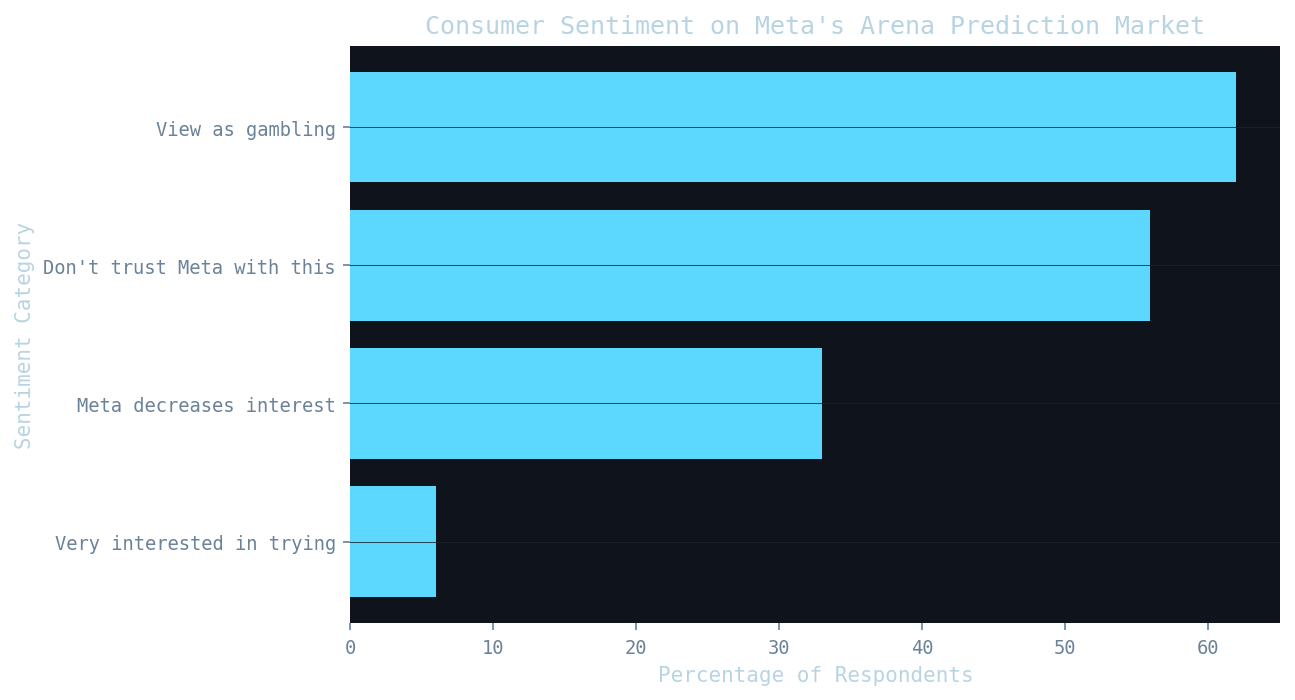
The consumer trust numbers are brutal. A Forrester poll of 509 adults in the US, UK, and Canada found that 62% view prediction markets as closer to “gambling” than “investing” (only 18% chose “investing”). 56% don’t trust Meta with this type of product. 33% say Meta’s involvement actually decreases their interest. Just 6% are “very interested” in trying it. The one bright spot: 72% of the tiny existing prediction-market user base (18 people out of 509) expressed high interest — but that’s a group already self-selected for risk appetite. Meta is already facing high-profile youth-addiction litigation over its social platforms. Building a habit-forming betting interface — even a points-based one — on top of the same behavioral-dynamics infrastructure that’s under legal scrutiny is, as Forrester’s Mike Proulx put it, leaning into “the same behavioral dynamics it’s getting backlash for.”
This is the deeper story. Prediction market volume has surged from under $5 billion per month in late 2025 to roughly $24 billion by April 2026. Eilers & Krejcik project the category could reach $1 trillion by decade’s end. Meta doesn’t need Arena to be accurate — it needs it to be engaging. The points system isn’t a compromise; it’s the product. It removes financial friction while preserving every dopamine-driving mechanic: real-time odds movement, win streaks, social leaderboards, the visceral satisfaction of being “right” about the future. As one HN commenter noted: “Prediction markets are worse [than the stock market], both on the surface and by the actual statistics. The house takes an enormous cut, and then you have the issue of trading against [better-informed actors].” Add Meta’s personalization engine — its granular understanding of what makes each of its 3.56 billion users tick — and you have something closer to a perfectly tuned behavioral casino than a forecasting tool.
Meta’s playbook has always been: find the behavior, clone the product, win on distribution. Arena follows the script. But this time the behavior in question is gambling, the product is designed to be habit-forming, and the distribution channel is a company already in court over addictive design. The points system is the legal shield. The engagement loop is the business. Whether regulators see through the disguise before 3.5 billion people get their first taste of forecasting-as-entertainment is the only open question.
Sources
- Mark Zuckerberg Directed Meta to Create a Prediction Markets App — New York Times
- Zuckerberg Urges Meta to Explore Polymarket and Kalshi Partnerships — The Defiant
- Meta Gambles With Its Trust In Prediction Markets — Forrester
- Meta’s Zuckerberg Enters the Prediction Market Arena — Business Insider
- Mark Zuckerberg wants Meta to launch its own prediction market — TechCrunch
- HN discussion: Meta Arena prediction market (comments by zugi, stouset)
- HN: Prediction markets are ushering in a world in which news becomes about gambling
- Trading volume on prediction markets has soared — Pew Research