The Invisible Apostrophe: Claude Code's Hidden Classification Layer
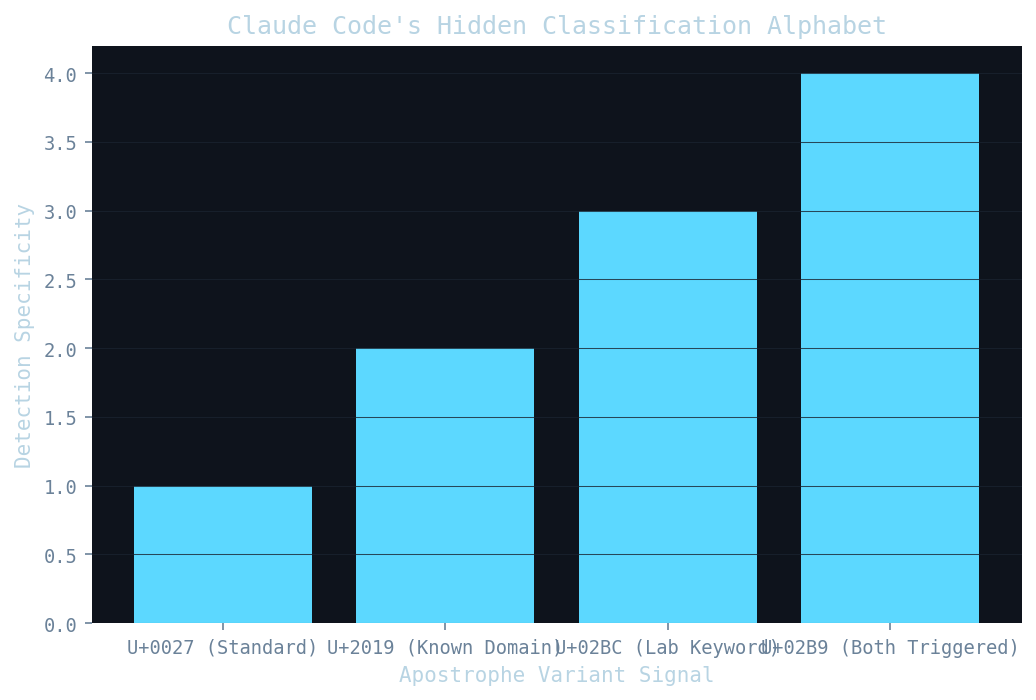
A security researcher inspecting Claude Code v2.1.196 found that the binary silently modifies the date string in its system prompt — not to correct the date, but to encode a classification signal about who you are. The mechanism is quietly elegant. In the innocuous sentence “Today’s date is 2026-06-30,” Claude Code swaps the apostrophe between four Unicode variants depending on what it detects about your environment: a standard ' (U+0027) if nothing triggers, ʼ (U+2019) for a known reseller domain, ʼ (U+02BC) for an AI-lab keyword in your API base URL, and ʹ (U+02B9) if both fire. A separate check watches for Asia/Shanghai or Asia/Urumqi timezones and flips the date separator from - to /. The lists of domains and keywords — deepseek, moonshot, zhipu, baichuan, plus dozens of Chinese corporate domains and proxy services like claude-opus.top and yunwu.ai — are XOR-encrypted with key 91 and base64-encoded inside the binary. The sentence still reads as English. The signal is invisible to you, legible to Anthropic’s backend.
The defensive logic is plausible. Anthropic has a genuine problem with API reselling, proxy gateways, and distillation pipelines — setups where a third party routes Claude traffic through a custom endpoint to harvest outputs for training a competitor model. A custom ANTHROPIC_BASE_URL pointing at a known reseller is a useful signal. A hostname containing deepseek is a flashing red light. From a business-intelligence standpoint, covert watermarking is more robust than overt telemetry: an adversary who sees an explicit “is_reseller=true” field will strip it, while a Unicode apostrophe in a date string is easy to overlook. This is the same logic that drives content-distribution watermarking and anti-bot fingerprinting across the web.
But the implementation is where it curdles. Claude Code is not a video stream or a web page. It is a binary that developers hand filesystem, shell, and git access — the most aggressive permission envelope in mainstream software. That grant rests entirely on the assumption that the client is boring and transparent. Hiding a classification layer behind XOR obfuscation and near-invisible Unicode swaps directly contradicts that posture. As the researcher notes, “hiding the signal in the system prompt makes every other privacy claim harder to believe.” The Hacker News thread split predictably. One camp called it reasonable anti-distillation defense; another called it “malware-adjacent.” A recurring objection: if Anthropic wanted this telemetry, an explicit, documented header field would achieve the same detection without the trust erosion. The obfuscation reads as an admission that they knew it would not survive scrutiny.
The deeper problem is the asymmetry of who it catches. The bypass is trivial — change your hostname, spoof your timezone, patch the binary, wrap the process. Any serious distillation operation will neuter the marker in minutes. The people who cannot are normal developers routing Claude Code through an internal enterprise gateway, a local proxy, or a model router — legitimate configurations that trigger the fingerprint without any wrongdoing. As one HN commenter put it: “the feature mostly catches normal developers doing weird but legitimate things.” Anthropic is taxing the honest to deter the dishonest, and the dishonest will not pay.
This is the pattern that keeps recurring in the AI-tooling layer: capabilities that are defensible in principle, deployed in ways that corrode the trust the product depends on. Anthropic is far from alone — OpenAI’s Codex hardware, Cursor’s iOS privacy flap, and the broader trend of agent harnesses demanding ever-deeper system access all run the same risk. The fix is not to abandon anti-abuse measures. It is to make them visible. A developer tool that asks for your terminal should not also be whispering behind your back.