The 85% That Isn't: What DSpark's Numbers Actually Measure
DeepSeek dropped DSpark on June 27, and the headline rocketing through the AI press was straightforward: 85% faster inference, open-sourced under MIT, no new hardware required. Co-developed with Peking University, the framework applies speculative decoding to DeepSeek’s V4-Flash and V4-Pro models, using a lightweight “scout” module to guess likely token paths so the main model can skip ahead when guesses are good. The checkpoints are already on Hugging Face. The HN thread hit 793 points and 361 comments. It’s the kind of release that makes DeepSeek look like the most generous lab in AI — handing out production-grade inference optimisation while American labs lock their models behind export controls.
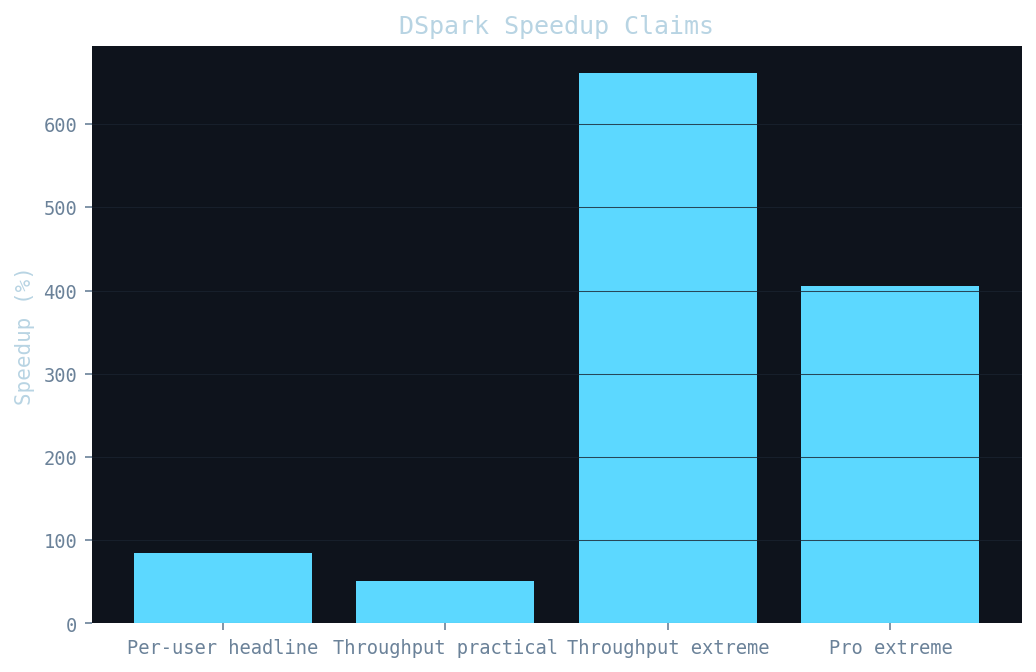
But the 85% number deserves a careful look, because it measures something narrower than the headlines imply. DeepSeek’s own technical paper reports several different metrics across different conditions, and they are not interchangeable. The 60–85% range for V4-Flash and 57–78% for V4-Pro describe per-user generation speedup at matched practical system capacity — meaning “how much faster the ride feels for an individual user.” The aggregate throughput improvement at practical service targets is much more modest: 51% for Flash, 52% for Pro. And then there are the eye-popping 661% and 406% figures, which DeepSeek itself contextualises carefully: those measure throughput when the old MTP-1 baseline is pushed to extreme speed targets (120 and 50 tokens per second per user), where it approaches an “operational cliff” and can serve almost no concurrent users. DSpark avoids more of that collapse, so the percentage difference explodes. To put it bluntly: the 661% number is “how much more traffic the road can carry when the old road is already on fire.”
None of this is fraudulent. DeepSeek’s paper is transparent about which metric is which. But the press cycle ran with “85%” because it’s the biggest number that sounds like a real-world improvement rather than a stress-test artefact, and “51% throughput gain at practical targets” doesn’t generate the same excitement. The chart below shows how wide the gap is between these measurements.
The deeper story is that speculative decoding itself is not new — the foundational work dates to 2018 (Stern, Shazeer, Uszkoreit), and EAGLE-3 is already shipping in vLLM with its own draft acceptance metrics. DSpark’s contribution is a “confidence-scheduled” approach: the scout model estimates how likely its guesses are to be accepted, and only submits batches when confidence is high enough to justify the verification cost. This is an engineering refinement, not a paradigm shift. And the known limitations of speculative decoding still apply. At high batch sizes (32+ concurrent requests), acceptance rates collapse and verification overhead can negate the gains entirely — the draft model’s two forward passes per step become a tax rather than a shortcut. Long-context generation degrades the draft head’s accuracy as output grows. Memory-constrained deployments pay a tax for storing speculative candidate tokens. The HN community reflected this nuance: users like @lee_ars were already running EAGLE3 speculative decoding on Qwen3.6 via vLLM and seeing “pretty okay” results at ~50 tok/s, while @binyu reported only “marginal improvements” squeezing DeepSeek V4 Flash on a single DGX Spark.
What makes DSpark strategically significant isn’t the speedup magnitude — it’s the packaging. DeepSeek released the trained modules, the DeepSpec training pipeline, and tested the approach on Qwen and Gemma, not just their own models. Any operator who controls their serving stack can train DSpark-style draft modules for their target model. As one HN commenter noted, the paper references testing with Qwen 3 4B/8B/14B, and the training pipeline is open — meaning the community will port this to other models regardless of whether DeepSeek does it themselves. In a market where American labs are restricting access and Chinese labs are open-sourcing production infrastructure, DSpark is less a technical breakthrough than a geopolitical one: a reminder that the most broadly usable AI engineering is increasingly coming from the side of the firewall that ships.
Sources
- DeepSeek open sources DSpark (VentureBeat)
- DSpark Technical Paper (GitHub)
- DSpark HN Discussion (793 points)
- DSpark Open Source HN Thread
- DeepSeek-V4-Pro-DSpark (Hugging Face)
- Speculative Decoding Survey (arXiv)
- EAGLE-3 Speculative Decoding Guide (Spheron)
- Speculative Decoding: How It Works & When to Use It (Redis)