The $200 Leak: How the AI Cost Wall Exposed the Grok Subsidy
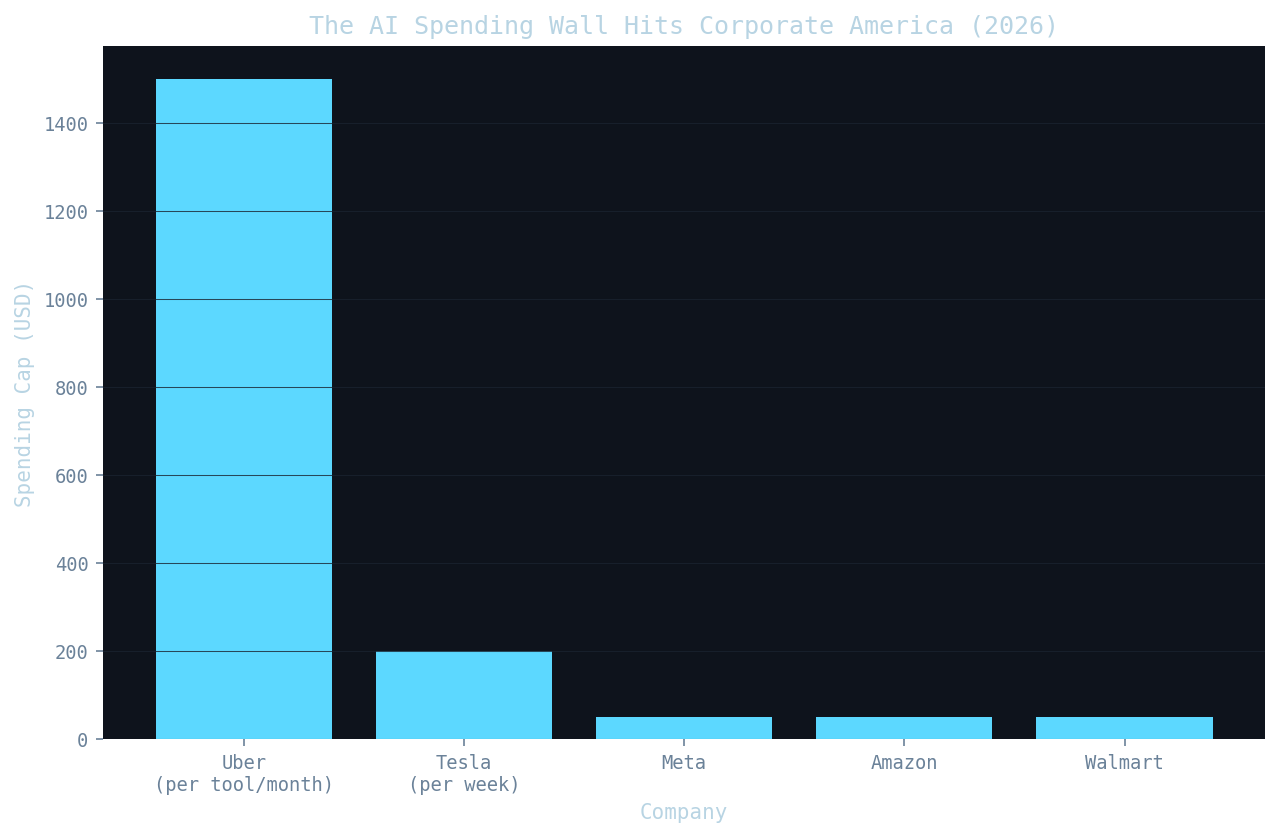
Tesla spent six months gamifying AI adoption — leaderboards ranking engineers by token consumption, internal memos urging staff to try Cursor’s Composer and Grok — then slammed on the brakes. Starting July 6, employees face a $200-per-week cap on AI spending, with sign-off required above that threshold. The detail that matters: the cap doesn’t apply to beta versions of xAI products. Tesla is using an expense policy to funnel internal usage toward Elon Musk’s own AI company, while its own engineers quietly prefer Anthropic’s Claude. When you need spending limits to win internal market share for your product, that’s not a vote of confidence — it’s a confession.
Tesla isn’t alone. Uber blew through its entire 2026 AI budget in four months and capped engineers at $1,500 per tool per month. Meta, Amazon, and Walmart have all introduced caps or pushed workers toward cheaper models. The pattern is now consistent enough to name: companies pushed adoption, token-based billing exposed the true per-prompt cost, and finance departments panicked. The Gartner numbers explain the pressure — AI spending jumped from 13.7% of total IT budgets in 2024 to 31.7% in 2025, eating into everything else. As one HN commenter put it about Uber’s leaderboard-driven adoption: “When you pay by the dead cobra, don’t be surprised when people start breeding cobras.” The leaderboards incentivised maximum token consumption; the bill followed inevitably.
The cost wall is hitting simultaneously with a capability wall. Mark Zuckerberg told staff on Thursday that “the trajectory of agentic development over the last four months hasn’t really accelerated in the way we expected.” This came four months after a restructuring that cut 8,000 jobs and moved 7,000 employees into AI roles, with Meta projected to spend up to $145 billion on AI infrastructure this year. The bets “haven’t come to fruition yet,” he said, promising “more significant benefits” in three to six months — without specifying which products or teams would deliver them. The admission is candid by corporate standards, and devastating in context: if Meta, with near-infinite compute and 7,000 reassigned engineers, can’t make agents work at scale, the problem isn’t spending levels. It’s that the technology isn’t there yet.
The desperation to control costs is producing genuinely strange artefacts. A project called pxpipe, which hit the front page of Hacker News this week, claims a 60% cost reduction on Claude Fable 5 by converting code to images and having the model OCR them — exploiting an asymmetry in how vision tokens are priced versus text tokens. Whether this is a genuine efficiency or a billing loophole that providers will close, it reveals the same pressure from the opposite end: when per-token costs are the binding constraint, engineers will route around them. The HN discussion was sceptical — one commenter noted that “if you fix the seed and run the same text through as text tokens and as compressed image tokens, you will not get identical output” — but the fact that teams are bending their pipelines this far to dodge API bills tells you where the economics sit.
What ties these threads together is a market discovering price. For two years, AI adoption was driven by FOMO and the assumption that costs would fall faster than usage would rise. They haven’t. Token pricing has proven sticky — Anthropic even paused a billing change that would have raised costs for Claude Agent SDK users, and its enterprise seat deals dropped bundled tokens. Meanwhile the capability curve has flattened enough for Zuckerberg to admit it internally. Companies are now learning what the actual unit economics of AI-assisted work look like, and the answer is: more expensive than the free trial suggested, less transformative than the keynote promised. The caps are a rational response. The Grok carve-out is the tell that, at Tesla at least, the rational response is already being subverted by the boss’s conflicts.
Sources
- Tesla caps employee AI spending at $200/week except for Grok — Electrek
- Tesla caps employee AI spending at $200 per week — The Decoder
- Zuckerberg says Meta’s AI agent progress is slower than expected — The Next Web
- Meta’s Zuckerberg says AI agent tech progressing slower than expected — Reuters via Yahoo Finance
- Uber burns its 2026 AI budget in four months on Claude Code — Forbes
- Uber caps usage of AI tools like Claude Code to manage costs — Simon Willison
- 60% Fable cost cut by converting code to images and having the model OCR it — Hacker News discussion
- Uber blows through its AI budget in 1 quarter — Hacker News discussion
- Chip capacity constraints put a governor on AI spending growth — The Register