The £30 Billion That Wasn't: How OpenAI and Whitehall Invented a Datacentre
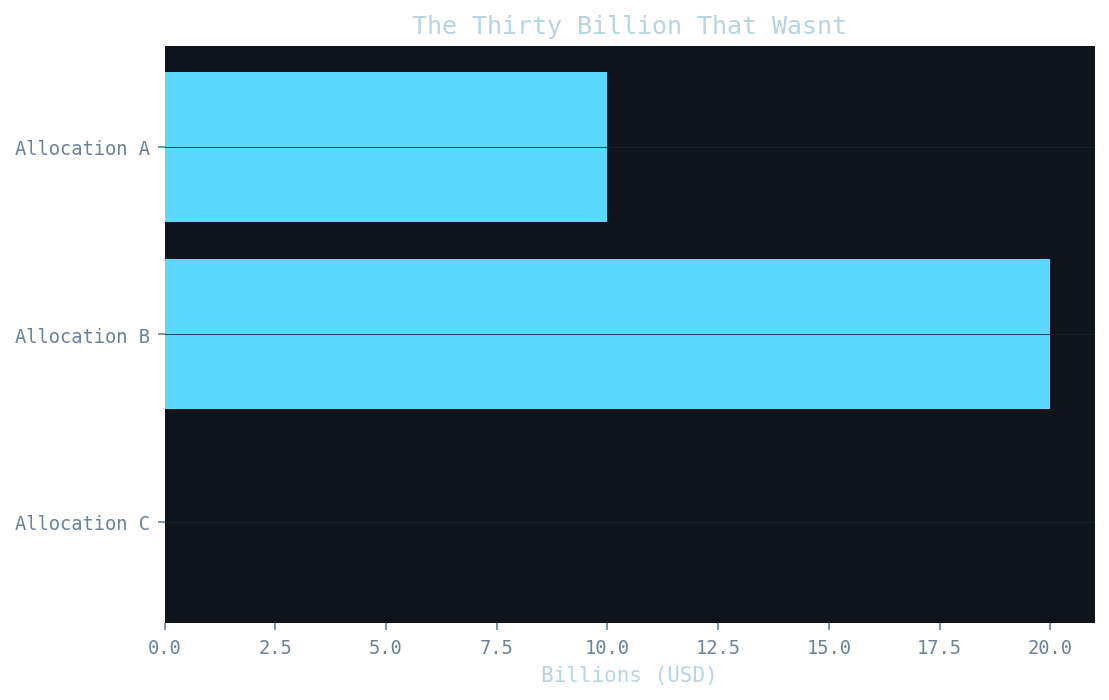
The UK government’s September announcement was unambiguous: a new “AI growth zone” at Cobalt Park, North Tyneside was “set to bring in £30bn in investment,” a centrepiece of the Stargate UK project launched during Donald Trump’s state visit. Nine months later, the Guardian’s investigation has pulled the thread, and the whole jumper unravelled. The £30bn was never £30bn. £10bn is a genuine, committed Blackstone datacentre — a separate project that appears to be proceeding. The remaining £20bn — two-thirds of the headline figure — was, in the government’s own explanation to Spotlight on Corruption, the amount of money the site would need to build a datacentre and exploit its 1.1 GW grid allocation. In other words, the government cited £20bn of investment because £20bn was the bill, not because anyone had pledged it.
The logistical evidence is equally damning. A freedom-of-information request shows that neither OpenAI nor its ostensible UK partner Nscale ever met with the North East combined authority that oversees the Cobalt Park site. Only Nvidia visited — once, in February 2026, five months after the triumphant announcement. The local Conservative leader, John Johnsson, said his authority was “really, really taken aback” by the news, having been excluded from any prior discussion. The site had no grid connection in place, and OpenAI, when asked whether it had ever visited, referred reporters to the same non-answer it issued when it quietly pulled out of Stargate UK in April. By any reasonable accounting, the project was a press release with a postcode.
This is not a one-off. The Stargate UK story slots into a documented pattern the Guardian began exposing in March, when it revealed that a multibillion-pound drive to “mainline AI into the veins” of the British economy was riddled with “phantom investments” — numbers aggregated from chip-purchase intentions, rent-a-GPU capacity plans, and speculative site allocations. Nscale’s $2.5bn “investment,” for instance, may largely mean it intends to buy Nvidia GPUs and place them in UK datacentres to rent back to US customers — a round-trip that inflates the headline without necessarily building anything new. Stargate UK is the same logic at a larger scale: a number reverse-engineered from an aspirational grid capacity, assigned to partners who hadn’t been consulted, announced at a photo-op, and quietly shelved when the optics expired.
The pushback is worth noting: OpenAI’s decision to pause was blamed on UK energy costs and regulation, and there is some truth there — power is genuinely the binding constraint for any large-scale AI compute project, and the UK’s grid is not the cheapest or fastest to access. But The Register’s coverage drily observed that as a designated AI Growth Zone, the project should already have benefited from streamlined planning and priority grid access. The regulatory complaint is thin; the more parsimonious explanation is that there was never a concrete project to regulate. OpenAI hired former Chancellor George Osborne to steward Stargate’s global expansion, Nscale added former Deputy PM Nick Clegg to its board, and both appointments generated more press coverage than any bulldozers at Cobalt Park ever did.
The takeaway is uncomfortable for anyone who treats government-issued investment figures as capital. When a site’s need is reported as committed investment, when partner visits are zero, when local authorities learn of a project from the news, and when the entire thing is quietly shelved months later — the headline number is fiction by construction. The UK is not alone in this; the $500bn US Stargate announcement has faced its own scrutiny over what is actually financed versus what is merely promised. But the Cobalt Park case is unusually clean evidence of the mechanism: a circular accounting trick, laundered through a state visit, that converted an electricity allocation into a political asset. The £30bn that wasn’t should be a template for how to read every subsequent AI infrastructure announcement — ask not what was pledged, but what was merely needed.
Sources
- OpenAI’s apparent failure to visit key site raises questions over Stargate UK project — The Guardian
- Revealed: UK’s multibillion AI drive is built on ‘phantom investments’ — The Guardian
- Missing money, shipped chips and a 350,000% profit — The Guardian
- OpenAI puts Stargate UK on ice over energy cost, regulations — The Register
- US tech firms pour £30B into UK as Trump lands — Politico
- Announcing The Stargate Project — OpenAI