When 98% Uptime Stops the Trains: The Telstra Cascade and the Architecture of Fragility
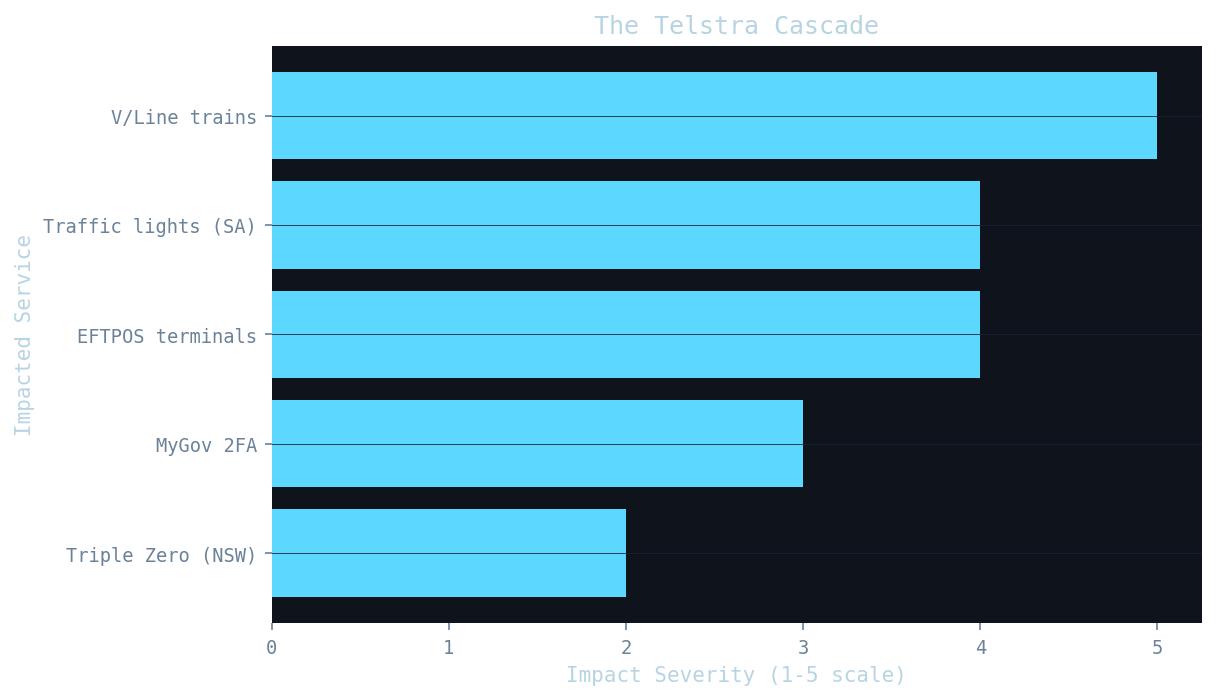
At approximately 5:00 AM on July 8, 2026, a fault in Telstra’s core network cascaded through Australia’s critical infrastructure like a power line touching a gas main. Victoria’s entire regional rail network — every V/Line line, from Bendigo to Gippsland — ground to a halt. Hundreds of traffic lights went dark across South Australia. Commonwealth Bank warned merchant terminals couldn’t connect. MyGov two-factor authentication codes stopped arriving, locking people out of government services. NSW Police advised residents that Triple Zero calls from Telstra devices might not connect. One network, five critical systems, one failure mode.
The reason this happened is not mysterious, and it was not unforeseeable. In September 2024, VicTrack — Victoria’s rail infrastructure asset manager — proudly announced it had completed a “major project” migrating V/Line’s Regional Rail Communications Network from Telstra 3G to Telstra 4G. The RRCN is the radio link between train controllers and drivers — the system that makes trains safe to run. VicTrack’s own project lead explained the logic plainly: the 3G network was being shut down, so they moved to 4G. What they did not do — what nobody did — was add a second carrier. The same migration also moved Yarra Trams’ SCADA substation monitoring to Telstra 4G, where a VicTrack engineer admitted: “If the primary fibre goes down, the backup is over 3G; if the 3G shuts down there is no backup and you lose the monitoring of power stations.” When 3G became 4G, the single point of failure wasn’t eliminated. It was upgraded.
This is the architecture problem that Hugo Barrera’s widely-shared essay “98% isn’t very much” gestures at, even if the essay itself stays in the realm of web browsers and CSS support. Barrera’s point is that 98% reliability sounds high until you apply it to something people depend on — a restaurant where 2% of customers get food poisoning, a babysitter who’s attentive 98% of the time. Telstra’s network uptime is well above 98%. It doesn’t matter. When the network that carries train radio, tram power monitoring, EFTPOS, emergency calls, and government authentication goes down — even for a few hours — the cost isn’t measured in percentage points. It’s measured in stranded commuters at Ballan with no taxis, no Uber, and no way to call for help. On HN, one commenter captured the asymmetry: “If I’m one of the 2% then that’s everything for me.” Another was blunter: “Some things are measured from 0, some are measured from 100. Depending on expectation.”
Australia has been here before. The 2023 Optus outage — 14 hours, millions affected — prompted a Senate inquiry and confident promises of reform. In November 2025, an Optus emergency calling outage was linked to at least two deaths. The pattern is now clear enough to be embarrassing: three major carriers, each operating as a monoculture, each serving as the sole lifeline for systems that were never designed to tolerate a total carrier failure. RMIT’s Mark Gregory, quoted during today’s outage, called it simply: “Their networks are very fragile.” The Telecommunications Ombudsman has announced yet another investigation. There will be a report. There will be recommendations. The fundamental geometry — one rail network, one radio system, one carrier — will not change, because fixing it costs money and the outage isn’t frequent enough to make it a political priority.
The deeper problem is that “redundancy” in infrastructure planning has come to mean “we have a backup link on the same vendor’s network” rather than “we have a fundamentally independent path.” V/Line’s radio comms run on Telstra 4G. The backup to fibre is also Telstra. The payment terminals default to Telstra. The 2FA codes route through Telstra. Multi-carrier redundancy — actual, physically diverse, independently-operated paths — is treated as a luxury rather than a baseline for systems where failure stops trains and silences emergency lines. Until that calculation changes, the next outage is not a possibility. It is a scheduled event whose date we don’t yet know.
Sources
- Telstra outage brings Victorian regional rail network to a halt — ABC News
- Telstra outage live updates — ABC News
- Essential communications services migrated to 4G — VicTrack
- 98% isn’t very much — Hugo Osvaldo Barrera
- 2025 Optus emergency calling outage — Wikipedia
- HN discussion: 98% isn’t much
- Optus outage: Anger in Australia after telecom outage linked to deaths — BBC News