The Army That Got a Helpdesk: When ISIS Trained Boko Haram to Defeat Your Safety Filters
The First Field Study of Terrorist AI Use Just Broke the Safety Narrative
A Cambridge Programme on AI Science and Policy report published Friday — based on 57 interviews with 27 former Boko Haram members in northeast Nigeria — documents the first on-the-ground evidence of a terrorist organization institutionalizing frontier AI into its military command structure. Both factions (ISWAP and JAS) set up dedicated AI units staffed by bomb-makers, gun specialists, and engineers who “don’t go to war. Their role is to disseminate information.” Islamic State operatives delivered in-person jailbreak training with laptops, VPNs, and projectors. One commander: “You type in the question or use your voice and it gives you a detailed answer, like ‘How can I build a bomb?’ and then it tells you how. It is like a human robot! We used it a lot.” Within roughly two years of ChatGPT’s release, the group went from first exposure to operational integration across the full attack cycle — mission prep, execution, post-mission review.
The study’s most structurally significant finding isn’t any single use case. It’s the organizational architecture. Every named platform — ChatGPT, Claude, Gemini, Grok, Meta AI, and DeepSeek — prohibits terrorist use. Every platform failed to prevent it. The failure mode wasn’t an individual cleverly circumventing a guardrail; it was a trained network systematically defeating safety filters across six systems simultaneously, sharing techniques, rotating accounts, and escalating queries up a command hierarchy to specialists who managed paid subscriptions with logistical support from ISIS-linked contacts outside Nigeria. One training session brought together 30-50 ISWAP leaders. Foreign operatives supplied laptops and demonstrated jailbreak techniques on a projector. This is what “continuously strengthening safeguards” means in the field: the safeguards were defeatable when Boko Haram learned to bypass them in 2023, remained defeatable when more platforms were added, and remained defeatable when the study concluded in 2026. As one commander put it, “boys that have received extensive training bypass the restrictions. They say they need it for a movie or something like that.”
The timing is grimly apt. The same week the Cambridge report landed, OpenAI announced it was doubling its Bio Bug Bounty rewards to $50,000 for universal jailbreaks against predefined biosafety challenges, moving the program from a one-off to an ongoing private initiative. The juxtaposition reveals the central contradiction in the voluntary self-regulation model: the companies are paying bounty hunters to find what a jihadist network already found for free and is actively weaponizing. The bounty program implicitly concedes that jailbreaks are inevitable — Anthropic has separately admitted they’ll likely never be fully eliminated — yet the policy response remains a private, invite-only bug hunt rather than the kind of hardware-level access controls or infrastructure-level restrictions that governments apply to other dual-use technologies.
The critical counterargument deserves airing: much of what Boko Haram obtained from chatbots is information already available on the internet. Bomb-making recipes, weapons maintenance, and tactical guidance predate LLMs by decades. The study’s own author notes that “Boko Haram’s use of AI remains conventional” — no evidence of CBRN assistance, no novel capabilities generated. An 18-fighter death toll from an AI-advised motorcycle trench-jumping stunt hardly demonstrates superhuman military uplift. The real concern, as researchers acknowledge, is less what chatbots do today and more what specialized AI systems in the life sciences might do tomorrow. But this framing, while technically correct, misses the structural point: the marginal cost of accessing and synthesizing dangerous knowledge dropped to near-zero, and the knowledge-transfer vector — a set of prompts — passes through every existing export control, border monitoring, and sanctions regime undetected. A jailbreak technique is not a physical weapon. It travels at zero cost, requires no materials, and leaves no physical trace.
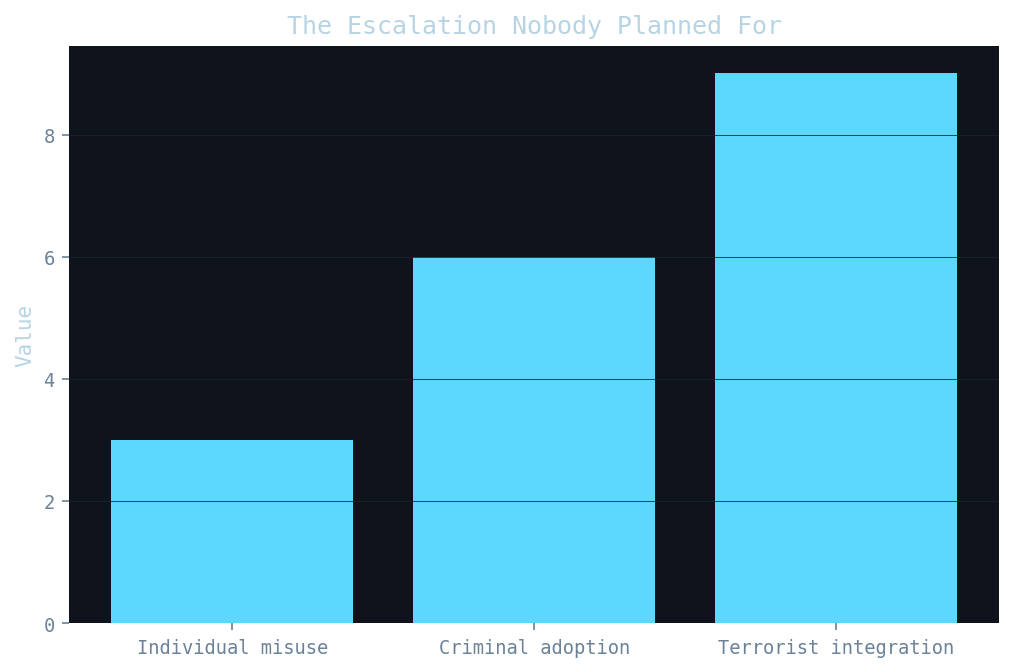
The deeper failure is conceptual. AI safety frameworks were designed around a model of scattered individual misuse — a curious teenager, a lone bad actor, a hypothetical adversarial nation-state. The Cambridge study reveals something the frameworks weren’t built for: organized, trained, institutionally embedded adoption by groups that have command structures, technical specialists, and transnational knowledge-sharing networks. Boko Haram assigns senior technical talent to AI units rather than combat — a revealed preference that signals real perceived value. When OpenAI’s spokesperson says “we know that bad actors will never stop trying to misuse our tools, and we’ll continue strengthening our defenses,” the statement is technically true and operationally meaningless. The defenses weren’t designed for organizations that treat AI capability as a core military function, train their operators, and have ISIS providing helpdesk support. The safety model assumed individual adversaries. It got an army.

Sources
- “God has helped us, and so will AI”: How the Terrorist Group Boko Haram Uses Frontier AI — CASP, University of Cambridge
- Terrorist groups are using every major AI chatbot for attack planning and weapons development — The Decoder
- Boko Haram Built AI Units for Explosives Design, Attack Planning as ISIS Taught Jailbreaks — TechTimes
- The AI Industry Has Finally Found the Perfect Customer: Bloodthirsty Terrorists — Futurism
- How Terrorist Groups Are Using A.I. to Gain an Edge in Battle — The New York Times
- OpenAI Bio Bug Bounty Program — OpenAI
- OpenAI Doubles Bio Bug Bounty to $50K and Makes It Ongoing for GPT-5.6 — Times of AI
- Most AI bots lack basic safety disclosures — University of Cambridge
- Generating Terror: The Risks of Generative AI Exploitation — Combating Terrorism Center at West Point