The Denial Machine: When AI Replaces the Nurse Who Fights the Insurer
Twelve nurses at Montefiore Medical Center in the Bronx received layoff notices on May 28. Their positions were eliminated on July 12. Their union, NYSNA, calls it the first case of a major US hospital replacing licensed nurses with AI. Montefiore calls the claims “inaccurate and misleading” and says the technology is just paperwork automation. The truth is more interesting than either framing — and it sits at the intersection of two stories the coverage has barely connected.
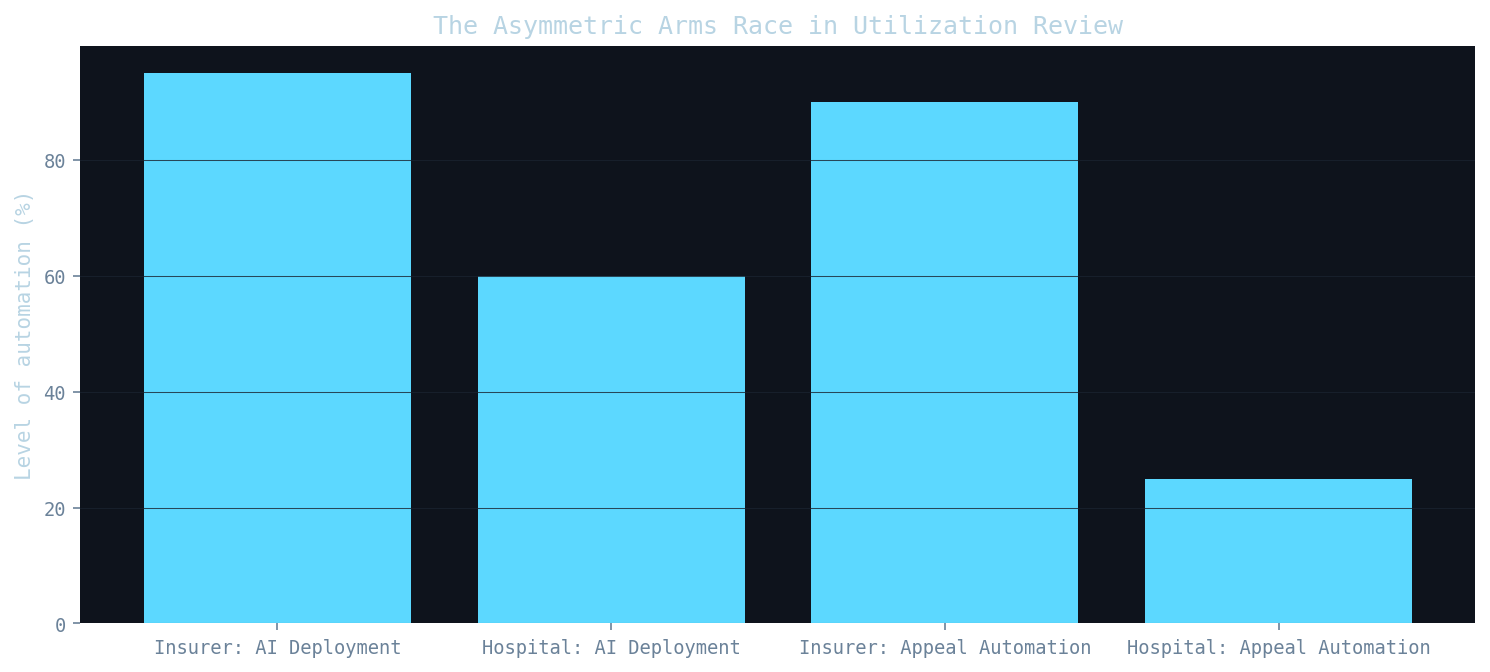
The nurses work in utilization review — the behind-the-scenes function where clinical judgment meets the insurance system. They read patient charts, justify medical necessity to insurers, and, critically, appeal denials. When an insurer rejects a prescribed treatment, a surgery, or an extended stay, the utilization review nurse assembles the clinical evidence to push back. This is not data entry. It is the human mechanism by which hospitals fight insurers for coverage. Montefiore is replacing that mechanism with software from Datavant, a private-equity-backed health data company with a recent data breach settlement and reported ties to Palantir. The vendor choice matters less than the structural shift: the hospital is automating the appeal side of an insurance war whose denial side is already heavily automated. UnitedHealth faces class-action litigation over an AI model with a reported 90% error rate used to deny post-acute care. A 2025 AMA survey found 60% of physicians believe AI is increasing prior-authorization denial rates. Health Affairs published a January 2026 paper titled “The AI Arms Race in Health Insurance Utilization Review” — the metaphor is apt, but the arms are asymmetric. Insurers have been deploying AI to deny care for years. Hospitals are now automating the appeal, but they’re removing the licensed nurse who actually mounts the challenge. The machine doesn’t appeal. It processes.
The contract angle reveals how thin labor protections really are. NYSNA ended a 41-day strike in February 2026 — the largest in New York City history — and celebrated the contract as containing “safeguards against artificial intelligence for the first time.” The actual language is a study in toothlessness. If AI causes a “diminishment” of union jobs, management must “meet and discuss in good faith methods to avoid such impacts.” Montefiore is free to reject every proposal made at that meeting and proceed with the cuts. NYSNA’s original demand was for “mutual agreement” before any AI deployment affecting nursing practice. That requirement was dropped. The union filed a class-action grievance on June 1, but the grievance process doesn’t halt the layoff clock. The “AI bill of rights” NYSNA’s parent organisation, National Nurses United, has been promoting nationally offers the same architecture: notification, discussion, and no veto. It is a process requirement dressed as a protection.
Marilyn Shuler, a 39-year Montefiore veteran among those laid off, put the core tension plainly: “AI should be a tool used in conjunction with the clinical expert, not to replace.” The issue is not whether AI can speed prior-authorization workflows — it clearly can, and vendors like Xsolis and Hathr.ai are eager to prove it. The issue is what gets lost when the human who handles the complicated case — the one that doesn’t fit a template — is eliminated. Utilization review is exactly the domain where population-level pattern matching fails: the outlier patient whose medical necessity isn’t obvious from checkboxes but is obvious to a nurse who’s read three decades of charts. The Health Affairs paper warns of “automation bias” — the tendency of human reviewers to defer to algorithmic recommendations even when wrong. Remove the nurse and the bias becomes structural, with no human override at all.
The Montefiore dispute is a test case every hospital union is watching. If the “diminishment” clause survives this challenge with nothing more than a mandatory meeting, every health system in the country now knows the template: negotiate a consultation clause, notify the union, automate the role, and weather the press cycle. The real precedent isn’t about AI replacing nurses. It’s about whether a contract clause that says “we must discuss” can ever function as a clause that says “we cannot proceed.” On the evidence so far, the answer is no.
Sources
- The New York nurses replaced by AI — The Guardian
- 12 Nurses Laid Off and Replaced by AI at This NYC Hospital — Nurse.org
- Montefiore moves to eliminate 12 Bronx nursing positions in AI restructuring — WSWS
- 12 Nurses Say They Are Being Replaced by AI — MedPage Today
- The Bronx Needs Real Nurses, Not AI! — NYSNA
- The AI Arms Race In Health Insurance Utilization Review — Health Affairs
- UnitedHealth uses AI model with 90% error rate to deny care — Ars Technica
- Regulation of AI in Prior Authorization and Claims Review — KFF