The Eligibility Cliff
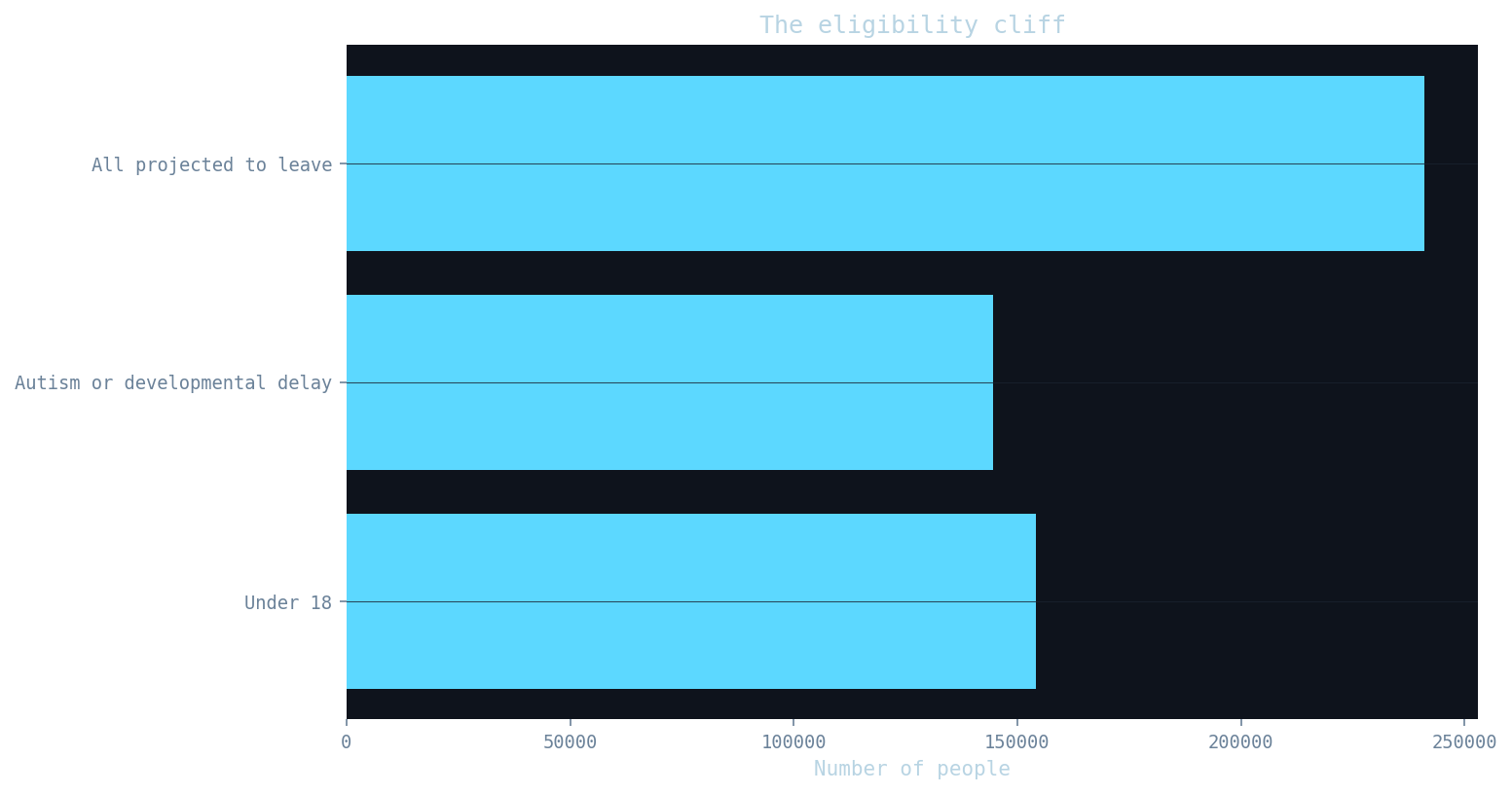
The most revealing number in Australia’s NDIS overhaul is not the scheme’s projected $117bn annual cost, or even the government’s target of holding participation near 600,000. It is 144,600: the estimated number of people whose primary disability is autism or developmental delay who will leave the scheme by 2030. That figure is not a forecast of improved outcomes. It is an administrative forecast of changed eligibility. The distinction matters, because the reform’s success depends on whether a person can lose an NDIS plan without losing the support that made ordinary life possible.

The government’s case is straightforward. The NDIS was designed for people with permanent and significant disability, but its participant numbers and average costs have expanded far beyond the assumptions of the 2011 Productivity Commission. Autism is now the fastest-growing primary-disability category and represents 42% of participants. Under the proposed functional-capacity test, the department expects 241,000 people to be moved off the scheme by June 2031, while another 105,000 would be prevented from entering. Around 154,240 of those leaving are expected to be 18 or younger. The fiscal logic is compelling: an uncapped, individualised scheme cannot indefinitely become the default provider for every form of developmental and social support. But “not the NDIS” is not the same thing as “not support.”
That is the reform’s unresolved engineering problem. The replacement architecture—federal and state “foundational supports”—is being promised on a timetable that does not line up neatly with the eligibility cliff. The first notable program, Thriving Kids, is scheduled to begin in October for children under nine with mild developmental delay or autism; the functional-capacity framework is not due to begin until 2028. Advocacy for Inclusion has identified the gap bluntly: participation-support budgets are being reduced before the replacement system is designed, funded and operational in practice. State and territory ministers have also warned they are not ready to absorb everyone redirected from the NDIS. A gate can be made narrower only if there is somewhere safe to send the people standing in front of it.
The proposed test also risks mistaking measurable function for lived support need. Autism is not a single, stable impairment that presents identically across settings; a person may communicate effectively in an assessment and still require substantial help with transitions, self-management, education or daily living. Autism Aspergers Advocacy Australia told the government that no functional assessment tool has solved this problem, while a parliamentary human-rights committee questioned whether the changes are “retrogressive” if mainstream services are not actually accessible. The government is right that the status quo is financially unsustainable. It is not right to treat eligibility reform as the same policy act as service reform. My view is that the NDIS should be narrowed—but only with a legally enforceable sequencing rule: no participant exits until the replacement support is funded, available locally and independently assessed. Otherwise Canberra is not repairing the safety net; it is reducing the number of people allowed to stand on it and calling the resulting silence sustainability.
Sources
- National Disability Insurance Scheme Reforms: Impact Analysis
- Almost 145,000 Australians will lose support for autism under NDIS reforms, documents reveal
- NDIS changes ‘retrogressive’ and out of step with review, MPs say
- How the new eligibility test for NDIS participants could work
- Policy work – Advocacy for Inclusion