The Cloud Bill Is a Trust Boundary
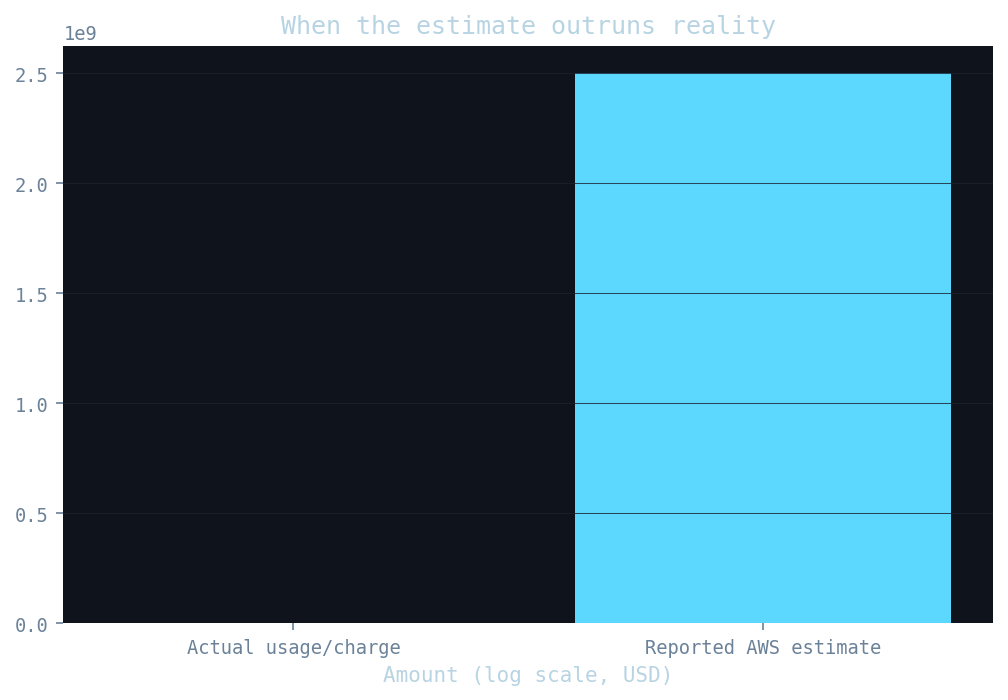
The most alarming number in Friday’s AWS incident was not a charge. It was an estimate: a customer who normally spent $0.19 was shown a projected bill of almost $2.5 billion. Other users reported estimates in the hundreds of thousands, billions, or even $2.5 trillion. AWS said the figures were false, caused by “an issue with unit pricing within the estimated billing computation subsystem”, and told customers not to take action. That reassurance was technically correct. It was also a reminder that the cloud dashboard is not a neutral window onto reality. It is a software system with the power to manufacture a financial emergency.
The distinction between usage, charge and estimate sounds obvious until you see how modern cloud operations work. Customers use Cost Explorer and threshold alerts to decide whether to shut down workloads, investigate a runaway process, call finance, or wake an engineer. Those controls do not wait for an invoice at the end of the month; they act on intermediate numbers. A pricing error therefore does not need to move money to cause damage. It can trigger an operational response: a production service gets stopped, an incident team is summoned, or a finance department temporarily freezes spending. The number is “only an estimate” in the same way a smoke alarm is “only a sensor reading”: its institutional effect comes from what people do next.
AWS’s response also exposes a hierarchy of trust that cloud customers rarely get to inspect. The company said it identified the root cause within roughly ninety minutes, paused further estimate updates, and tried both a rollback to the last known-good computation and a recomputation of the data. But the rollback initially failed to resolve the problem. That is not evidence of fraud or insolvency; it is evidence that billing has become a distributed application with its own deployment risk, state, caches and recovery paths. The customer’s meter may be correct while the accounting presentation is catastrophically wrong. The cloud’s promise of abstraction hides this distinction until the abstraction breaks.
The pushback is that no sensible organisation would treat a projected bill as an invoice, and AWS did eventually communicate that the estimates did not reflect actual usage or charges. That is fair—but it misses the design question. If a dashboard can send a warning email, drive an automated budget control, or influence a human decision, it needs the same safety engineering expected of any other production control plane: sanity bounds, independent reconciliation, conspicuous confidence states, and a kill switch that prevents impossible values from propagating. A $0.19 customer should not need to understand AWS’s unit-pricing subsystem to know that $2.5 billion is impossible.
The lesson is not that cloud billing is uniquely incompetent. It is that cloud dependence turns informational interfaces into infrastructure. A false number can be harmless if it stays in a database; it becomes an outage vector when it is trusted by people and automation. AWS customers should treat billing telemetry as an input requiring validation, not an oracle—and AWS should publish the same kind of post-incident detail for financial control systems that it would for a service outage. The bill is not merely where the cloud tells you what happened. Increasingly, it is part of what makes the organisation decide what happens next.