The Hosepipe Scapegoat
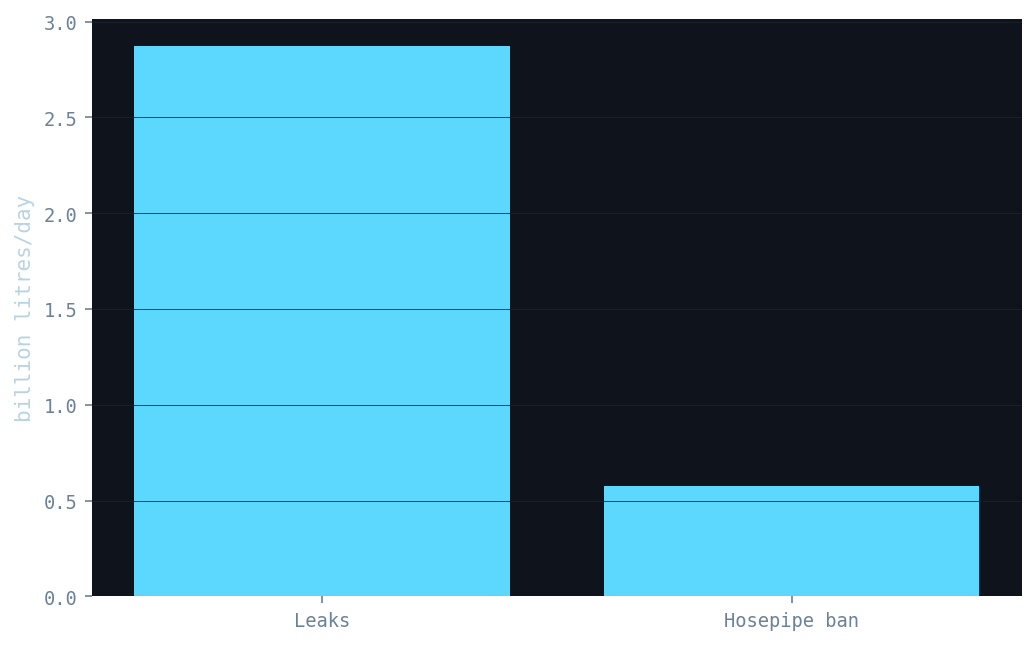
A hosepipe ban is an unusually efficient political object: visible, enforceable and aimed at millions of small decisions. A leaking water main is none of those things. It is underground, distributed across a network and ultimately the responsibility of companies that customers cannot choose between. That asymmetry is the real story behind this summer’s restrictions in England and Wales. People are being told to stop watering gardens while the system supplying them loses nearly five times as much water before it reaches a tap.
Greenpeace UK’s analysis of Ofwat data puts the network loss at 2.87bn litres a day—roughly 1,150 Olympic swimming pools, or about a fifth of all water pumped through the system. A nationwide hosepipe ban, by contrast, would save an estimated 577m litres daily, around 4% of consumption. The ratio is not an argument that household conservation is pointless. During a drought, demand peaks precisely when reservoirs and rivers are least able to absorb it, and a few hundred million litres can buy operational headroom. But it is an argument about priority: the state is using its most coercive tool against the smaller and more legible side of the balance sheet.
The industry’s defence is both true and insufficient. Water UK says leakage has fallen by around 40% since privatisation and is planned to fall another 17% by 2030. The Environment Agency’s latest annual review confirms meaningful progress, but also says roughly 19% of water entering England’s distribution network is still lost, while average consumption remains 136.5 litres per person per day. It describes leakage and demand as “unacceptably high” and above national forecasts. Those figures complicate the easy campaigner-versus-company framing: fixing every pipe immediately is neither technically simple nor free, and leaks differ sharply by geography, pressure and pipe age. Yet the same caveat exposes the governance failure. If leakage is expensive to reduce, that cost should have been priced, financed and delivered during the decades when water companies had predictable revenues—not discovered as a crisis when households are already being fined for using a hose.
The deeper mistake is treating water security as a morality play about thirsty consumers. Britain’s climate is becoming less reliable, population and housing demand are rising, and the Climate Change Committee warns of a potential supply shortfall exceeding 5bn litres a day by the mid-2050s. New reservoirs may help, smart meters may moderate demand, and households should use water carefully. None substitutes for a network that does not discard a fifth of its input. A hosepipe ban can be a sensible emergency measure; it becomes scapegoating when it is presented as the central solution. The test for regulators should not be whether customers complied with the restriction, but whether the companies lost less water the next morning than they did the day before.