The Oracle's Tip Jar: Why OpenAI's $100 Billion Ad Fantasy Is Already Collapsing
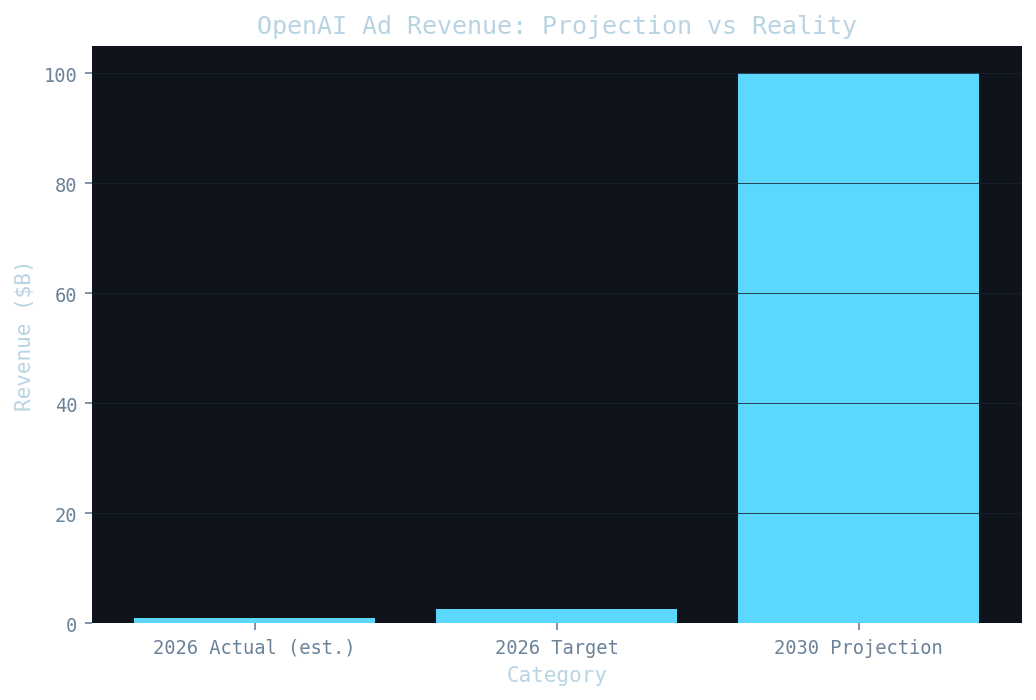
OpenAI launched “Advertise in ChatGPT” this week — a self-serve ad platform with CPC bidding, an Ads Manager, and the implicit promise that the world’s most trusted AI assistant is now a billboard. The company has told investors it expects $2.5 billion in ad revenue this year, scaling to $100 billion by 2030. Emarketer’s analysis, flagged by AdWeek, puts the entire addressable market for chatbot advertising at $5.4 billion — meaning OpenAI’s five-year projection overshoots the total market by nearly twentyfold. In 2026, the combined ad revenue of OpenAI, Microsoft, Google, and Amazon from AI chatbots will land under $1 billion. The gap between projection and reality isn’t a forecasting error; it’s the structural foundation of OpenAI’s valuation story, where ads are supposed to make up 36% of total revenue by 2030.
The architecture of the ad system exposes a more immediate problem than the fantasy math. OpenAI’s help pages insist that “ads do not influence ChatGPT’s answers” and that “ads run on separate systems from our chat model.” But advertisers provide “context hints” — keywords describing when their ads should appear — and these hints feed the targeting system that decides what users see. As HN commenter graypegg observed, nothing stops a Home Depot advertiser from stuffing competitor names like “Lowe’s” and “Rona” into their context hints: “If the LLM is talking about my competitors, of course I want my brand copy yelling louder than ChatGPT’s waffle-y responses.” The ad itself may not rewrite the model’s answer, but the model’s answer becomes the setup for a sponsored rebuttal the advertiser writes themselves. “SEO is back, baby,” graypegg concluded. This is the core tension: OpenAI claims a firewall between ads and answers, but the targeting layer that connects them is advertiser-controlled, and the conversational format makes the adjacency more persuasive than a search result ever was.
The resignation of researcher Zoë Hitzig in February — on the same day OpenAI began testing ads — frames the stakes. Hitzig, who spent two years shaping how OpenAI’s models were built and priced, wrote in The New York Times that ChatGPT’s accumulated user disclosures constitute “an archive of human candor that has no precedent.” People have shared medical fears, relationship crises, and religious doubts with the chatbot “because they believed they were talking to something that had no ulterior agenda.” She drew a direct parallel to Facebook’s early privacy pledges — the ones the FTC later found to be deceptive. Hitzig didn’t call advertising immoral; she called the data at stake categorically different from anything a social platform has ever held. The HN thread captured the cynicism concisely: one commenter wrote “This comment was brought to you by Coca-Cola,” and another replied “Carl’s Jr. now has custody of your child.”
The deeper story is about what happens when a company burning billions with no path to profitability discovers the only revenue stream growing fast enough to matter is the one that corrupts the product. OpenAI’s subscription revenue is real but insufficient; API margins are thinning under price wars with Chinese competitors; and the $500 billion infrastructure bill is coming due. Advertising is the only line item on the spreadsheet that compounds at venture-scale rates — if it works. The $100 billion projection isn’t a forecast; it’s a hostage note to investors, explaining why the company that promised to build beneficial AI now needs to monetize the confessional. Anthropic has so far held the line on ads, and Forrester notes that the contrast makes OpenAI’s “surface-level ad principles” look performative — particularly given Sam Altman’s own reversal on the ads question.
OpenAI is building the same machine every attention-economy platform has built, except the intake is more intimate than anything that came before. The firewall between ads and answers is a policy document, not a technical constraint, and the context-hints mechanism already shows how permeable it is. When the $2.5 billion 2026 target misses — and Emarketer says it will miss badly — the pressure to make the firewall more flexible will be enormous, because the alternative is admitting the valuation story doesn’t work. The researcher who saw this clearly is already gone.
Sources
- OpenAI Ads: Advertise in ChatGPT
- OpenAI launches self-serve ad platform — Axios
- OpenAI projects $2.5 billion in ad revenue for 2026 — Reuters
- OpenAI Appears to Be Missing Its Sales Goals by a Vast Margin — Futurism
- OpenAI researcher quits over ChatGPT ads, warns of “Facebook” path — Ars Technica
- Ads in ChatGPT — OpenAI Help Center
- What Consumers Actually Think About Ads In ChatGPT — Forrester
- HN discussion: Advertise in ChatGPT
- HN comment by graypegg on context hints