The $1.65 Trillion Footnote: How AI's Debt Is Hiding in the Margins
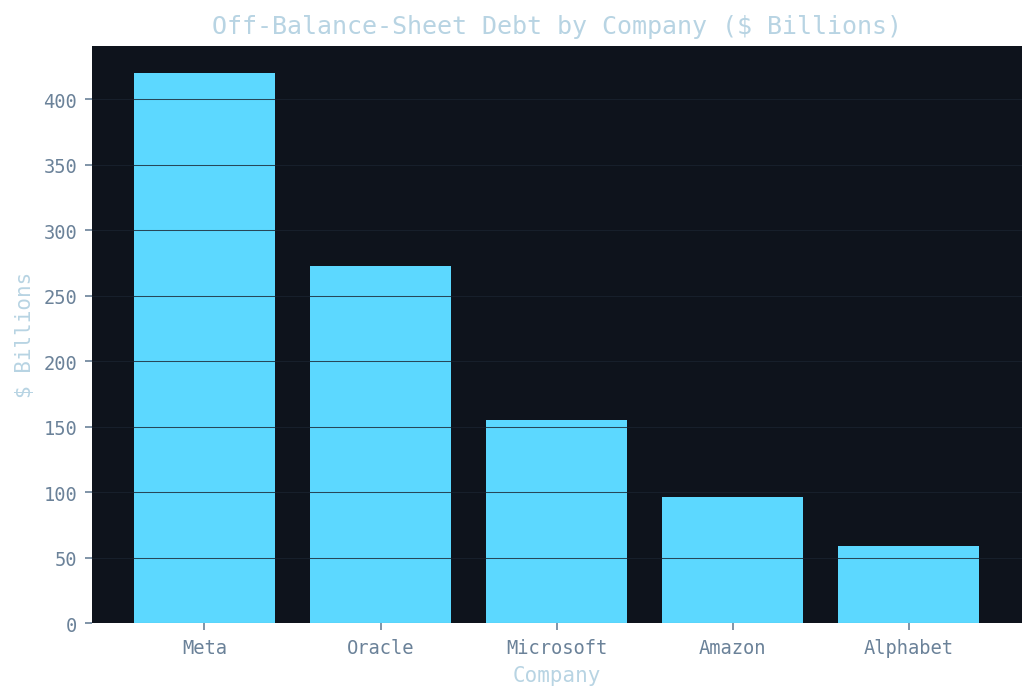
Five US tech giants — Alphabet, Amazon, Meta, Microsoft, and Oracle — are carrying an estimated $1.65 trillion in debt that doesn’t appear on their balance sheets. That’s the finding of a Nikkei Asia investigation published July 21, and it exceeds the $1.35 trillion in officially reported debt across the same companies. Meta alone has roughly $420 billion in off-balance-sheet liabilities — nearly triple its on-sheet debt of $140 billion. Oracle’s hidden obligations ballooned 2,900% since 2022 to $273 billion. The mechanism is mundane: long-term data center leases and GPU supply contracts that have been signed but not yet commenced. Under accounting rules (ASC 842 and IFRS 16), these “not-yet-commenced” leases sit in footnotes until the facilities come online, at which point the obligations crystallise into real, balance-sheet-recognized debt. The companies aren’t breaking any rules. They’re exploiting the gap between committed and commenced — and that gap is now worth more than the GDP of most countries.
The deeper analysis comes from New Constructs, a firm that reverse-engineers footnote disclosures to compute what it calls “true” free cash flow. Their July report found that the media’s headline figure — Alphabet, Microsoft, Meta, and Amazon “generated $200 billion in free cash flow” in 2025 — is off by $346 billion. Their own calculation shows these four companies burned $146 billion in FCF in 2025. The difference is driven by $427 billion in capex hidden in off-balance-sheet structures, predominantly “not-yet-commenced” data center leases. Oracle’s disclosure jumped from $26 billion to $248 billion in a single fiscal year. Meta’s went from $7 billion to $104 billion in two years. Microsoft’s sits at $155 billion. These aren’t speculative options — they’re contractual obligations that will convert to recognized debt as facilities come online, regardless of whether AI demand materialises. As New Constructs puts it, at least two of these companies “cannot keep up the pace for much longer” without serious equity dilution.
The Enron comparisons are loud but imprecise. Enron used special purpose vehicles to hide losses and inflate revenue. What the hyperscalers are doing is more like a tenant signing a 15-year lease on a warehouse that hasn’t been built yet — legal, disclosed (in footnotes), and structurally different from fraud. Ars Technica’s November analysis noted that Oracle’s debt-to-equity ratio has surged to 500%, versus Amazon’s 50% and Microsoft’s 30%, making it the outlier most exposed to a demand shortfall. And there is a counterweight: the same five companies report a $1.45 trillion cloud services backlog — signed contracts for future compute that hasn’t been delivered yet. If that backlog converts to revenue, the debt service is manageable. If it doesn’t, the asymmetry is brutal: fixed costs on data centers that run whether or not anyone queries the model. On Hacker News, one commenter captured the systemic risk: “as long as this debt does not make it into life insurance and pension funds, we are fine. The trouble is that private credit is taking control of some life insurance companies and off-loads this debt to these.” Another noted the spectrum of risk depends entirely on “the off-take agreement” — the contract obligating the tenant to pay for capacity regardless of utilisation. The structure is sound only if the demand is real.
The honest take: this is not fraud, but it is a transparency crisis. The $1.65 trillion is disclosed — in footnotes, in 10-Qs, in lease schedules that analysts can reconstruct. But the dominant financial media narrative — “Big Tech generates hundreds of billions in free cash flow” — is materially misleading because it ignores commitments that will consume that cash the moment data centers go live. The bet these companies are making is not that AI will be useful. It’s that AI demand will grow fast enough to absorb a $1.65 trillion liability conversion before the market starts pricing it in. OpenAI’s separate announcement of $750 billion in infrastructure spending through 2030, including a $20 billion Georgia campus, suggests the commitment cycle is accelerating, not peaking. If the demand holds, the accounting sleight-of-hand is a footnote. If it doesn’t, the footnote becomes the headline — and the $1.65 trillion becomes the number everyone wishes they’d read more carefully.
Sources
- Five US tech giants’ hidden debts soar to $1.65tn on opaque AI funding — Nikkei Asia
- The Hidden $500+ Billion Accounting Trick That Will Sink These AI Stocks — New Constructs
- AI Companies Are Trying to Hide a Staggering Amount of Debt — Futurism
- Oracle hit hard in Wall Street’s tech sell-off over its huge AI bet — Ars Technica
- AI tech companies have ‘hidden debt’ worth around $1.65 trillion — Tom’s Hardware
- HN discussion: AI Companies Are Trying to Hide a Staggering Amount of Debt