The Redundant Frontier: Why Opus 5's Real Story Is the Models It Made Pointless
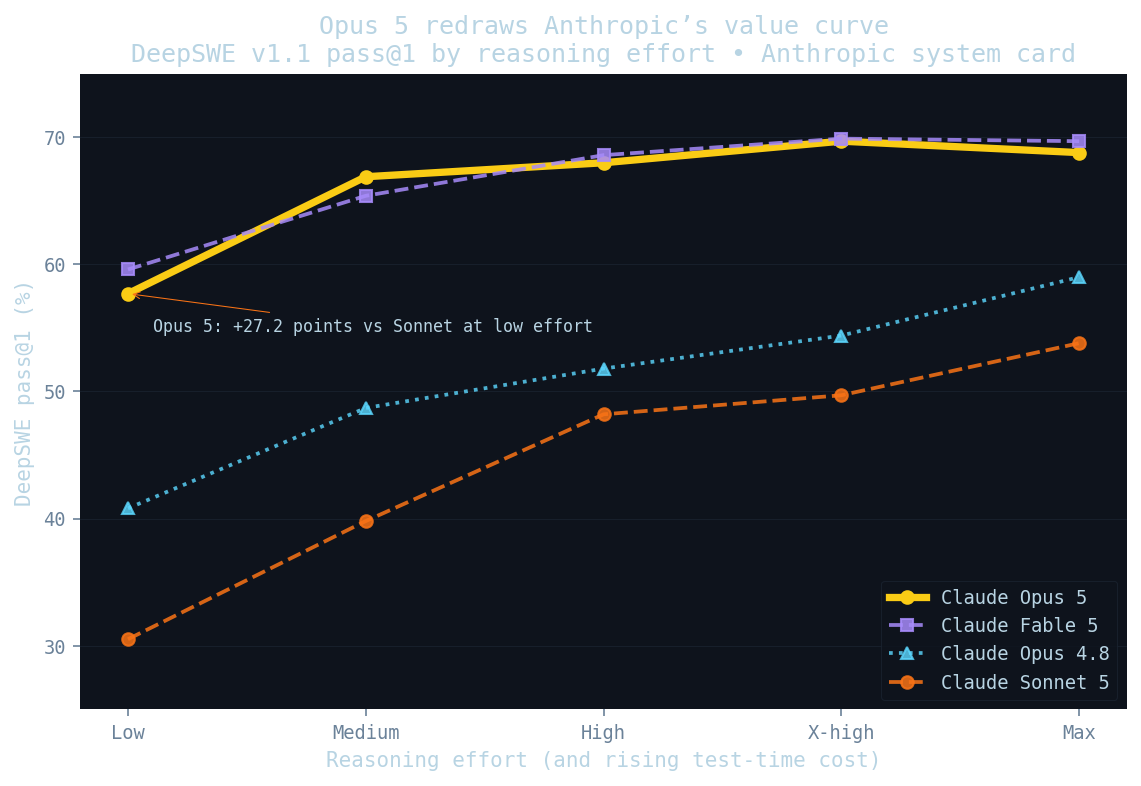
Anthropic’s Claude Opus 5 launched yesterday, and the headline is straightforward: near-Fable-5 intelligence at half the token price ($5/$25 vs $10/$50), with no data-retention requirement and a loosened cyber classifier that finally permits source-code vulnerability discovery. A few weeks after Fable 5 was ripped from the market by a twitchy US government, getting Fable-like performance without the janky guardrail router — at lower cost, with better performance on many tasks — is broadly to be welcomed. But the real story sits in the cost-per-task data, and it’s not the one Anthropic’s PR tells.
The launch announcement needed serious cherry-picking to find benchmarks where GPT-5.6 Sol wasn’t destroying Anthropic on a cost basis. Per Artificial Analysis, the weighted average cost per Intelligence Index task is $2.75 for Fable, $2.03 for Opus 5 (max), $1.04 for GPT-5.6 Sol (max), and $0.95 for Kimi K3. On DeepSWE — Datacurve’s contamination-free, long-horizon coding benchmark that is increasingly the most honest test in the field — the picture is starker still:
| Model | Pass@1 | Avg cost/task |
|---|---|---|
| GPT-5.6 Sol [max] | 73% | $8.39 |
| GPT-5.6 Terra [max] | 70% | $4.95 |
| Claude Fable 5 [max] | 70% | $21.63 |
| Kimi K3 [max] | 69% | $4.65 |
| GPT-5.6 Luna [max] | 67% | $3.03 |
| Claude Opus 4.8 [max] | 59% | $13.22 |
| Claude Sonnet 5 [max] | 54% | $26.40 |
Draw the Pareto frontier — the best score achievable at each cost level — and it runs through GPT-5.6 Luna ($3.03, 67%), Terra ($4.95, 70%), and Sol ($8.39, 73%). Every Anthropic model is below that line. Fable 5 matches Terra’s score at 4.4× the cost. Opus 4.8 scores worse than Luna at 4.4× the price. And Sonnet 5 — the model Anthropic positioned as the cost-effective workhorse — is the worst value on the entire leaderboard: 54% at $26.40, outscored by Grok 4.5 at one-tenth the cost. As HN commenter @benjiro29 noted, the Vals Index shows Opus 4.8 → 5.0 going from $2.90 to $8.54 per task for a 4% gain — “a massive cost increase.”
There’s a measurement problem here, as Mat notes: the Artificial Analysis cost-per-task benchmark tests only at max effort, which is not where engineers typically work, and this disproportionately penalises Anthropic models, whose token consumption blows out at the extreme end of their test-time compute effort. The real cost picture at low or medium effort is less brutal. But even accounting for that, the DeepSWE data from Opus 5’s own system card is damning: Sonnet 5 at low effort costs significantly more for a 30.5% score than Opus 5 at low effort does for 57.7%. In this specific case, Mat still thinks Sonnet 5 is likely redundant. OpenAI appears to be falling into the same trap — commentators point out that higher efforts of Luna and lower efforts of Sol both make the Terra model redundant. The labs are serving models with no clear use case, burning inference compute that delivers no marginal value.
But here’s the counterintuitive part that the benchmark race sidesteps. It is considered a failure of an AI benchmark if it can be saturated — but is that not a signal for the engineer? If Sonnet 5 and GPT-5.6 Luna at high effort both saturate a benchmark for moderate implementation tasks, that is exactly what a deploying engineer wants to know: which model can I trust to build a well-scoped task? Most engineering implementation tasks should not be left to chance where the performance difference between any Opus-like model and another determines success or failure. For those deploying SWE rigor to their AI-first workflow, we are firmly in the realm of good-enough AI. The labs will keep fighting for the biggest benchmark scores, but the Fable-performance question has become an ecosystem and systems question where cost and speed are more useful things to consider.
The pivot point is this: the labs need to seriously start thinking about the cost-performance Pareto frontier, not just peak intelligence. Otherwise they’re wasting inference compute serving models nobody needs, and customers are paying for a complexity of choices that delivers no marginal value. The very best models still have a use — system-level code reviews, security analysis — but a few weeks on from the Fable debacle, the question is no longer “which model is smartest” but “which models can I retire.” The answer, right now, includes at least one from every lab.
Sources
- Introducing Claude Opus 5 — Anthropic
- Claude Opus 5 System Card (PDF)
- Anthropic debuts Opus 5 at half the price of its Fable sibling — The Register
- The price is wrong: AI cost calculation has to consider task completion rates — The Register
- DeepSWE Leaderboard — Datacurve
- Artificial Analysis — Claude Opus 5
- HN: Claude Opus 5 (578 comments)
- GPT-5.6 Sol and Terra: Benchmark — CodeRabbit
- GPT-5.6 API Pricing: Sol, Terra, Luna — APIpulse