The Bridge Google Is Bricking: How a Real CVE Became the Pretext for Killing Android's Power-User Ecosystem
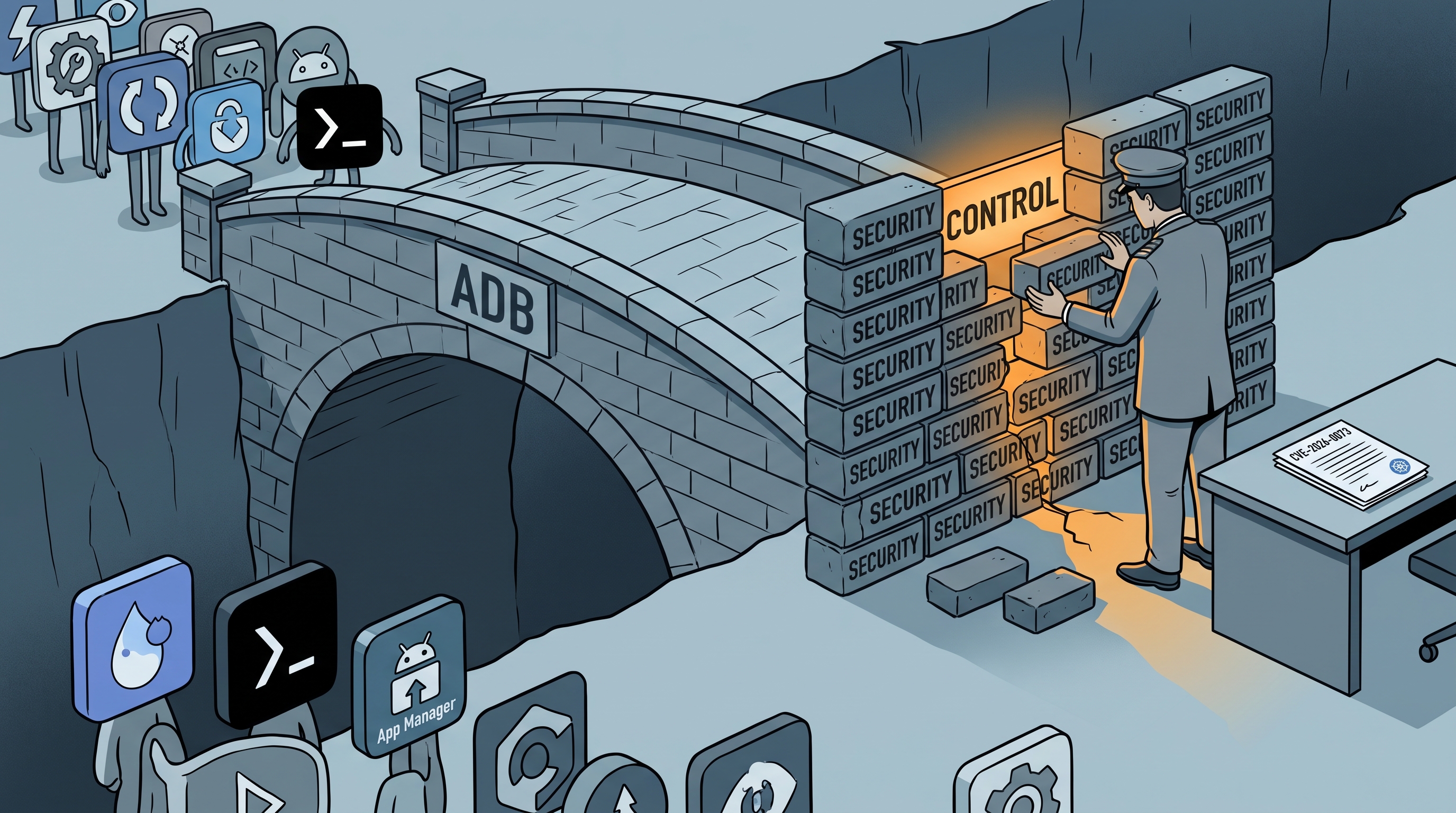
A Google ADB maintainer suggested on the project’s IssueTracker that Android’s debug daemon should “always only bind to the wlan0 interface” — a throwaway comment that would, if implemented, sever every loopback ADB connection on the planet. That’s the mechanism behind Shizuku, libadb-android, Termux-based mobile development, and a constellation of rootless power-user tools that let people debloat phones, manage apps, and record calls without root. The stated justification is CVE-2026-0073, a genuine zero-click authentication bypass in wireless ADB that lets an adjacent attacker present a cross-algorithm TLS certificate and fool adbd into treating a key-type mismatch as a successful host match. It’s a real bug, patched in the May 2026 security bulletin, and it genuinely enabled remote code execution as the shell user. The question is whether the appropriate response to a crypto-verification flaw is to demolish the loopback interface that an entire open-source ecosystem depends on.
The blog post by Kitsumed — developer of ShizuCallRecorder, a Shizuku-based accessibility tool — walks through the attack scenarios and finds them wanting. Every on-device ADB path requires manual human action: enabling Developer Options, turning on USB debugging, pairing wireless debugging with a code, or approving a TCP/IP authorization prompt. A malicious app cannot silently establish a loopback ADB connection by itself. The CVE that actually matters (CVE-2026-0073) exploited wireless ADB’s TLS certificate verification — a network-facing path, not a loopback one — and it’s already patched. Restricting 127.0.0.1 does nothing to address it. As Kitsumed drily notes, the maintainer’s own example of “apps using that socket to escalate privileges” describes a scenario that requires the user to have already granted ADB authorization, which is a different problem entirely. The fix for “users approve too many ADB prompts” is better authorization UX, not removing the feature.
What makes this resonant is the pattern. Google’s sideloading “Accountability Layer” arrives in September 2026, requiring identity verification or a 24-hour wait for app installation outside the Play Store. Play Integrity enforcement increasingly gates basic app functionality behind attestation. And now the last escape hatch — ADB, the thing commenters pointed to when sideloading restrictions were announced — is itself under threat. On Hacker News, bayindirh captured the trajectory plainly: “When Google first announced sideloading restrictions, somebody told ‘but we have ADB’, and who disagreed with them was criticized harshly. Now, I’m waiting for a workaround to enable ADB, so sideloading can be handled now, too.” Another commenter, SwellJoe, was more direct: “There’s only one reason for anyone to choose Android — it’s more open. So they don’t want me to even have that one reason.”
The counterargument that carries the most weight isn’t Google’s — it’s the stalkerware angle raised in the HN thread. On-device ADB does enable a privilege escalation path for apps that have already gained user-level trust: location tracking, notification reading, file access, call recording, all without root. If a stalkerware app convinces a user to approve one ADB prompt, the damage is severe and the victim may not understand what they authorized. This is real. But it’s an argument for granular per-app authorization — letting ADBD distinguish which app is connecting, rather than presenting the same blind prompt to everything — not for bricking the loopback interface. The article’s proposed compromise, a persistent developer toggle invisible to third-party apps, addresses both the stalkerware concern and the power-user need. Google has not engaged with it.
The cynical read is that Google doesn’t need to. The stalkerware concern provides cover, the CVE provides urgency, and the power-user constituency is small enough to sacrifice without measurable impact on Play Store revenue. Android’s openness was always a competitive differentiator against iOS; now that Google has captured the market, the differentiator has become a liability — an unmonitored channel for app distribution, ad-blocking, OEM debloating, and privacy tools that circumvent Google’s own telemetry. Each restriction is individually defensible. The aggregate is a platform that retains the word “open” in its marketing while systematically closing every corridor that made the claim true. The ADB maintainer may genuinely care about security. The system he works inside has other priorities.
Sources
- Android May Soon Restrict On-Device ADB — Kitsumed
- CVE-2026-0073: Android ADB-over-TCP authentication bypass — BARGHEST
- Android May Soon Restrict On-Device ADB — Developers Digest analysis
- Google will let Android power users bypass upcoming sideloading restrictions — Ars Technica
- HN discussion: Android May Soon Restrict On-Device ADB
- Google IssueTracker: ADB interface binding feature request