The 97.8% Discount: How a Chinese Relay Economy Is Eating the Token Market's Foundation
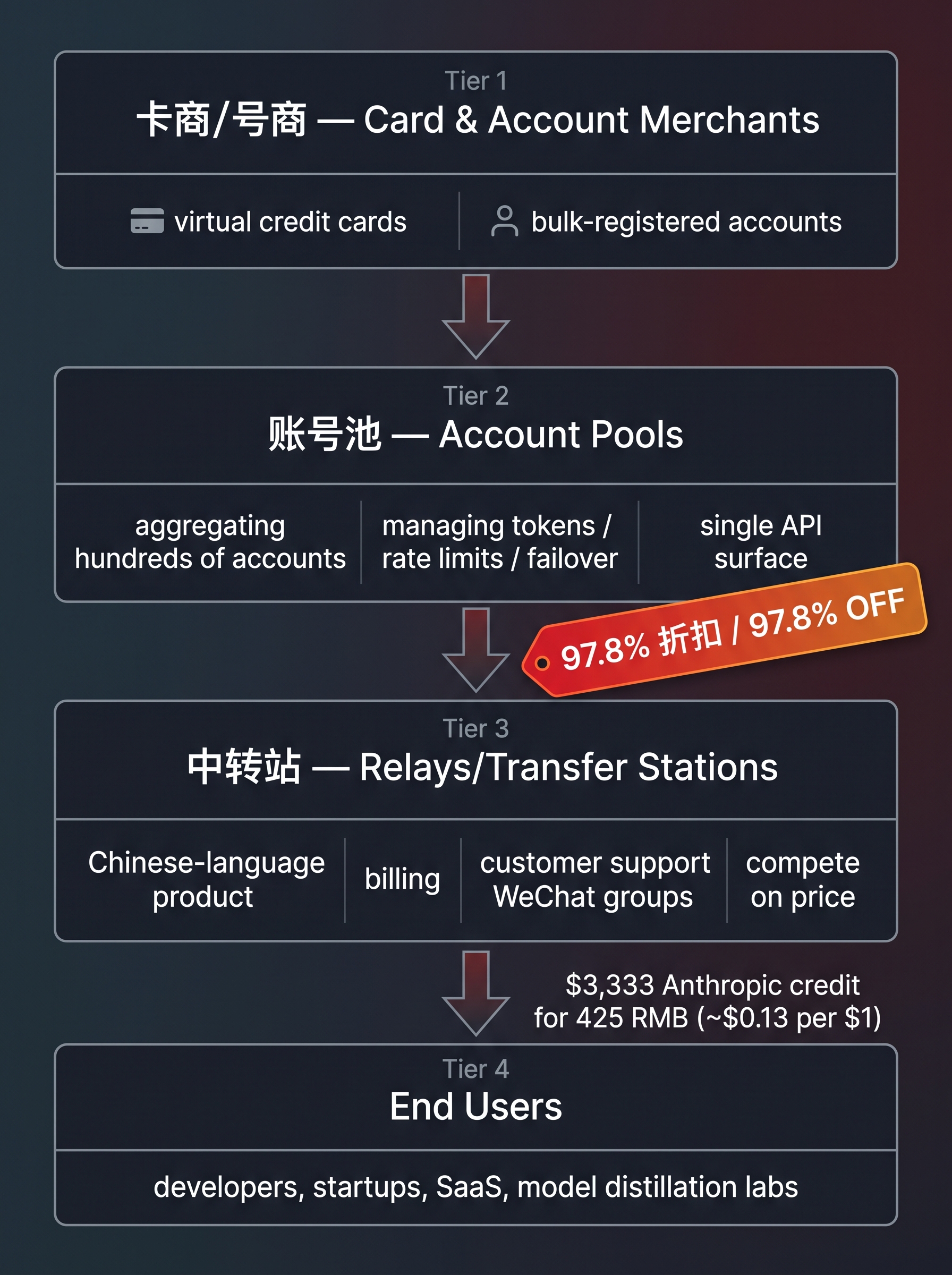
A former AI-gateway engineer at a major lab, Matt Lenhard, has mapped a four-layer grey-market economy that resells OpenAI, Anthropic, and Google API access at up to 97.8% off official pricing. Writing at Vectoral, Lenhard traces a supply chain running out of mainland China: upstream card and account merchants (卡商/号商) who supply virtual credit cards and bulk-registered accounts; midstream account pools (账号池) that aggregate hundreds of stolen or abused accounts into a single API surface; downstream relays (中转站) that wrap the pool in a clean, billed, Chinese-language product; and end users ranging from individual developers to commercial labs running model distillation at scale. The cheapest relay tracked, 01Now Coding, offers $3,333 worth of official Anthropic credit for 425 RMB — roughly $0.13 of usage per dollar spent. The top ten relays pull a combined 3.6 million visits per month.
The infrastructure is almost entirely open-source. Almost every relay Lenhard examined runs on one of two projects: one-api or its more commerce-oriented fork new-api. Both are OpenAI-compatible gateways — a panel that pools API keys, exposes a single endpoint, and deducts quota per request via a multiplier (倍率). The software is neutral and widely used for legitimate internal API management. The fraud enters when channels are stocked with stolen, leaked, or abused keys rather than the operator’s own. Methods include mass free-trial abuse, chargeback attacks, prepaid card funding, and “open inference” exploitation — proxying traffic through any support chatbot without strict guardrails. Anthropic’s newest identity-verification requirements (photo ID, live selfie) have been met by recruiting real people in lower-income countries to complete checks in person, following the Worldcoin biometric black-market template.
The most consequential buyer segment is distillation. Lenhard surfaces translated V2EX forum posts claiming “companies with strong programming capabilities are all distilling Claude; it’s a multi-billion RMB industry chain, and many big players earn hundreds of thousands a day.” This corroborates Anthropic’s February disclosure of roughly 24,000 fraudulent accounts linked to Chinese labs including DeepSeek, Moonshot AI, and MiniMax, and the White House’s late-April accusation of “industrial-scale” distillation campaigns. The relay market is the plumbing that makes that campaign economically viable: cheap frontier-model access at 2-7% of list price, at volumes sufficient to train smaller domestic models.
The Hacker News discussion was skeptical of the “reseller market” framing. User altmanaltman cut through the euphemism: “‘Token reseller market’ is a fancy way of saying credit card fraud. If someone stole Xboxes from stores using stolen credit cards and then sold them at 10% of their price, at what point is it a ‘reseller market’ and not ‘criminal enterprise?’” Another commenter, blfr, flagged the model-substitution risk that buyers cannot verify: “I disabled automatic downgrading/rerouting because it sometimes takes me a second to tell when the answer came from a different model than I wanted. You could easily sell Opus as Fable for a good while.” A former ad-tech financial-integrity engineer (wtobey1) noted the pattern is not novel — identical resale markets attacked the last generation of internet giants’ billing systems, and the same defensive cat-and-mouse is now being deployed by the labs. Simon Willison linked to one-api and new-api on GitHub, calling the whole thing “pretty fascinating.”
The structural problem is that the labs cannot fully eat these losses. Every chargeback, stolen card, and abused free trial gets priced into the API rates that legitimate developers pay — the 97.8% discount is effectively a tax on honest customers. Stripe’s own analysis found 7.4% of customer sign-ups at AI companies are implicated in suspected multi-account abuse, a figure that has climbed sharply from November 2025 through February 2026. Anthropic’s move to ban subscription tokens in third-party agents and impose passport-level KYC is a direct response, but it raises the friction floor for legitimate users while the relay operators simply recruit another verification mule. The deeper vulnerability is epistemic: when a buyer cannot verify which model answered their request, the entire price-discovery mechanism of the API market becomes unreliable. The relay economy is not just theft — it is a parallel distribution layer that quietly reprices intelligence and redirects it toward competitors who did not pay to develop it.
Sources
- An Inside Look at the Relay Market Powering Token Resellers and Fraud — Matt Lenhard, Vectoral
- The Underground Relay Market for AI API Tokens (HN analysis) — Developers Digest
- Chinese grey market sells Claude API access at 90% off — Tom’s Hardware
- Dark Token Economy: Unauthorized LLM API Proxies Harvest Prompts for Fraud and Distillation — SOCRadar
- Analyzing first-party fraud trends: Account, free trial, and refund abuse — Stripe
- The relay market powering token resellers and fraud (HN discussion) — Hacker News