The Safety Moat: How Dario's 'Not a Ban' Is the Ban That Maintains the Advantage
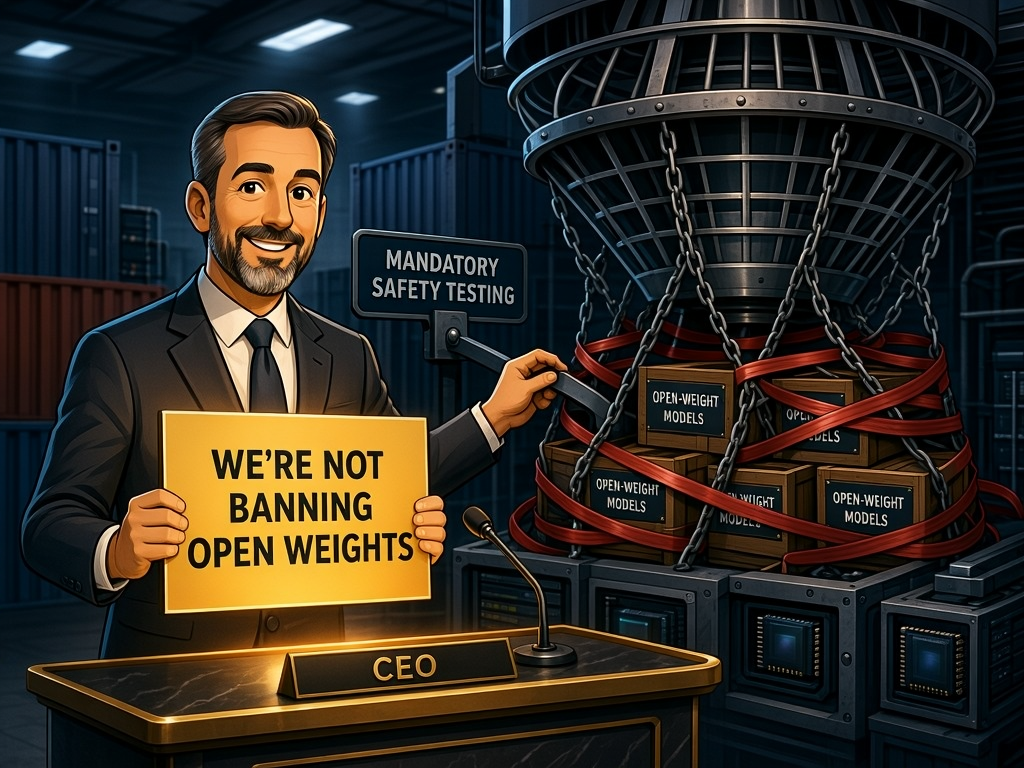
Dario Amodei wants you to know he’s not banning open-weight models. In a post last week, Anthropic’s CEO wrote, in bold, that “Anthropic has never advocated for a ban on open-weights models.” The statement came as the Trump administration reportedly mulled restricting Chinese open-weight models like Kimi K3, and as Nvidia, Microsoft, Meta, and Palantir signed an open letter defending them. Dario agrees with “much of” that letter — before pivoting to what he does support: stronger chip export controls, cracking down on distillation, and “requiring safety testing of all sufficiently capable models, open and closed.” That last clause is doing all the work.
As Mat’s currently reading it, the post is authored to give you the impression Anthropic isn’t for regulation, by saying they’re not arguing for a ban. But what they are arguing for is a process — mandatory safety testing before deployment — that achieves much the same thing through a more palatable route. Think it through: “required safety testing” implies you can’t run a model until it’s been cleared. Target American inference outfits, and you’ve built a gate that’s relatively easy to enforce. Even if the testing works as intended rather than stalling indefinitely under onerous fees, it’s reasonable to assume it delays competitor products by months. For a frontier lab whose entire advantage rests on chips and time-to-market, that delay is the moat. Dean Ball, OpenAI’s new head of strategic futures, was more blunt in a tweet last Friday: he predicted the Trump administration would “create large amounts of regulatory risk around the use of open-weight Chinese models,” generating enough FUD that hyperscalers would back off. As Futurism reported, even Trump’s AI czar David Sacks called this “either confessing to a regulatory capture strategy or predicting it” — and declared it “completely unacceptable.” The irony is that Dario is running the same play through a different door, dressed in safety language rather than competitive panic.
The puzzle, of course, is that Dario and Daniela Amodei have framed Anthropic as a safety company since its founding. Their track record suggests the safety framing is genuine, not naked self-interest. But as Mat notes, these are engineering companies — they don’t miss the two-birds-one-stone strategy. It’s entirely possible Dario believes the safety argument and that it helps Anthropic. The HN community is less charitable. One commenter quipped: “No guys, Anthropic actually loves open weight models! Yeah, and Microsoft famously loves Linux.” Another translated the post as: “We want tight regulations on highly powerful open or closed weight models that should go through mandatory safety testing that we outline which makes them safe to use.” A third caught the internal contradiction — Dario says bans don’t work, then advocates banning chip sales to China. If bans truly don’t work, that applies to hardware too.
What’s telling is the short-term thinking this exposes. Dario also advocates strengthening chip export controls — but China is rapidly building native chip design, fabrication, and CUDA alternatives. It’s not a matter of if they sidestep the need for Nvidia; it’s a matter of when. And it hasn’t exactly been holding them back today, has it? Kimi K3 is open-weight, competitive with frontier closed models, and a fraction of the cost. Meanwhile, Nvidia’s position is refreshingly transparent: more open-weight activity, more people running inference themselves, more hardware sold. Jensen Huang’s self-interest is legible. Dario’s is wrapped in a lab coat.
The most important thing on Dario and Co’s minds is impending IPOs, and ensuring their largest markets stay comfortable adopting American products over Chinese ones — in the short term certainly, but longer term also. So sure, Dario, you’re not arguing for banning openly distributed software. You’re just arguing for processes that maintain your advantage. We don’t need a planetary AI to see what’s really at stake here.
Sources
- Our position on open-weights models — Anthropic
- OpenAI Exec Laments That China Is Giving Away Models So Good That For-Profit Companies Won’t Be Able to Compete — Futurism
- The secret Trump administration battle to fight Chinese AI — Axios
- Jensen puts his thumb on the scales against open-weights fearmongering — The Register
- Nvidia, Microsoft, Meta warn against overregulating open-weight AI models — CNBC
- Our position on open-weights models — HN discussion