The Ownership Gradient: Why What You Can Touch Gets Built and What You Can't Gets Blocked
The Clean Energy Council took the stage at its own annual summit on Tuesday and told the Australian renewables industry it has a “fundamental problem”: nobody in the regions trusts it. Guardian Australia’s Adam Morton reports that CEO Jackie Trad called for a national, legislated “Renewable Resources Payment” — a per-megawatt-hour levy paid directly to local councils for the life of every project, replacing the current “patchwork of community benefit funds, grants and negotiated payments.” The frankness is striking. As Trad put it: “Our intentions are sincere. Our product is clean. But go looking for the research that says regional communities trust the renewable energy industry, and you will not find it. It does not exist.”
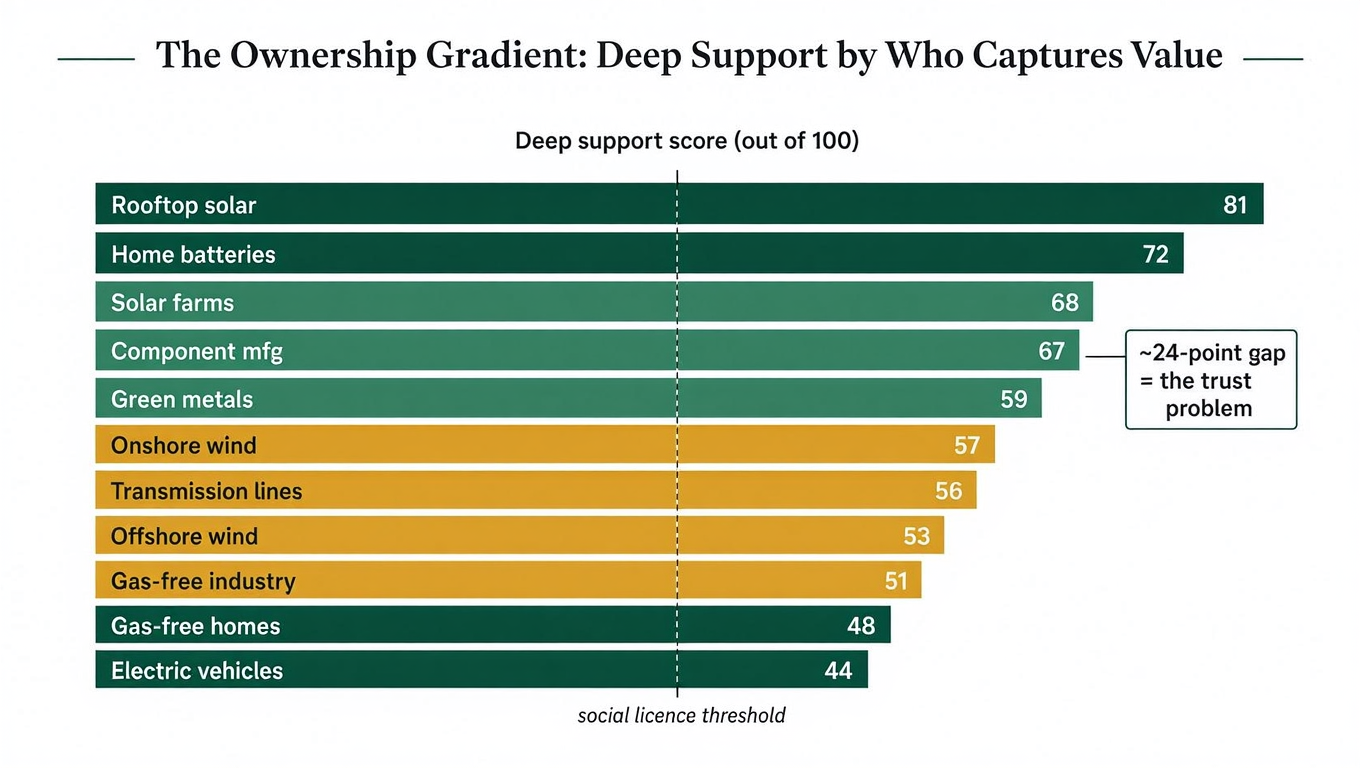
What gives the call weight is the data sitting underneath it. The 2026 Clean Energy Solutions Index, run by social researcher Rebecca Huntley’s firm 89 Degrees East, scores “deep support” — personal backing, national-good belief, willingness to advocate, and perceived community support — for eleven clean technologies. The pattern is the story. Rooftop solar tops the table at 81/100; home batteries sit at 72. The moment the asset leaves your property, support collapses: solar farms 68, onshore wind 57, transmission lines 56, offshore wind 53. EVs and gas-free homes languish at 44 and 48 — but for different reasons (cost and familiarity) than the infrastructure technologies, which fail on trust. The 70-point “social licence threshold” is cleared only by things you own and benefit from directly. Everything regional Australia is asked to host falls below it.
This is the ownership gradient, and it reframes the debate. The renewables industry has been treating regional opposition as a messaging problem — better consultation, nicer brochures, the footy-club sponsorship Trad now dismisses as piecemeal. The Index suggests it is a property problem. Coal and gas built country-town swimming pools and Returned Services clubs because the extractive industries paid royalties into the communities they disrupted. Renewables have refused the analogy, relying on voluntary, confidential, developer-by-developer deals. The Global Voices policy paper found only 63% of operating wind farms have any benefit-sharing mechanism, contributions range from $150 to $1,800 per MW per year, and just $5.35 million is distributed annually across the entire country. Scotland’s onshore benchmark is £5,000 per MW per year and it is widely considered inadequate; Australia’s actual spend is a fraction of that, and inconsistent.
The pushback is real, and it is not just NIMBYism. The same Guardian Australia piece quotes Huntley calling organised anti-wind campaigns “extremely effective” — and the evidence backs her. The SMH has documented conservative anti-renewables groups, some linked to US climate-countermovement figures like Michael Shellenberger, touring rural Australia promoting nuclear as the alternative. A Senate inquiry submission from Farmers for Climate Action described coordinated social media campaigns designed to manufacture the false impression that farmers oppose renewables. An anti-renewables group was caught using AI to generate hundreds of fake submissions against a $1 billion wind farm. The campaign works not by changing minds on the science but by manufacturing the perception of opposition — what Huntley calls the “perception gap.” Australians personally support renewables but believe their neighbours don’t, and that belief is enough to stall projects. Sixty-two per cent of Australians think renewables supply under 30% of electricity; the real figure is 46%. People don’t know what’s already been built, and they overestimate the resistance to building more.
Whether the Renewable Resources Payment is the right mechanism is a separate question, and Trad is candid that the rate, administration and even whether it adds new cost or just repackages existing spend are “to be developed in consultation.” Denmark’s 2008 Renewable Energy Act didn’t bother with payments — it mandated offering local residents within 4.5 km of a turbine a 20% ownership stake. That is a meaningfully different answer to the same problem: not “we’ll pay you to tolerate our machine” but “the machine is partly yours.” Australia’s council-payment model is cleaner to administer and politically safer — mayors are the most trusted tier of government, as Trad notes — but it stops short of the thing that actually moved the needle in Jutland. If the goal is to close a 24-point trust gap between the technology people own and the technology people host, a royalty cheque is the minimum plausible response. It may not be sufficient. But the patchwork has failed, and admitting that on the industry’s own main stage is, at least, the correct start.
Sources
- Australians value batteries and EVs but renewables industry must earn trust of regions, summit told — Guardian Australia
- Clean Energy Council calls for Renewable Resources Payment to put regional communities first
- Australia’s First Clean Energy Solutions Index: A New Compass — EnviroInvest
- From Voluntary to Enforceable: A Federal Framework for Community Benefit-Sharing in Renewable Energy — Global Voices
- The conservative anti-renewables groups pushing the nuclear option to rural Australia — SMH
- Renewable energy technologies and community benefits — ClimateXChange (Scotland)
- Dangerous anti-renewables rhetoric, bullying and intimidation creates growing chasm in rural communities — ABC News
- Cheap power to the people could shift the dial for renewables in the regions — The Conversation