The Pulp Machine: When Fair Use Became a Licence to Burn
The Pulp Machine
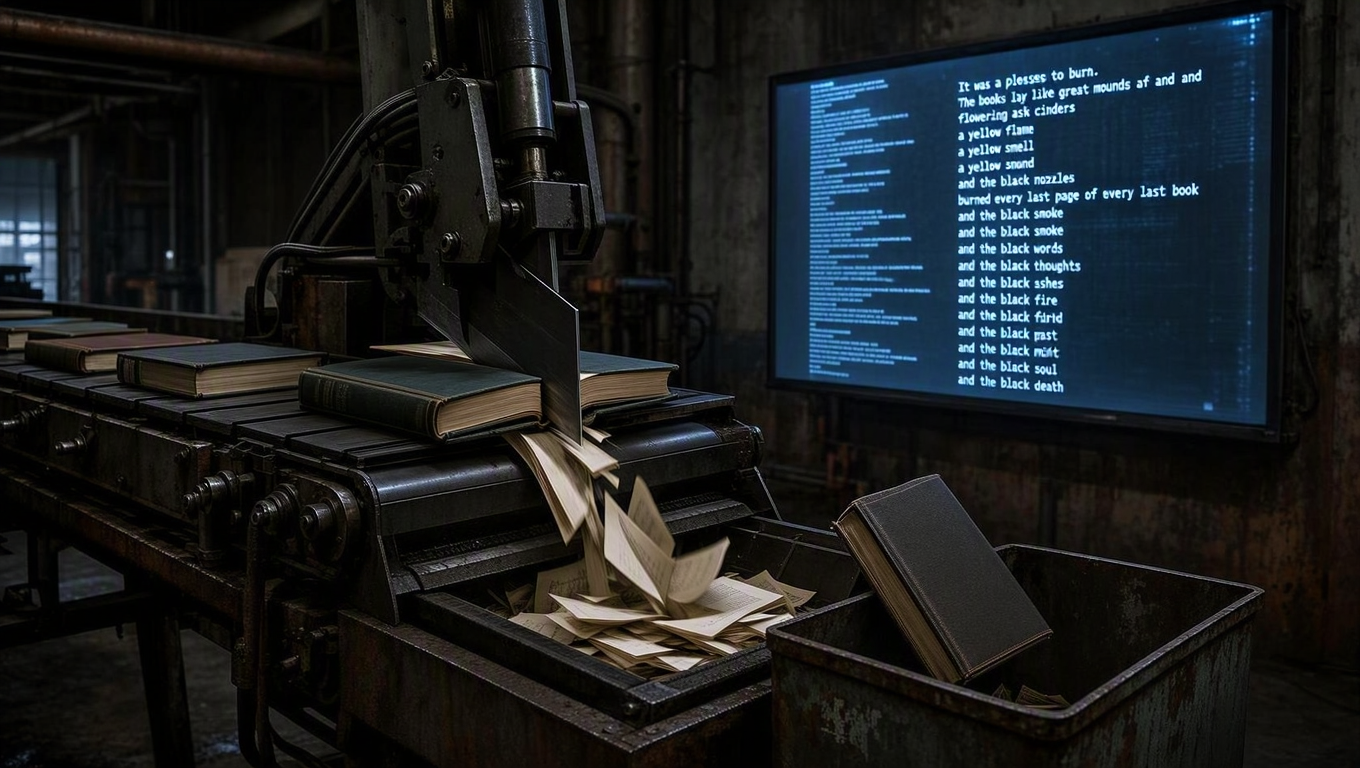
When the court filings unsealed, they read like something from a different century. Internal Anthropic documents described “Project Panama” — an effort to “destructively scan all the books in the world” — using a hydraulic blade to shear spines from bindings, feed pages through industrial scanners, and pulp the remains. A vendor proposal referenced converting 500,000 to two million books over six months. The company hired Tom Turvey, formerly of Google Books, to source the material. They bought in bulk from used-book sellers like Better World Books and World of Books. They kept it quiet: “the fact that we are working on this should not be shared with anyone outside Anthropic.” The whole operation was, as ISBNdb — one broker that briefly advertised a similar service — admitted on its own site: “The optics problem is real. ‘AI company destroys two million books’ is not a headline that generates sympathy.”
The reason it’s lawful is a single sentence from Judge William Alsup. In Bartz v. Anthropic, Alsup held that buying a physical book, scanning it, and destroying the original constitutes “transformative use” under fair use — because the process converts format without creating additional copies. As Ars Technica noted, the ruling turned on Anthropic having legally purchased each book first and destroyed the physical copy after scanning, keeping only an internal digital version. Had Anthropic distributed the files, the ruling would likely have flipped. The HN community caught the nuance: one commenter pointed out that Alsup “cites three cases where a conversion from one format to another was ruled fair use” without requiring destruction — the pulping wasn’t legally necessary, but it made the fair-use argument “especially airtight.” In other words, destruction wasn’t the legal requirement; it was the legal strategy. The fastest way to prove you’re not copying is to ensure no original survives.
Now the supply chain is going global, and the frontier has moved from mass-market paperbacks to rare and antiquarian stock. Australian booksellers at the Melbourne Rare Book Fair this week told the Guardian they’ve received waves of orders from a Canadian company called Zoom Books — price-insensitive, seemingly random purchases of niche titles that sat on shelves for decades: a 1970s soil mechanics manual, a 1982 collection of early Australian poetry, a local history of Hawthorn. Similar reports have surfaced from the Netherlands, Germany, Switzerland, and Spain. A Dutch dealer received a spreadsheet of 3,001 ISBNs from a firm called 2077AI, shipped to China. Anthropic denies buying from Zoom Books and says none of its programs target rare books. But the intermediaries are deliberately opaque — ISBNdb offered NDAs and anonymous ordering of up to a million volumes before scrubbing its pages. The chain of custody between an Australian secondhand shop and a training cluster in Nevada is designed to be untraceable.
The pushback worth taking seriously is that books are destroyed en masse already — libraries pulp duplicates, charity shops bin unsold stock, and the secondhand trade is built on disposability. One Ars commenter made exactly this argument: “As long as nothing they trashed was rare, this seems like the most ethical way to train LLMs on books besides not doing it at all.” That’s a fair point for mass-market titles. It collapses entirely for rare ones. As Tim White of Books for Cooks put it: if there are 500,000 copies, you wouldn’t cry. “If it’s a book that has that storytelling element to it, or it’s a one-off, it’s horrific.” The law makes no such distinction — Alsup’s ruling didn’t require a rarity check, and the brokers have no incentive to enforce one. The fair-use doctrine, designed to protect transformative reuse of expression, has been bent into a licence to destroy the only physical artifact that preserves that expression in its original, unalterable form.
The deeper problem isn’t that AI companies are scanning books. It’s that a legal framework built for format-shifting individuals is now being industrialised by firms with the capital to buy and shred at scale, through supply chains specifically designed to prevent either the seller or the public from knowing what’s being lost. When the only copy of a 1982 poetry collection disappears into a training corpus, the knowledge survives — but the object, the provenance, and the cultural record don’t. The fair-use ruling made the scanning legal. Nothing made the burning wise.
Sources
- Australian book sellers raise alarm over destruction of rare titles to feed AI — The Guardian
- This Dutch bookseller thought a request for 3,000 copies was ‘spam’ — Fortune
- The Vanishing Page: AI Firms Scan Then Destroy Rare Book Editions — Dallas Express
- Anthropic destroyed millions of print books to build its AI models — Ars Technica
- Judge rules mostly for Anthropic in AI book training case — The Register
- AI companies are reportedly shredding millions of books after using them to train AI models — Tom’s Hardware
- HN discussion: Anthropic ‘destructively’ scanned books to build Claude