The Transceiver Rehearsal: Why the FCC's Next China Ban Is Actually About the Last One
A pattern disguised as policy
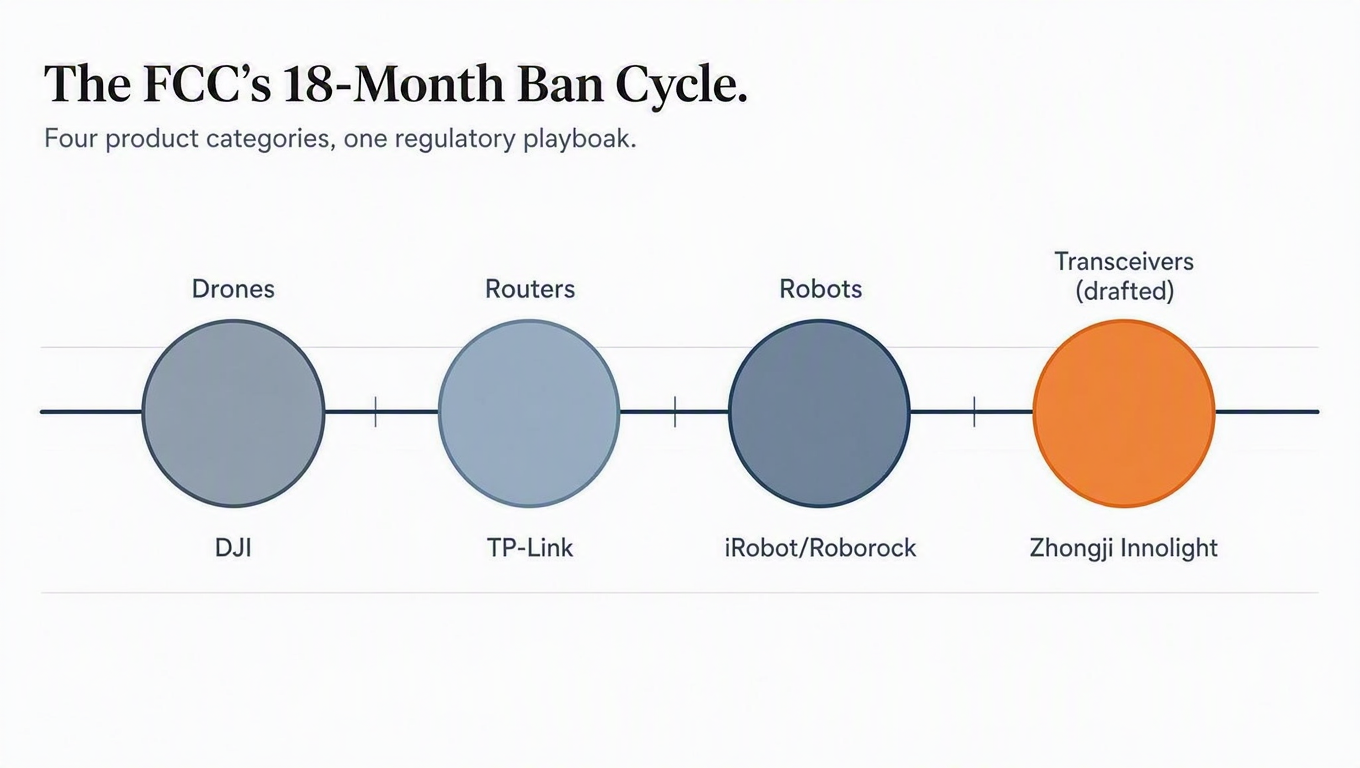
The Trump FCC is reportedly drafting a ban on Chinese-made optical transceivers — the devices that convert electrical signals to light inside fiber-optic datacenter links. The target is Zhongji Innolight, a Suzhou-based firm that controls an estimated 27% of the global transceiver market and just raised $6.81 billion in a Hong Kong IPO. The official rationale is the familiar triad: data theft, malware, service disruption. What’s more interesting than the rationale is the rhythm. This is the FCC’s fourth Chinese-tech import ban in eighteen months — drones in December, routers in April, robots in July, and now the invisible plumbing of the AI datacenter itself. As consultant Aman Mahapatra put it, the agency “has run this exact playbook four times in eighteen months. The mechanism is tested, the machinery is warm.”
The problem is upstream of the ban
The draft reportedly carries a “new models only” framing — existing installed gear stays, but next-generation products from Chinese vendors would be barred. That compromise is, as Mahapatra noted, “generous enough to mute the hyperscaler objection.” Microsoft and Meta have already qualified Innolight optics across their AI clusters; a grandfather clause protects that installed base. But the ban’s real friction point isn’t the hyperscalers — it’s everyone below them. The non-Chinese transceiver supply (Lumentum, Coherent, Apple Optoelectronics) doesn’t yet match Innolight’s scale. Regional datacenter operators, colocation providers, and enterprises running private AI clusters will find themselves competing with hyperscalers for constrained non-Chinese supply — and, as geopolitical analyst Irina Tsukerman observed, many non-Chinese suppliers themselves incorporate Chinese subcomponents, meaning the exact wording of the restriction will force buyers to audit their suppliers’ supply chains, not just their own.
The Huawei ghost
The administration’s own framing invokes Huawei as cautionary tale — equipment so deeply embedded that removal became a years-long, billion-dollar ordeal. That reference cuts both ways. The FCC’s “rip and replace” program for Huawei and ZTE gear ballooned from an estimated $700 million in 2019 to $1.9 billion by late 2020, and the program has since required repeated deadline extensions because replacements and funding couldn’t keep pace. The lesson the administration draws is “act early, before entrenchment.” The lesson the supply chain draws is “bans are easy to pass and expensive to complete.” Optical transceivers are cheaper, more interchangeable, and shorter-lived than Huawei’s carrier-grade networking gear — but they’re also vastly more numerous, deployed by the millions in every AI datacenter, and their replacement cycle runs continuously. A “new models only” restriction doesn’t eliminate the replacement problem; it just narrows it to future procurement, where the supply gap is widest.
The risk calculus nobody agrees on
The most telling disagreement is among security professionals about whether the threat is real. Tsukerman argues modern optical transceivers carry firmware, onboard memory, and management interfaces — making them plausible vectors for compromised updates, manipulated diagnostics, or service disruption during political crises. Mahapatra sees a dumb device: “a transceiver is a comparatively dumb device converting electrical signals to optical and back, not a router running a network operating system with deep packet visibility. The near-term espionage risk from currently shipping Chinese optics is thin, and CISOs who reallocate budget toward this threat over their software supply chain and identity attack surfaces are responding to headlines rather than risk.” Both can’t be fully right, and the FCC hasn’t published evidence settling the question — the ban is being drafted behind closed doors, with assessment criteria classified.
The takeaway
The pattern here matters more than any single ban. The FCC has discovered that national-security import restrictions are politically durable, procedurally repeatable, and resistant to industry pushback — especially when framed as “new models only.” But each ban moves the chokepoint further down the stack: from consumer-facing devices to the optical substrate of the AI buildout itself. The US has committed trillions to datacenter construction that is already falling behind schedule. Banning the cheapest, most abundant supplier of a critical component — before domestic alternatives have demonstrably scaled — is a bet that the security risk is real enough and urgent enough to justify the cost. The Huawei rip-and-replace program suggests that cost is always larger than the initial estimate, and the timeline always longer. The transceiver ban may be sound policy. But it’s being drafted with the confidence of an agency that has never had to finish paying for one of these.
Sources
- Trump administration reportedly drafting ban on Chinese datacenter components — The Guardian
- With FCC ban on new Chinese-made optical transceivers for DCs likely, it may be time to stock up — Network World
- US mulling ban on key Chinese networking tech in data center component crackdown — Tom’s Hardware
- US effort to rip and replace hardware made in China is ballooning in cost — Cybersecurity Dive
- Zhongji Innolight raises $6.81 billion in Asia’s second-largest listing of 2026 — Reuters
- Top Optical Transceiver Manufacturers in 2026 — FB-LINK
- FCC adds mobile hotspots to router ban — The Register